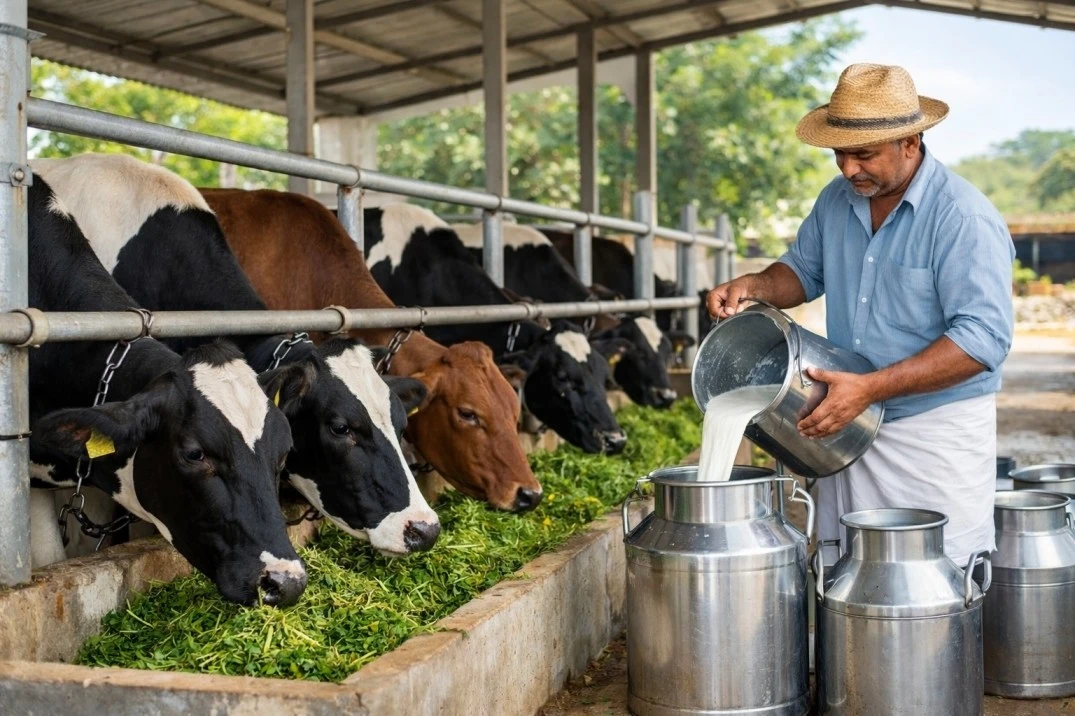
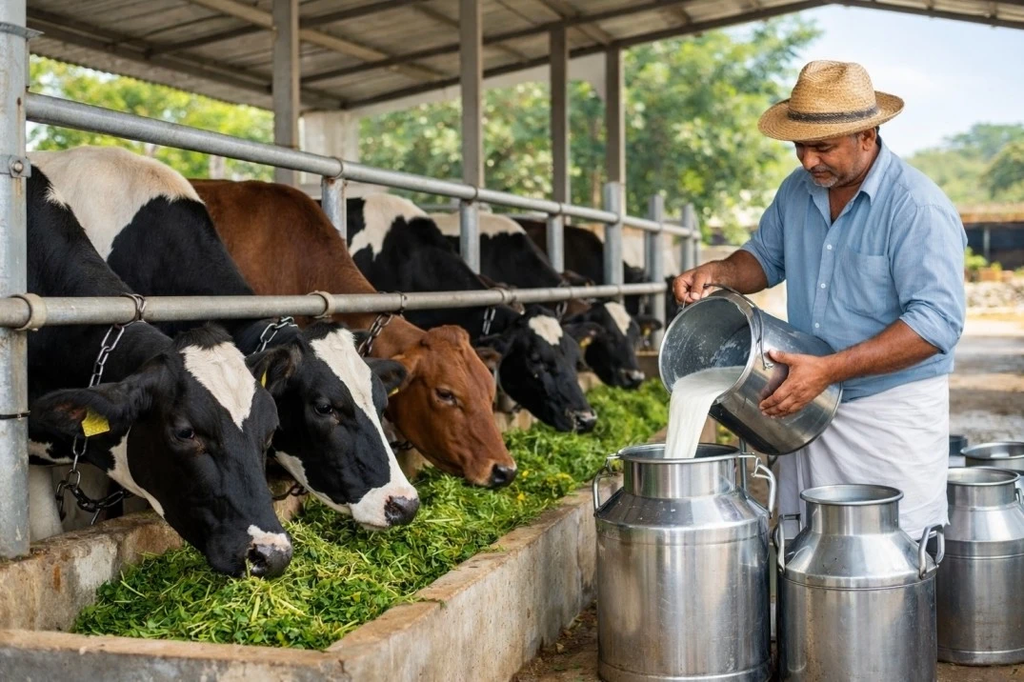
Prime Minister inaugurates Bharat Bovine Breeding and Research Centre, advances Banas Dairy’s bio-CNG projects and highlights the role of cooperatives in rural economic growth.
GUJARAT: Prime Minister Narendra Modi has reiterated that farmers and livestock keepers are central to India’s development, describing them as the strongest pillars of Viksit Bharat. Addressing a gathering of agricultural producers, cooperative leaders and milk union representatives in Banaskantha, Gujarat, he said that farmers’ welfare, income security and rural prosperity remain key priorities of the government.
During the event, the Prime Minister dedicated and laid the foundation stones for development projects valued at more than ₹14,000 crore across multiple sectors. Several initiatives focused on livestock breeding, dairy infrastructure, renewable energy and agricultural value addition.
Bharat Bovine Breeding and Research Centre inaugurated
A major highlight was the inauguration of the Bharat Bovine Breeding and Research Centre (BBBRC) at Bhildi in Banaskantha.
Developed across 127 acres, the facility has been established with technical support from the National Dairy Development Board (NDDB) and Banas Dairy under the Rashtriya Gokul Mission.
Also Read: India’s Average Daily Milk Yield Rises to 8 Litres per Animal from Below 5 Litres in FY14: PM Modi
The centre is designed to use advanced reproductive technologies, including in vitro fertilisation (IVF) and embryo transfer, with a stated target of producing 25,000 high-pedigree bovine embryos annually.
The initiative aims to strengthen genetic improvement programmes, support the development of indigenous cattle breeds and improve the productivity of dairy animals. The focus on the Kankrej breed also highlights efforts to conserve and improve India’s indigenous livestock resources.
Banas Dairy advances bio-CNG and circular economy projects
The event also marked progress in dairy-linked renewable energy infrastructure. The Prime Minister laid the foundation stones for two bio-CNG plants being developed by Banas Dairy at Tharad and Radhanpur.
The proposed facilities will have cattle-dung processing capacities of:
- Tharad: 75 metric tonnes per day
- Radhanpur: 100 metric tonnes per day
Together, the plants are designed to process 175 metric tonnes of cattle dung daily. The projects aim to convert livestock waste into compressed biomethane and organic bio-fertilisers, supporting cleaner energy production and more efficient resource utilisation.
For dairy farmers, such initiatives can create additional value from livestock waste while strengthening the link between dairy production, renewable energy and sustainable agriculture.
Investments in dairy storage and food processing
The Prime Minister also dedicated an automated dairy storage facility in Palanpur and highlighted the expansion of the potato processing complex at Sanadar.
These projects are intended to strengthen agricultural processing, storage and supply-chain infrastructure. Their development reflects the growing role of dairy cooperatives in moving beyond milk procurement and processing towards diversified, value-added rural enterprises.
Government support for farmers and income security
Addressing agricultural policy, Modi highlighted the government’s efforts to support farmers through direct financial assistance, fertiliser subsidies, Minimum Support Price (MSP) procurement and crop insurance programmes.
He stated that nearly ₹4.5 lakh crore had been transferred directly into farmers’ bank accounts through the PM-KISAN scheme.
The Prime Minister also emphasised the importance of cooperative institutions in improving rural livelihoods. He highlighted the contribution of Banas Dairy and Gujarat’s dairy cooperative network in strengthening milk procurement, creating income opportunities for rural women and promoting resource conservation in water-stressed regions.
Cooperatives at the centre of rural transformation
The initiatives in Banaskantha underline the expanding role of dairy cooperatives in India’s rural economy. Institutions such as Banas Dairy are increasingly connecting milk production with scientific breeding, food processing, renewable energy and agricultural diversification.
The broader approach seeks to improve livestock productivity, strengthen farm-level income opportunities and make better use of agricultural and animal-based resources.
Join Our “Dairy & Food Jobs Updates” WhatsApp group
Follow the Agri Jobs Updates channel on WhatsApp:
Disclaimer
I do my best to share reliable and well-researched insights but occasional errors or omissions may slip through. Please view all content as informational.
Stay informed on all the latest news updates
All Agriculture Books Free Download
All Dairy Technology Books Free Download
All Agricultural Engineering Books Free download
All Horticulture Books Free Download
All Fisheries Science Books Free Download
For Daily Update follow us at:
Facebook Telegram Whatsapp Instagram YouTube
The contents are provided free for noncommercial purpose such as teaching, training, research, extension and self learning.
If you are facing any Problem than fill form Contact Us
If you want share any article related Agriculture with us than send at info@agrimoon.com with your contact detail.