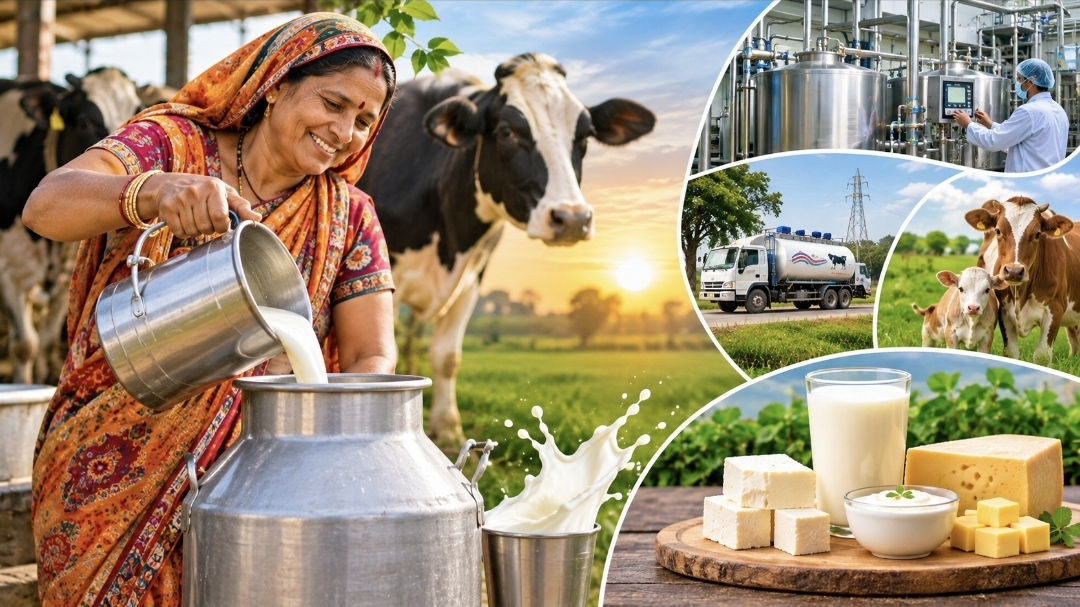
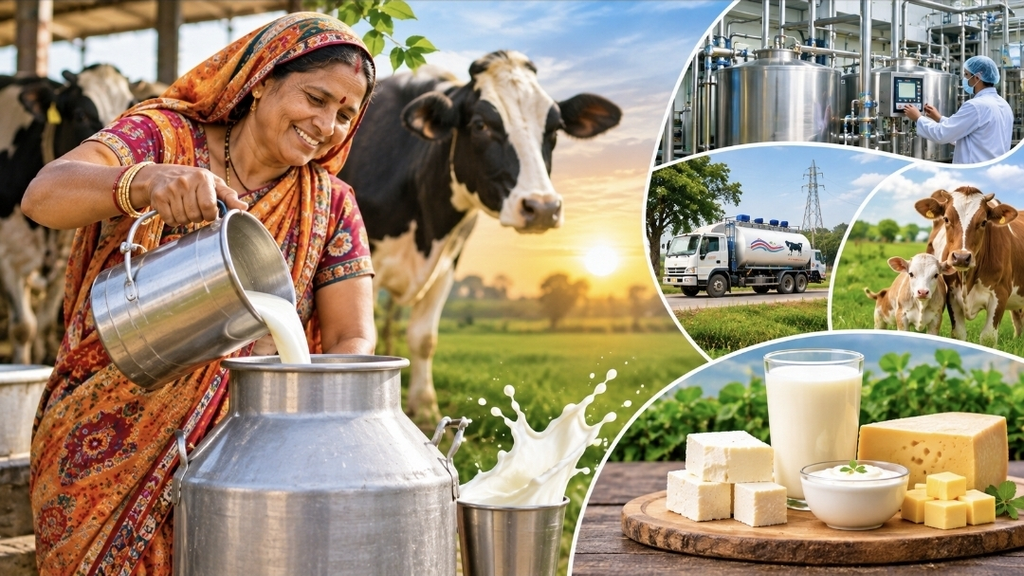
India’s dairy industry continues to strengthen the country’s agricultural economy, supporting millions of rural households, improving nutritional security and creating economic opportunities for women. With milk production reaching 247.87 million tonnes in 2024–25, India remains the world’s largest milk producer, accounting for nearly one-fourth of global output. As the country observes National Milk Day on November 26, the sector’s progress reflects the combined strength of farmer cooperatives, scientific livestock management, government initiatives and technological development.
National Milk Day is celebrated every year on the birth anniversary of Dr. Verghese Kurien, widely recognised as the Father of India’s White Revolution. The occasion honours his contribution to transforming India’s dairy cooperative movement and recognises the millions of dairy farmers who sustain the country’s leadership in milk production.
According to the Press Information Bureau (PIB) release dated November 25, 2026, India’s dairy sector has made significant progress in milk production, cooperative development, livestock productivity, rural employment and international trade.
India’s Dairy Sector Records Strong Growth
India has maintained its position as the world’s largest milk producer through sustained growth in milk production and improvements in livestock productivity.
Key achievements between 2014–15 and 2024–25 include:
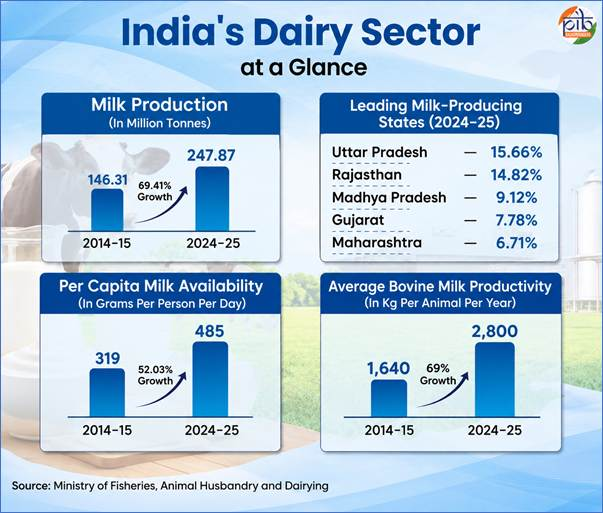
- Milk production: Increased by 69.41%, from 146.31 million tonnes to 247.87 million tonnes.
- Annual growth: Recorded a compound annual growth rate (CAGR) of 5.41%.
- Per capita milk availability: Increased by 52.03%, from 319 grams to 485 grams per person per day.
- Bovine milk productivity: Increased from 1,640 kg per animal per year to 2,800 kg per animal per year, according to the PIB release.
Leading Milk-Producing States
Five states account for more than half of India’s total milk production.
| State | Share of national milk production |
|---|---|
| Uttar Pradesh | 15.66% |
| Rajasthan | 14.82% |
| Madhya Pradesh | 9.12% |
| Gujarat | 7.78% |
| Maharashtra | 6.71% |
| Combined share | 54.09% |
These states play a significant role in India’s milk supply, supported by large livestock populations, dairy farming communities and organised procurement networks.
Dairy Farming: A Major Source of Rural Livelihoods and Women’s Empowerment
The dairy sector is an important source of income and employment for rural India. According to PIB, dairying supports approximately 8.5 crore rural households.
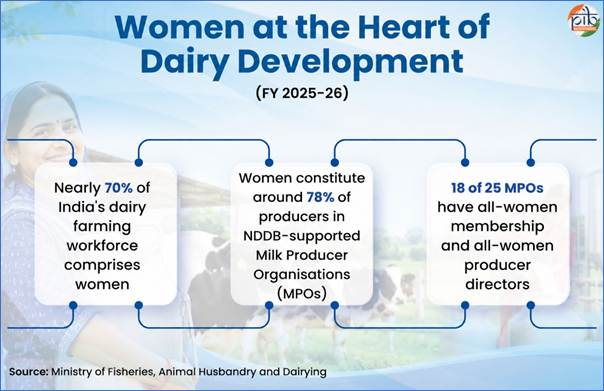
Women account for nearly 70% of India’s dairy farming workforce and contribute significantly to daily livestock management, including animal feeding, milking, breeding, healthcare and milk collection.
Their participation makes dairy farming an important instrument for rural economic development, household income generation and women’s empowerment.
Cooperative Network: The Backbone of India’s Dairy Economy
India’s dairy cooperative movement connects village-level milk producers with district milk unions, state federations and organised dairy markets.
The country’s dairy cooperative network comprises:
- 22 milk federations
- 241 district cooperative milk unions
- 28 marketing dairies
- 25 Milk Producer Organisations (MPOs)
- Approximately 2.45 lakh villages covered
- Around 1.65 crore dairy farmers as members
These institutions support milk procurement, processing, marketing, quality testing and organised payment systems. Many cooperatives use automated milk collection and testing facilities, with payments transferred directly to farmers’ bank accounts.
NDDB Dairy Services: Strengthening Farmer-Owned Organisations
The National Dairy Development Board (NDDB), through its wholly owned, not-for-profit subsidiary NDDB Dairy Services (NDDB-DS), supports the establishment and development of Milk Producer Organisations.
MPOs are farmer-owned Producer Companies that organise milk producers into professionally managed institutions. They facilitate collective milk procurement, market access, transparent pricing and direct bank payments.
As of October 31, 2026, NDDB Dairy Services reported:
- 25 MPOs established.
- 18 MPOs with entirely women members and women producer-directors on their boards.
- More than 13 lakh milk producers covered.
- Operations across 175 districts in 12 states.
- Approximately 78% of participating producers are women.
- Around 70 lakh litres of milk procured per day.
This model demonstrates how women-led producer institutions can strengthen farmers’ participation in organised dairy markets.
Milk Procurement and Sales by Dairy Cooperatives
Dairy cooperatives provide a structured market for milk producers and help maintain regular procurement and distribution.
As reported by PIB for October 31, 2026, dairy cooperatives recorded:
- Milk procurement: 690.90 lakh kg per day.
- Liquid milk sales: 462.95 lakh litres per day.
These figures underline the scale of India’s organised dairy supply chain and the importance of cooperative institutions in connecting producers with consumers.
White Revolution 2.0: Expanding India’s Cooperative Dairy Network
White Revolution 2.0 is a major cooperative-led initiative launched on December 25, 2024. Its Standard Operating Procedure (SOP) was launched on September 19, 2024.
The initiative aims to increase milk procurement by dairy cooperatives by 50% over five years. Its primary objectives include expanding dairy cooperative coverage in uncovered villages and Panchayats, strengthening existing societies, improving market access, generating rural employment and promoting women’s empowerment.
By 2028–29, the programme aims to:
- Establish 75,000 new Dairy Cooperative Societies.
- Strengthen 46,422 existing Dairy Cooperative Societies.
According to PIB, progress as of October 31, 2026, includes:
- 24,097 new Dairy Cooperative Societies established.
- 31,394 existing societies strengthened.
Activities under White Revolution 2.0 are funded through the National Programme for Dairy Development (NPDD).
Sustainability and Circular Economy in the Dairy Sector
India’s dairy development strategy increasingly incorporates sustainability, renewable energy and efficient resource utilisation.
White Revolution 2.0 promotes climate-smart practices and circularity across the dairy value chain. An important concept is ‘Gold out of Garbage’, which focuses on converting cattle dung and agricultural residues into biogas, organic manure and biofertilisers.
Two multi-state cooperative institutions support this approach:
- Cooperative Inputs and Services Delivery Multi-State Limited: Focuses on providing quality inputs and services, including animal feed, disease control and artificial insemination.
- Gomay Sahkari Samiti Multi-State Limited: Focuses on the scientific management and utilisation of cattle dung.
GOBARdhan: Turning Organic Waste into Clean Energy
The PIB release also highlights the GOBARdhan initiative, which promotes the conversion of cattle dung and agricultural residues into biogas, bio-slurry and other useful products.
Also Read: Sumul Dairy Raises Milk Procurement Prices by ₹50 per Kg of Fat for Cow and Buffalo Milk
The initiative was originally launched in 2018 under the Swachh Bharat Mission (Grameen), supporting village cleanliness, waste management and additional rural livelihood opportunities.
The release further refers to a National Circular Bioenergy Scheme with a proposed outlay of ₹23,731 crore for FY 2026–27 to FY 2035–36. It aims to expand compressed biogas production through measures such as assured offtake, stable pricing, capital assistance, pipeline connectivity and credit support.
Together, these initiatives highlight the potential of integrating dairy farming, organic waste management, renewable energy and rural entrepreneurship.
Government Schemes Strengthening Dairy Infrastructure
Government programmes are supporting the expansion of milk procurement, processing, value addition, scientific breeding and animal healthcare.
1. National Programme for Dairy Development (NPDD)
The National Programme for Dairy Development aims to strengthen milk procurement and dairy infrastructure across the country.
It operates through two components:
Component A: Strengthening Milk Procurement and Quality Infrastructure
- Expansion of organised milk procurement networks.
- Development of milk processing and value-addition facilities.
- Support for village-level chilling infrastructure and milk testing facilities.
- Training in clean milk production and quality management.
- Special infrastructure support in the North Eastern Region, hilly areas and Union Territories.
Component B: Dairying through Cooperatives
- Strengthening dairy processing and marketing infrastructure.
- Improving farmers’ access to organised dairy markets.
- Supporting producer-owned institutions.
- Increasing the sale of milk and dairy products to improve farmers’ returns.
Component B is implemented in nine states: Andhra Pradesh, Bihar, Madhya Pradesh, Punjab, Rajasthan, Telangana, Uttar Pradesh, Uttarakhand and West Bengal.
According to PIB, physical achievements under NPDD as of October 31, 2026, include:
- 40,800 new Dairy Cooperative Societies organised or revived.
- 25.82 lakh additional farmers enrolled.
- 168 lakh litres per day of milk chilling capacity created.
- 94,000 milk quality testing devices distributed.
2. Rashtriya Gokul Mission (RGM)
Launched in December 2014, the Rashtriya Gokul Mission focuses on the scientific development and conservation of indigenous bovine breeds.
The programme aims to improve milk production and productivity, strengthen breeding infrastructure and make dairy farming more remunerative.
Revised in March 2025, the mission places greater emphasis on advanced reproductive technologies, artificial insemination services and genetic improvement.
Reported progress includes:
- 50,023 Multi-Purpose Artificial Insemination Technicians in Rural India (MAITRIs) trained and equipped.
- 24 in-vitro fertilisation (IVF) laboratories established.
- 48 semen stations being strengthened.
- 32 heifer-rearing centres sanctioned.
3. Nationwide Artificial Insemination Programme (NAIP)
The Nationwide Artificial Insemination Programme aims to expand access to quality artificial insemination services at farmers’ doorsteps using semen from high-genetic-merit bulls, including indigenous breeds.
According to the PIB release:
- More than 18.71 crore artificial inseminations have been performed.
- Nearly 11.17 crore animals have been covered.
These interventions support genetic improvement and the development of more productive dairy herds.
4. Animal Husbandry Infrastructure Development Fund (AHIDF)
AHIDF supports investment in modern dairy processing, value addition and cold-chain infrastructure in the private sector and cooperatives.
Its major financial support includes:
- 3% interest subvention for eligible beneficiaries for eight years.
- Support for dairy processing and value-addition projects.
- Encouragement for private-sector and cooperative investment in modern infrastructure.
Since 2020–21, 258 dairy processing plants have reportedly received support under the scheme, leveraging investment of approximately ₹21,797 crore.
The projects have been approved with a reported milk processing and value-addition capacity of 500.58 lakh litres per day.
Strengthening Animal Health and Disease Control
Healthy livestock is essential for sustainable milk production. Government programmes are supporting disease prevention, veterinary services and improved access to animal healthcare.
5. Livestock Health and Disease Control Programme (LHDCP)
The LHDCP supports the prevention and control of economically important livestock diseases while strengthening veterinary infrastructure.
An important component is the deployment of Mobile Veterinary Units (MVUs), which provide veterinary services at farmers’ doorsteps.
As of October 31, 2026:
- 4,019 MVUs were operational across 29 states and Union Territories.
- Approximately 1.5 crore farmers had received doorstep veterinary services.
- Around 3.3 crore animals had been treated.
6. National Animal Disease Control Programme (NADCP)
The National Animal Disease Control Programme supports the control and eventual eradication of Foot and Mouth Disease (FMD), alongside Brucellosis control through vaccination and surveillance.
Reported progress includes:
- More than 152 crore cumulative FMD vaccine doses administered.
- Around 8 crore farmers benefited.
- FMD outbreaks declined from 132 in 2019 to 40 in 2025.
- Brucellosis outbreaks declined from 22 in 2019 to 15 in 2025.
Disease control and vaccination are important for protecting livestock productivity, reducing economic losses and improving the reliability of milk production.
Digital Transformation Through Bharat Pashudhan
Digital technology is becoming increasingly important in livestock identification, breeding management, vaccination and veterinary care.
The Department of Animal Husbandry and Dairying, in collaboration with NDDB, has developed the Bharat Pashudhan database.
Animals registered in the database receive a unique 12-digit identification number through an ear tag, known as Pashu Aadhaar. The number serves as a primary identifier for recording animal-related activities, including vaccination, breeding and treatment.
As of October 31, 2026, the database recorded:
- 9,98,55,955 registered livestock owners.
- More than 39.42 crore Pashu Aadhaar identification numbers issued.
Digital livestock records can strengthen traceability, improve animal health monitoring and support data-driven livestock management.
Indian Dairy Products Expanding in Global Markets
India’s dairy industry primarily serves a large domestic market but is also strengthening its international presence.
During FY 2025–26, India exported:
- Dairy products: 97,524.82 metric tonnes.
- Export earnings: US$407.12 million.
Major export destinations included the UAE, Saudi Arabia, the United States, Bhutan and Bahrain.
Expanding international trade will depend on maintaining consistent product quality, food safety compliance, modern processing facilities and the ability to meet importing countries’ regulatory requirements.
National Milk Day: Celebrating the Strength Behind Every Drop
India’s dairy journey is built on the collective contribution of farmers, women, cooperatives, veterinary professionals, dairy technologists, scientists and policymakers.
From the cooperative movement led by Dr. Verghese Kurien to today’s advances in digital livestock records, scientific breeding, modern processing and renewable energy, the sector continues to evolve.
As India moves towards the next phase of dairy development, priorities such as sustainable production, better animal productivity, stronger farmer institutions, quality assurance, improved cold-chain infrastructure and women’s economic empowerment will remain essential.
National Milk Day is a celebration not only of India’s position as the world’s largest milk producer, but also of the millions of farmers whose daily work strengthens nutritional security, rural prosperity and the country’s dairy economy.
Join Our “Dairy & Food Jobs Updates” WhatsApp group
Follow the Agri Jobs Updates channel on WhatsApp:
Disclaimer
I do my best to share reliable and well-researched insights but occasional errors or omissions may slip through. Please view all content as informational.
Stay informed on all the latest news updates
All Agriculture Books Free Download
All Dairy Technology Books Free Download
All Agricultural Engineering Books Free download
All Horticulture Books Free Download
All Fisheries Science Books Free Download
For Daily Update follow us at:
Facebook Telegram Whatsapp Instagram YouTube
The contents are provided free for noncommercial purpose such as teaching, training, research, extension and self learning.
If you are facing any Problem than fill form Contact Us
If you want share any article related Agriculture with us than send at info@agrimoon.com with your contact detail.