
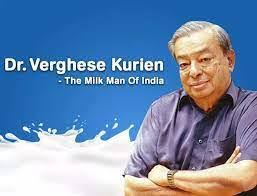
November 26 marks the birth anniversary of Dr Verghese Kurien, widely recognised as the Father of India’s White Revolution. Observed as National Milk Day, the occasion celebrates the visionary who transformed India’s dairy economy through a farmer-owned cooperative model that connected rural milk producers with organised processing, marketing and consumers.
His contribution went beyond increasing milk production. Kurien helped establish a system in which farmers could collectively own dairy institutions, participate in decision-making and receive a greater share of the value generated from their milk.
Anand: Where India’s dairy transformation began
Dr Verghese Kurien arrived in Anand, Gujarat, in 1949 as a dairy engineer. His professional journey took a defining turn when he became associated with the Kaira District Cooperative Milk Producers’ Union, a farmers’ cooperative that later became nationally recognised through the Amul brand.
At the time, many milk producers depended on private intermediaries and faced limitations in accessing organised markets. The cooperative approach offered an alternative.
Under this model, farmers collectively organised milk procurement, processing and marketing through their own institutions. Instead of functioning merely as suppliers of raw milk, producers became stakeholders in the dairy business.
The Anand model demonstrated that small milk producers could strengthen their market position through collective ownership, professional management and organised marketing.
From Anand to the National Dairy Development Board
The success of the cooperative movement in Anand provided the foundation for a national dairy development strategy.
In 1965, the Government of India established the National Dairy Development Board (NDDB), with Dr Kurien as its founding chairman. The institution was created to replicate and adapt the Anand cooperative model across other milk-producing regions of India.
The objective was to build a nationwide dairy network that could connect village-level milk producers with processing facilities and urban consumers.
This institutional framework became a major step towards transforming India’s fragmented dairy sector into an organised national milk economy.
Operation Flood: The foundation of the White Revolution
In 1970, India launched Operation Flood, one of the world’s largest dairy development programmes.
Implemented by NDDB, the programme aimed to increase milk production, strengthen dairy cooperatives, expand milk marketing infrastructure and connect rural producers with major urban consumption centres.
Also Read: Jharkhand Targets 5 Lakh Kg Daily Milk Procurement by 2028–29; Expands Medha Dairy Infrastructure
Operation Flood developed milk collection and distribution networks, supported dairy processing infrastructure and encouraged the growth of farmer-owned cooperative institutions.
The programme was implemented in three phases:
- Phase I (1970–1980): Established milk-shed areas and connected major milk-producing regions with urban markets.
- Phase II (1981–1985): Expanded dairy cooperatives, procurement networks and processing infrastructure.
- Phase III (1985–1996): Strengthened cooperative institutions, increased milk production and improved the long-term sustainability of the dairy sector.
These efforts laid the foundation for India’s White Revolution and helped establish the country as a major global milk producer.
India’s dairy sector: Measuring the transformation
The growth of India’s dairy industry reflects the long-term impact of cooperative development, technological progress, improved market access and increased participation by rural households.
According to government data, India’s milk production increased from 146.31 million tonnes in 2014–15 to 247.87 million tonnes in 2024–25, representing a growth of approximately 69.41%.
Per-capita milk availability also increased from 319 grams per day to 485 grams per day during the same period.
Other important indicators highlight the sector’s contribution to rural livelihoods:
- Approximately 8.5 crore rural households depend on dairying for their livelihoods.
- Women account for nearly 70% of India’s dairy farming workforce, according to government estimates.
- India has developed an extensive dairy ecosystem involving cooperative societies, milk unions, processing plants, private dairy companies and millions of milk producers.
These developments demonstrate that dairying is not simply an agricultural activity; it is an important source of rural employment, household income and nutritional security.
Beyond milk production: The cooperative legacy
One of Dr Kurien’s most important contributions was his belief that farmers should control the institutions responsible for collecting, processing and marketing their produce.
The cooperative model helped establish a stronger connection between milk producers and consumers by reducing dependence on fragmented marketing arrangements and creating organised channels for milk procurement and distribution.
Its broader impact can be understood through several developments:
Farmer ownership: Milk producers became members and stakeholders in cooperative institutions rather than remaining only raw-material suppliers.
Organised milk marketing: Cooperative networks created structured systems for collecting, processing and distributing milk.
Rural economic development: Regular milk procurement created an additional and relatively frequent source of income for rural households.
Women’s participation: Dairy farming provided significant economic opportunities for women, particularly in rural households where livestock management and milk production are important activities.
Institution building: Amul and NDDB demonstrated how professional management, technology and farmer participation could work together to build a large-scale dairy enterprise.
Dr Verghese Kurien’s vision remains relevant
India’s dairy industry continues to evolve through investments in modern processing plants, cold-chain infrastructure, quality testing, automation, animal genetics, digital milk procurement and value-added dairy products.
Current priorities also include improving animal nutrition, controlling livestock diseases, reducing production costs, managing climate-related risks and strengthening market access for small dairy farmers.
The principles established by Dr Kurien remain relevant to these developments: professional management, farmer participation, institutional accountability and the creation of sustainable markets for milk producers.
His legacy is not measured only by the millions of tonnes of milk India produces today. It is also reflected in the millions of farmers who became part of an organised dairy economy.
The transformation that began in Anand became a national movement, changing India’s position in the global dairy industry and demonstrating the power of collective action.
November 26, National Milk Day, is a reminder that India’s White Revolution was not simply a story of increased milk production. It was a story of farmers gaining ownership, opportunity and a stronger voice in the dairy value chain.
Join Our “Dairy & Food Jobs Updates” WhatsApp group
Follow the Agri Jobs Updates channel on WhatsApp:
Disclaimer
I do my best to share reliable and well-researched insights but occasional errors or omissions may slip through. Please view all content as informational.
Stay informed on all the latest news updates
All Agriculture Books Free Download
All Dairy Technology Books Free Download
All Agricultural Engineering Books Free download
All Horticulture Books Free Download
All Fisheries Science Books Free Download
For Daily Update follow us at:
Facebook Telegram Whatsapp Instagram YouTube
The contents are provided free for noncommercial purpose such as teaching, training, research, extension and self learning.
If you are facing any Problem than fill form Contact Us
If you want share any article related Agriculture with us than send at info@agrimoon.com with your contact detail.