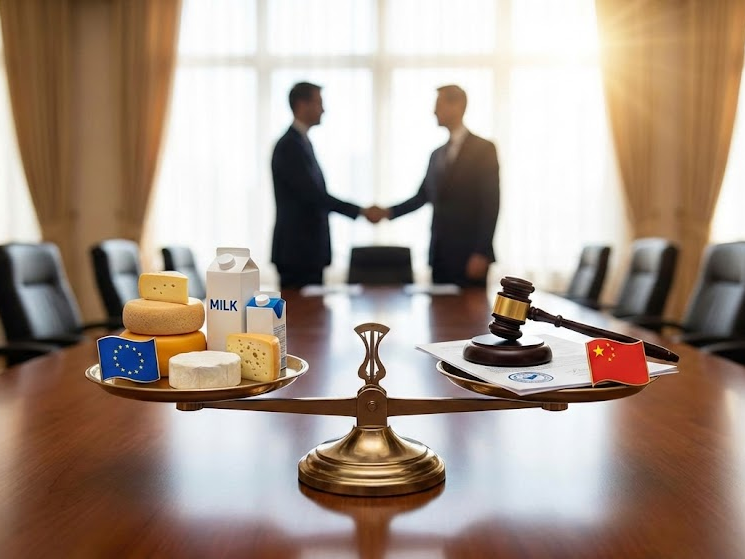
Beijing, Dec. 29 (Yicai) — China’s decision to levy temporary countervailing duties on European Union dairy imports is a lawful and justified trade defense aimed at counteracting distortions created by unfair EU subsidies, an international trade expert told Yicai.
The Chinese anti-subsidy investigation, launched in August 2024, covers products including fresh and processed cheeses and high-fat cream. Beijing began applying temporary countervailing duty deposits on these EU dairy imports effective Dec. 23, 2025, after preliminary findings indicated that subsidised EU products were causing “substantial harm” to China’s domestic dairy sector.
Legal Foundation and Compliance
According to Zhang Xiaopeng, an expert at the Shanghai Institute for Openness Strategy Research, China’s investigation was conducted in strict accordance with:
- Chinese domestic laws and regulations, and
- The World Trade Organization’s (WTO) Agreement on Subsidies and Countervailing Measures
“This approach is fair, lawful and fully compliant [with WTO rules],” Zhang said, characterising the countervailing measures as a legitimate market defence rather than protectionism.
EU Subsidies and Market Distortion
Zhang highlighted that the EU’s Common Agricultural Policy (CAP) provides extensive support to farms and processing companies, including the dairy sector. These subsidies, he argued, allow European dairy exporters to remain profitable even when global milk prices are weak, enabling them to sell in China at below-cost prices.
“These subsidised imports not only diminish China’s dairy sales,” Zhang said, “they also hinder the domestic sector’s efforts to pivot toward higher-end and more processed products.”
Read More: Which Cheese Is the Healthiest? A Calorie, Fat & Sodium Face-Off
Targeted Scope of the Probe
China’s investigation focused on a subset of dairy product categories, especially cheese and high-fat cream, which are strategically important to China’s value-added dairy ambitions. The preliminary determinations found:
- Subsidies existed
- China’s dairy industry suffered significant harm
- A clear causal link between the subsidies and that harm
Comparisons with EU Trade Actions
Zhang observed that China has generally been more restrained than the EU in deploying trade remedy tools. He cited the EU’s Foreign Subsidies Regulation, which he said has been used to initiate surprise investigations targeting Chinese firms, as an example of potential trade discrimination.
In contrast, China’s dairy investigation, Zhang said, was:
- Limited in scope
- Focused on specific products
- Aligned with standard WTO trade remedy procedures
Willingness to Resolve Disputes Diplomatically
China, he added, has been open to dialogue and negotiation in trade disputes. As one example, Zhang cited the recent conclusion of China’s anti-dumping case on EU pork imports, where final duties were significantly reduced from preliminary levels — a move interpreted as an effort to ease bilateral tensions.
Join Our “Dairy & Food Jobs Updates” WhatsApp group
Disclaimer
I do my best to share reliable and well-researched insights but occasional errors or omissions may slip through. Please view all content as informational.
Stay informed on all the latest news updates
All Agriculture Books Free Download
All Dairy Technology Books Free Download
All Agricultural Engineering Books Free download
All Horticulture Books Free Download
All Fisheries Science Books Free Download
For Daily Update follow us at:
Facebook Telegram Whatsapp Instagram YouTube
The contents are provided free for noncommercial purpose such as teaching, training, research, extension and self learning.
If you are facing any Problem than fill form Contact Us
If you want share any article related Agriculture with us than send at info@agrimoon.com with your contact detail.