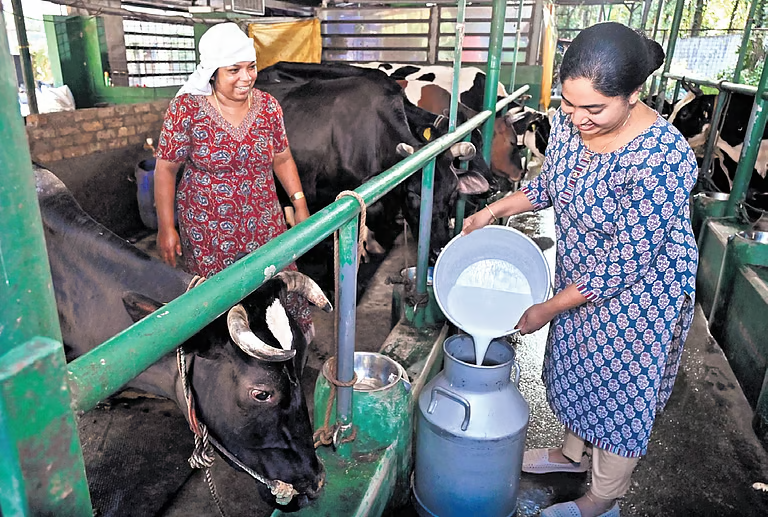
Kozhikode ; At around 4 a.m., while most of the neighbourhood is still asleep, Shyma P begins her working day at Ruby’s Dairy Farm in Umalathoor, Palazhi. For the 50-year-old dairy farmer, the cows are not simply livestock—they are the foundation of a diversified farm business built around milk, value addition and direct marketing.
Known locally as Ruby, Shyma started her dairy journey with just two Vechur cows. Over the years, the herd expanded to around 25 animals, including Vechur cattle, Holstein Friesians (HF) and Jersey crossbreds.
Today, the farm produces approximately 200 litres of milk a day.
Turning milk into higher-value products
Unlike farmers who send most of their milk to dairy societies, Shyma retains a significant portion of the milk for processing.
The farm produces curd, paneer, ghee and other dairy products, which are sold directly to consumers, primarily from her home.
Around 25 litres of curd are sold daily, while paneer is produced twice a week. Ghee is prepared regularly, with monthly sales of around 60 litres, according to Shyma.
The remaining milk is either sold directly to local customers or supplied to the dairy society.
“Why should we sell only milk? We can make so many products from it. If we make and market the products ourselves, there is an opportunity to earn more,” Shyma says.
Direct sales create a local market
Shyma’s business model relies heavily on direct customer relationships rather than depending entirely on conventional milk procurement channels.
Her products are marketed mainly from the farm itself, with support and opportunities through Krishi Bhavan and self-help groups.
She says demand for fresh dairy products increases during warmer months, particularly for curd and buttermilk.
Also Read: Kishan Reddy Says Sabar Dairy Plant Could Revive Telangana’s Dairy Sector
“People are buying these products from the house itself. There is good demand. Especially when the summer heat increases, the demand for curd, buttermilk and other dairy products also increases,” she says.
The model gives the farm greater control over processing and marketing while allowing Shyma to capture part of the value generated after milk leaves the farm.
Diversification beyond dairy
Dairy farming is only one component of Shyma’s agricultural enterprise.
She also grows bananas, cultivates mushrooms and keeps hens, creating multiple sources of farm income.
Her husband, Raveendran K, a civil engineer and architect who works in construction, supports her farming activities. Their children—Amarthya K Ravi, Advaidh K Ravi and Angath K Ravi—have also grown up around the farm.
Despite the farm’s size, daily operations are largely managed with one worker, with Shyma herself remaining closely involved.
Farmer involvement remains central
For Shyma, hands-on management is essential to running a successful dairy farm.
“Dairy farming needs serious love. We cannot depend completely on labourers. The farmer should know what is happening on the farm and should be involved in the work,” she says.
She also stresses the importance of keeping detailed financial records.
Farmers, she says, need to track feed and other expenses, milk production, processing costs, product prices and overall earnings if they want to understand whether their dairy operation is genuinely profitable.
“We should have good calculations. We should know how much we are spending, how much milk we are producing, how much the products cost to make, and how much we are earning. Without proper calculation, it is difficult to make dairy farming profitable,” she says.
From 2 cows to a diversified farm enterprise
Shyma’s journey illustrates how a small dairy operation can gradually evolve beyond the sale of raw milk.
Starting with two Vechur cows, she has built a herd of around 25 cattle, while developing a customer base for value-added dairy products and adding other agricultural activities to the farm.
For her, the central business lesson is straightforward: the value of milk does not end at the farm gate. Processing, direct marketing, careful cost management and diversification can create additional opportunities for small dairy farmers.
“I am very happy doing this. It gives me satisfaction, and I am also able to make a good amount of money from the farm,” Shyma says.
Join Our “Dairy & Food Jobs Updates” WhatsApp group
Follow the Agri Jobs Updates channel on WhatsApp:
Disclaimer
I do my best to share reliable and well-researched insights but occasional errors or omissions may slip through. Please view all content as informational.
Stay informed on all the latest news updates
All Agriculture Books Free Download
All Dairy Technology Books Free Download
All Agricultural Engineering Books Free download
All Horticulture Books Free Download
All Fisheries Science Books Free Download
For Daily Update follow us at:
Facebook Telegram Whatsapp Instagram YouTube
The contents are provided free for noncommercial purpose such as teaching, training, research, extension and self learning.
If you are facing any Problem than fill form Contact Us
If you want share any article related Agriculture with us than send at info@agrimoon.com with your contact detail.