
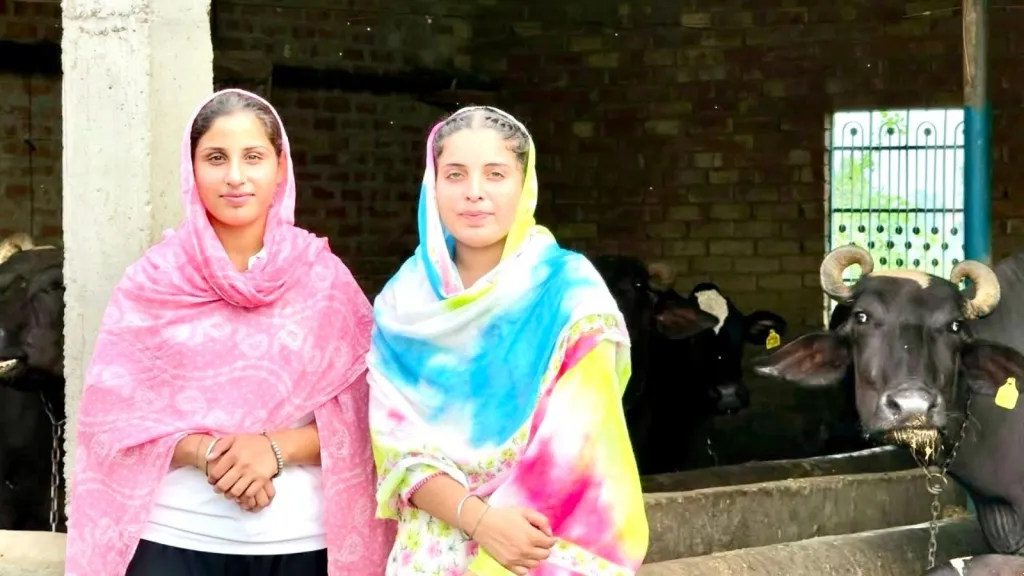
Punjab: At 4:30 every morning, when much of their peer group is still asleep, sisters Jashanpreet Kaur, 19, and Supandeep Kaur, 17, are already at work in their family’s cattle shed in Ladhuwala Uttar village of Fazilka.
Feeding animals, cleaning the shed, milking buffaloes, managing daily milk supplies, helping with household responsibilities and then attending to their studies has become routine for the two sisters.
Their working day can stretch until 11 pm.
What makes their routine remarkable is that they have been sharing these responsibilities since they were around 10 and 8 years old.
The sisters grew up in a financially constrained household. Their father, Gurvinder Singh, owns about 2.5 acres of inherited agricultural land and, until a few years ago, also drove a school van to supplement the family income.
Rather than abandoning dairy farming, the sisters encouraged their parents to continue and gradually expand the business.
From one buffalo to 22 animals
The family’s dairy journey began about seven or eight years ago with a single buffalo. Today, the herd has grown to 22 cows and buffaloes, with the livestock valued at around ₹30 lakh.
The family sells nearly 100 kg of milk a day, generating about ₹5,000 in daily revenue. Income from the sale of calves and young animals provides an additional source of earnings. According to the family, the dairy currently generates a profit margin of around 40–50 per cent.
The transformation has also improved the family’s overall financial position.
A loan taken during the initial years to construct the cattle shed and purchase animals has been repaid. The family now owns a tractor, agricultural implements, a house and a car, while also leasing additional agricultural land.
But for Gurvinder and his wife, Simarjeet Kaur, the dairy’s growth is as much a story about their daughters as it is about livestock.
“They were just 10 or 11,” Simarjeet recalls.
“At an age when most children depend entirely on their parents, my daughters began taking responsibility for household work and helping with the animals. Because of their support and motivation, we could think of continuing and expanding our dairy,” she says.
A difficult beginning
The family’s first experience with livestock farming was far from successful. Gurvinder had inherited two cows, but both died.
The family decided to try again when a relative gave them a buffalo. That animal became the starting point for what would eventually grow into a sizeable dairy enterprise.
Also Read: Haryana Dairy Farmers Demand Higher Vita Procurement Prices as Feed Costs Squeeze Margins
Over the years, the herd expanded, and the family diversified its income beyond milk.
Simarjeet says calves and young animals are sold for between ₹70,000 and ₹1.25 lakh, depending on their breed, age and quality.
Education remains a priority
Despite their extensive responsibilities at home and on the farm, the sisters have continued their education and have ambitions beyond dairy farming.
Jashanpreet is pursuing a B.Sc. in Fashion Designing and is learning boutique-related skills, with plans to start her own boutique.
Her younger sister, Supandeep, has completed Class 12 and is pursuing graduation through open education. She hopes to join the police.
At one point, Jashanpreet was also preparing to move abroad. She appeared for the IELTS examination, and her parents had considered sending her overseas. As the family dairy expanded and its income improved, however, the plan was dropped.
“We are earning well here. What is the need to send our children away from us when they can earn more than dollars here, build their lives and careers here as well?” her parents say.
Building the next phase
The sisters do not intend to completely distance themselves from the family enterprise. The family is now considering expanding its livestock activities by adding goats and horses.
Their 10-year-old brother, Gursikhdeep, has also begun taking part in household and dairy-related work while continuing his studies.
For Simarjeet, the family’s experience demonstrates that education and practical skills do not have to be competing choices.
“Today, I can say that my children are so skilled that they can take care not only of themselves but even of the entire dairy,” she says.
In Ladhuwala Uttar, Jashanpreet and Supandeep have earned a local reputation as the ‘Mehnati Kudiyan’ — hardworking girls.
For their parents, however, their contribution goes beyond the hours they spend in the cattle shed. What they value most is that their daughters understood the family’s financial responsibilities at a young age and motivated their parents to keep working towards a better future.
Their story is a reminder that a rural enterprise does not always begin with large capital or sophisticated infrastructure. Sometimes, it begins with one animal, a family willing to work together and the determination to keep going.
And for the sisters, that journey starts every morning at 4.30 am.
Join Our “Dairy & Food Jobs Updates” WhatsApp group
Follow the Agri Jobs Updates channel on WhatsApp:
Disclaimer
I do my best to share reliable and well-researched insights but occasional errors or omissions may slip through. Please view all content as informational.
Stay informed on all the latest news updates
All Agriculture Books Free Download
All Dairy Technology Books Free Download
All Agricultural Engineering Books Free download
All Horticulture Books Free Download
All Fisheries Science Books Free Download
For Daily Update follow us at:
Facebook Telegram Whatsapp Instagram YouTube
The contents are provided free for noncommercial purpose such as teaching, training, research, extension and self learning.
If you are facing any Problem than fill form Contact Us
If you want share any article related Agriculture with us than send at info@agrimoon.com with your contact detail.