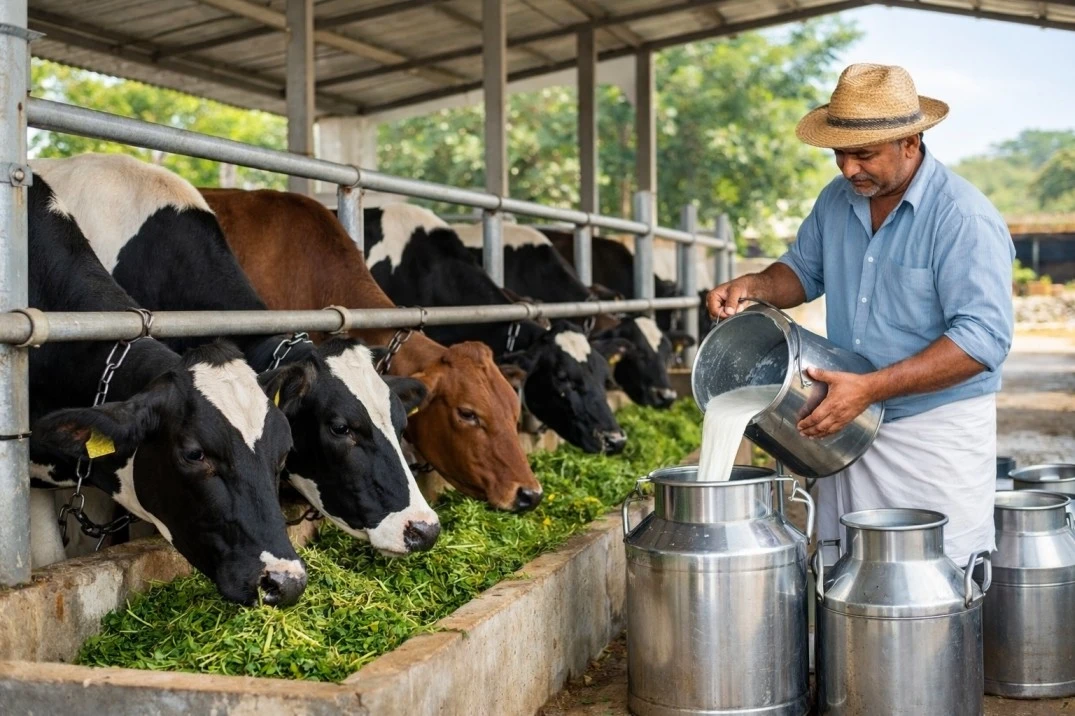
India’s dairy sector presents one of the biggest paradoxes in global agriculture. The country produces 248 million tonnes of milk annually, contributes nearly 25% of global milk production, and supports the livelihoods of around 450 million people. Yet, despite being the world’s largest milk producer, India accounts for less than 1% of global dairy exports.
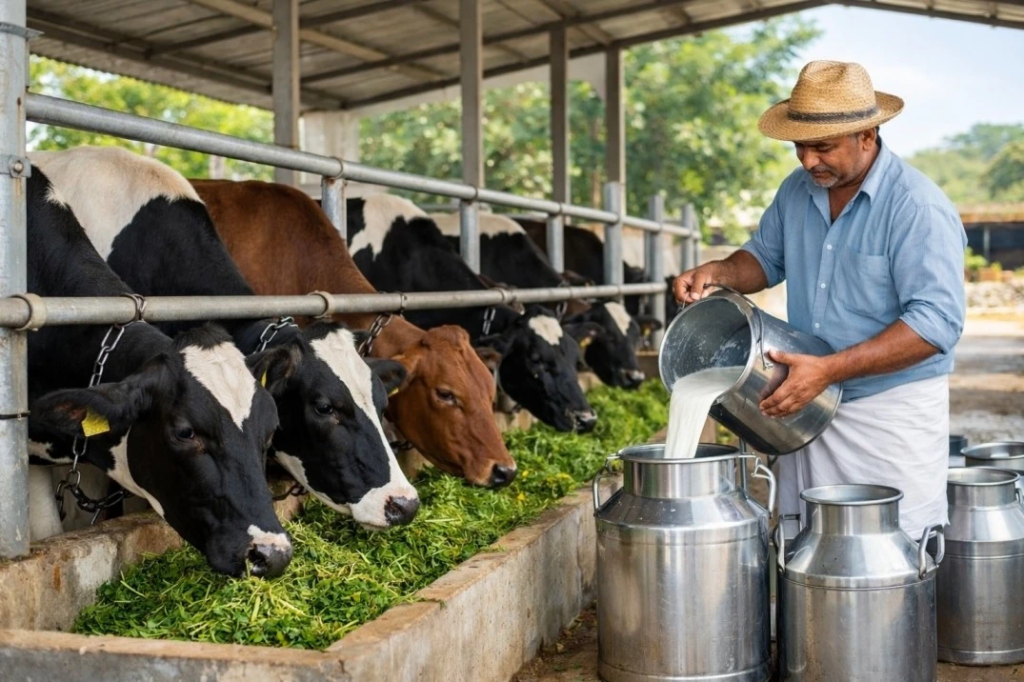
While countries producing far less milk dominate international dairy trade, India remains largely a domestic dairy economy. The reasons lie in consumption patterns, product mix, infrastructure gaps, and structural challenges.
The Numbers Tell the Story
India’s Dairy Strength
248 million tonnes
- World’s largest milk producer.
- Nearly 25% of global milk output.
- Around 90 million rural households linked to dairying.
- Supports approximately 450 million people.
- Contributes about 5% to India’s economy.
- Per capita milk availability: 485 grams/day.
- Global average: 328 grams/day.
Yet India’s dairy export earnings remain modest compared with global dairy leaders.
Problem 1: India Drinks Most of What It Produces
Unlike export-oriented dairy nations, India has an enormous domestic market.
Milk is a daily staple in Indian households:
- 93% of rural households consume milk regularly.
- 95% of urban households consume milk regularly.
- Milk is central to tea, sweets, curd, paneer, and household nutrition.
As a result, most milk never enters export channels.
What Happens to India’s Milk?
Out of total production:
- About 37% is consumed by producers or sold locally.
- Only 63% becomes marketable surplus.
This immediately limits exportable volumes.
Problem 2: India Produces Fluid Milk, the World Buys Processed Dairy
One of the biggest mismatches is between production and global demand.
India’s Production Pattern
About 85% of milk production is sold as fluid milk.
Global Demand Pattern
International dairy trade is dominated by:
- Cheese
- Whey proteins
- Lactose
- Infant formula
- Caseinates
- Dairy ingredients
- Specialty nutrition products
Countries like:
- New Zealand
- Netherlands
- Germany
- France
- United States
earn billions from value-added dairy products.
India’s Export Basket
Current exports are dominated by:
- Butter and ghee: ~59%
- Skim milk powder: ~27%
- Cheese: ~10%
High-value products remain a small portion of exports.
Problem 3: Highly Fragmented Dairy Farming
India’s dairy model is very different from Western dairy systems.
Structure of Indian Dairy Farming
- Around 80% of farmers own only 1–3 animals.
- These smallholders produce nearly 70% of total milk.
While socially inclusive, this creates challenges:
- Variable milk quality.
- Higher collection costs.
- Limited mechanization.
- Lower productivity.
- Difficulty maintaining export-grade standards.
By contrast, export leaders operate large-scale, highly standardized dairy farms.
Problem 4: Weak Cold-Chain Infrastructure
Milk is highly perishable.
Fresh milk should ideally be cooled from approximately 38°C to 4°C within a few hours after milking.
India continues to face major infrastructure gaps.
Consequences
- Approximately 80% shortage in critical refrigeration infrastructure.
- Around 6.3 million tonnes of milk lost annually through spoilage.
- Reduced shelf life.
- Quality deterioration.
- Lower export readiness.
For comparison, countries like New Zealand maintain highly integrated cold-chain systems from farm to export terminal.
Problem 5: Food Safety and Quality Concerns
International markets impose strict Sanitary and Phytosanitary (SPS) requirements.
Major importers such as the:
- European Union
- United States
- Japan
require rigorous quality compliance.
Challenges occasionally identified in India include:
- Aflatoxin contamination.
- Antibiotic residues.
- Adulteration risks.
- Inconsistent testing systems.
Even isolated incidents can affect export credibility.
Problem 6: Large Unorganized Sector
India’s dairy sector remains predominantly informal.
Of the marketable surplus:
- Only about 32% is handled by organized dairies.
- Around 68% remains in the unorganized sector.
In developed dairy-exporting countries:
- Up to 90% of milk is handled by organized processors.
This difference affects:
- Traceability.
- Standardization.
- Product quality.
- Export compliance.
Problem 7: Logistics Costs Reduce Competitiveness
Even when Indian dairy products are competitive, logistics can erode the advantage.
Challenges include:
- Higher transportation costs.
- Energy inefficiencies.
- Multiple handling points.
- Limited refrigerated transport.
Experts estimate that these factors can add 10–15% additional costs, reducing competitiveness in international markets.
The New Zealand Comparison
The strongest comparison comes from New Zealand.
| Indicator | India | New Zealand |
|---|---|---|
| Milk Production | ~248 million tonnes | ~22 million tonnes |
| Share of World Milk | ~25% | ~2% |
| Export Performance | <1% of global dairy trade | Among world’s largest exporters |
| Focus | Fluid milk | Value-added exports |
New Zealand produces less than one-tenth of India’s milk but exports dramatically more dairy value because it focuses on:
- Cheese
- Infant formula
- Protein concentrates
- Butter
- Specialty ingredients
Read More: Mother Dairy Targets ₹24,000 Crore Revenue in FY27, Expands Beyond Delhi-NCR
How India Can Become a Dairy Export Powerhouse
Experts believe India’s next dairy revolution must focus on value addition rather than volume growth.
Key Priorities
1. Expand Cheese Production
Global cheese demand continues to grow rapidly.
2. Develop Infant Formula Industry
High-margin nutrition products offer major export opportunities.
3. Strengthen Cold Chain Infrastructure
More:
- Bulk milk coolers
- Chilling centres
- Refrigerated transport
- Export logistics hubs
4. Improve Quality Assurance
Greater focus on:
- Residue testing
- Traceability
- SPS compliance
- International certifications
5. Formalize the Dairy Sector
Increase milk handled by organized cooperatives and private dairies.
6. Promote Dairy Ingredients
Growth opportunities exist in:
- Whey protein
- Lactose
- Casein
- Milk protein concentrates
The Road Ahead
India’s dairy sector has already achieved what many thought impossible—becoming the world’s largest milk producer through millions of small farmers, cooperatives, and institutions such as National Dairy Development Board.
The future lies not in producing more milk alone, but in converting milk into globally competitive, high-value products. If India can strengthen processing, quality systems, cold-chain infrastructure, and export-oriented manufacturing, it could move from being merely the world’s largest milk producer to becoming one of the world’s leading dairy-exporting nations over the next decade.
Join Our “Dairy & Food Jobs Updates” WhatsApp group
Follow the Agri Jobs Updates channel on WhatsApp:
Disclaimer
I do my best to share reliable and well-researched insights but occasional errors or omissions may slip through. Please view all content as informational.
Stay informed on all the latest news updates
All Agriculture Books Free Download
All Dairy Technology Books Free Download
All Agricultural Engineering Books Free download
All Horticulture Books Free Download
All Fisheries Science Books Free Download
For Daily Update follow us at:
Facebook Telegram Whatsapp Instagram YouTube
The contents are provided free for noncommercial purpose such as teaching, training, research, extension and self learning.
If you are facing any Problem than fill form Contact Us
If you want share any article related Agriculture with us than send at info@agrimoon.com with your contact detail.