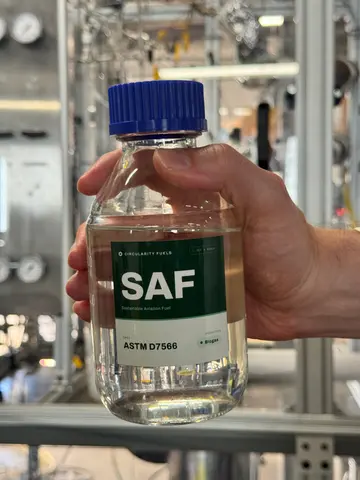
Redwood City, California, June 17: In a development that could reshape the economics of sustainable aviation fuel (SAF), Circularity Fuels has announced the successful completion of what it describes as the world’s first end-to-end conversion of raw agricultural biogas into aviation fuel meeting commercial jet fuel standards.
The California-based renewable fuels startup said it produced sustainable aviation fuel directly from dairy farm biogas over a six-month pilot programme, demonstrating a pathway that could significantly reduce both production costs and greenhouse gas emissions.
Turning Dairy Waste into Aviation Fuel
The pilot was conducted using biogas sourced directly from a dairy farm near Madera housing more than 5,000 cattle. Instead of requiring expensive gas-cleaning infrastructure, the company’s system processed raw biogas composed of roughly 65% methane and 35% carbon dioxide directly from the manure digester.
According to the company, the resulting fuel met the specifications of ASTM D7566 Annex A1, the international standard governing Fischer-Tropsch synthetic aviation fuels. The fuel can be blended with conventional Jet-A fuel at levels of up to 50% for use in commercial aircraft.
“The full stack works end-to-end on real feedstock from a real dairy farm, and the economics put commercial SAF from dairy waste within reach of fossil jet fuel,” said Stephen Beaton, founder and chief executive officer of the company.
Cost Advantage Over Existing SAF Projects
One of the most significant claims emerging from the pilot concerns capital expenditure. Circularity estimates that commercial-scale facilities based on its technology could be built for less than $100,000 per barrel-per-day of installed capacity—roughly one-fifth the cost of several sustainable aviation fuel projects currently being developed in Europe.
Industry analysts have frequently identified high production costs as one of the principal barriers to SAF adoption. Despite growing regulatory mandates and airline commitments, sustainable aviation fuel currently accounts for less than one percent of global jet fuel consumption.
The company argues that agricultural biogas represents an abundant and underutilised feedstock capable of overcoming some of the scale limitations associated with used cooking oil, which currently dominates global SAF production.
Carbon-Negative Fuel Potential
A notable aspect of the project is its claimed carbon-negative profile. Circularity’s internal lifecycle assessment, based on California’s regulatory framework, estimates a carbon intensity score of minus 350.7 grams of carbon dioxide equivalent per megajoule.
The negative emissions result from preventing methane—a greenhouse gas significantly more potent than carbon dioxide—from escaping into the atmosphere. By capturing and converting methane from dairy waste, the process generates climate benefits that exceed the emissions produced during fuel manufacture and combustion.
According to the company, each gallon of fuel produced is equivalent to removing approximately 100 pounds of carbon dioxide-equivalent emissions from the atmosphere.
Implications for Farmers and Energy Security
The technology could also create new revenue opportunities for dairy farmers, many of whom currently vent or flare excess biogas because upgrading infrastructure for pipeline-quality renewable natural gas remains prohibitively expensive.
Read More: Kaladi Cheese Gets Scientific Boost, Eyes National and Global Markets
“Circularity is the first team I’ve seen take raw biogas straight from a digester and turn it into finished jet fuel on-site,” said Craig Hartman of Hartman Engineering. “That changes the conversation for every dairy operator we work with.”
Beyond farm economics, proponents argue the approach could enhance energy security by reducing dependence on imported feedstocks and volatile crude oil markets.
Commercial Deployment Planned
Following the successful pilot, Circularity Fuels is preparing for its first commercial-scale deployment. The company expects construction on its inaugural commercial facility to begin in 2027, targeting agricultural biogas resources across the United States, Latin America and Europe.
Founded by Beaton, a former chief of the U.S. Air Force Petroleum Office laboratory, the company emerged from the incubator programme of DCVC and has secured $8 million in seed funding alongside support from organizations including the ARPA-E, the National Science Foundation and the California Energy Commission.
If commercial performance matches pilot-scale results, the project could provide a new pathway for scaling sustainable aviation fuel production while simultaneously reducing agricultural methane emissions—two challenges that have remained difficult to address at scale.
Join Our “Dairy & Food Jobs Updates” WhatsApp group
Follow the Agri Jobs Updates channel on WhatsApp:
Disclaimer
I do my best to share reliable and well-researched insights but occasional errors or omissions may slip through. Please view all content as informational.
Stay informed on all the latest news updates
All Agriculture Books Free Download
All Dairy Technology Books Free Download
All Agricultural Engineering Books Free download
All Horticulture Books Free Download
All Fisheries Science Books Free Download
For Daily Update follow us at:
Facebook Telegram Whatsapp Instagram YouTube
The contents are provided free for noncommercial purpose such as teaching, training, research, extension and self learning.
If you are facing any Problem than fill form Contact Us
If you want share any article related Agriculture with us than send at info@agrimoon.com with your contact detail.