UK research partnership explores turning a difficult dairy by-product into renewable fuel and other value-added products
SCOTLAND: Scientists and biotechnology researchers in Scotland have demonstrated a potential new route for converting salty whey, a challenging by-product of cheese production, into bioethanol.
The project was carried out by Take Root Bio in collaboration with Heriot-Watt University, with support from the Industrial Biotechnology Innovation Centre (IBioIC).
The work explores how sugars present in salty whey can be processed through biological methods to produce ethanol, potentially creating an additional source of value from a dairy by-product that can otherwise be costly and difficult to manage.
Turning dairy waste into a resource
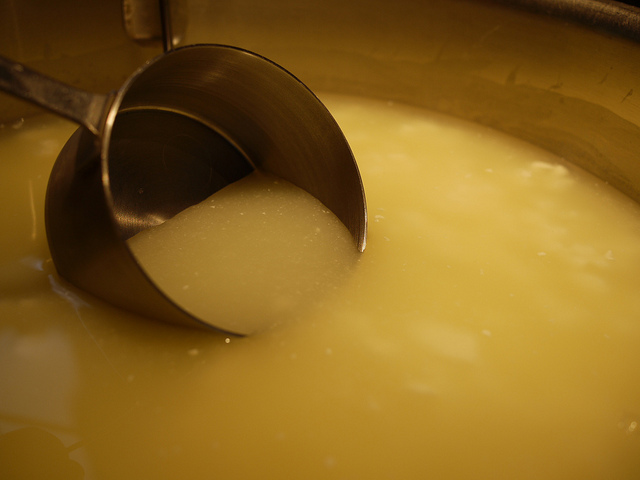
Salty whey is generated during the production of cheeses such as cheddar. Unlike conventional whey, its relatively high salt content makes disposal and further processing more challenging.
The UK generates around 95,000 tonnes of salty whey each year from cheddar and similar cheese production, according to the project partners.
Individual dairy producers can generate tens of thousands of litres of whey every week, creating both waste-management costs and environmental pressures.
The research takes a different approach by treating the material not simply as waste, but as a potential feedstock for bio-based production.
Whey sugars converted into ethanol
At the centre of the project is the utilisation of sugars contained in salty whey.
Researchers investigated a biological process capable of converting these sugars into bioethanol, a fuel widely used in transport and industrial applications.
The process also produces a secondary stream that could potentially be recovered and reused, opening the possibility of extracting additional value from the same raw material.
The approach reflects the principles of a circular bioeconomy, in which waste or by-products from one production process become inputs for another.
Space technology inspires terrestrial application
Take Root Bio’s involvement brings an unusual dimension to the project.
The company originated from work focused on biosphere engineering and resource recycling for food production in space, where limited resources make waste minimisation particularly important.
Researchers are now applying similar closed-loop thinking to terrestrial food production.
The underlying principle is straightforward: rather than treating a by-product as the end of a production chain, identify whether it can become an input for another process.
Potential to reduce transport and processing costs
The partners are also examining whether mobile production units could eventually be positioned close to dairy-processing facilities.
Such an approach could reduce the volume of material that needs to be transported and potentially make decentralised processing more practical.
Also Read: 10 Tonnes of Suspected Fake Paneer, 5,000 Kg Khoya Seized in Pune FDA Raid
For dairy producers, this could be significant if future commercial systems can convert a disposal liability into a revenue-generating feedstock.
However, further work will be needed to establish the economic viability, scalability and commercial performance of the technology.
Research expertise in brewing and biotechnology
Heriot-Watt University has a long history of research and teaching in brewing and distilling and is home to the International Centre for Brewing and Distilling (ICBD).
The university is also developing a Centre for Sustainable Brewing and Distilling, intended to support low-carbon technologies, product development and industry training.
Researchers involved in the whey project specialise in areas including waste valorisation and fermentation development, bringing relevant expertise to the conversion of food-processing by-products into useful products.
Beyond dairy waste
The researchers are now examining whether similar biological processes could be applied to other food and agricultural by-products.
Potential areas include waste streams generated by fruit and vegetable processing.
The team is also investigating the possibility of capturing gases generated during fermentation, including methane and hydrogen, and exploring how these resources could potentially be incorporated into future food-production systems.
A potential circular-economy model for dairies
The project illustrates how dairy processing could increasingly move towards integrated biorefineries, where milk is used to produce conventional dairy products while by-products are further processed into fuels, ingredients, chemicals or other valuable materials.
For the dairy industry, the significance extends beyond bioethanol.
If technologies can be developed to economically recover multiple components from whey and other dairy side-streams, processors could potentially reduce waste-management costs while creating new revenue streams.
The immediate challenge is commercial scale. Turning a successful laboratory or pilot process into a reliable industrial operation will require further work on process efficiency, economics, infrastructure and market demand.
Nevertheless, the salty-whey project demonstrates a growing shift in food manufacturing: dairy by-products are increasingly being viewed not as waste to dispose of, but as resources waiting to be recovered.
Join Our “Dairy & Food Jobs Updates” WhatsApp group
Follow the Agri Jobs Updates channel on WhatsApp:
Disclaimer
I do my best to share reliable and well-researched insights but occasional errors or omissions may slip through. Please view all content as informational.
Stay informed on all the latest news updates
All Agriculture Books Free Download
All Dairy Technology Books Free Download
All Agricultural Engineering Books Free download
All Horticulture Books Free Download
All Fisheries Science Books Free Download
For Daily Update follow us at:
Facebook Telegram Whatsapp Instagram YouTube
The contents are provided free for noncommercial purpose such as teaching, training, research, extension and self learning.
If you are facing any Problem than fill form Contact Us
If you want share any article related Agriculture with us than send at info@agrimoon.com with your contact detail.