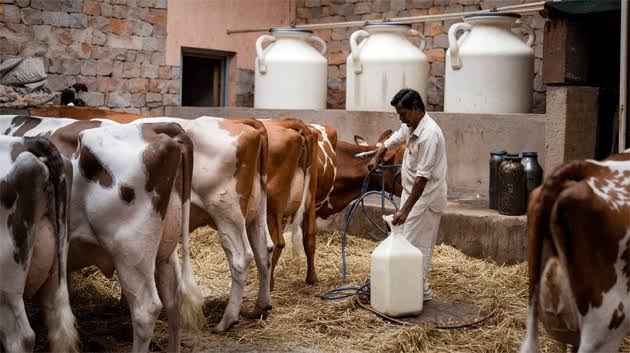
New Delhi: India has established itself as the world’s largest milk producer, but the next phase of dairy-sector growth may depend less on increasing milk volumes and more on creating and retaining greater value across the dairy value chain, according to an article by the chief executive of Heritage Foods.
The article, published on September 19, 2026, argues that rising milk procurement costs, changing consumer demand, pressure on farmer incomes and supply constraints are making value creation increasingly important for India’s dairy industry.
From milk scarcity to the world’s largest producer
India’s dairy sector has undergone a significant transformation, moving from an era of milk scarcity to becoming the world’s largest milk-producing country.
The expansion has increased milk availability and brought millions of farmers into organised dairy value chains. However, the article argues that future progress should be assessed not only by the quantity of milk produced but also by the economic value generated for farmers, processors and other participants.
According to estimates cited in the article, India has around 150 million tonnes of marketable milk surplus. Cooperatives and private dairies together procure approximately 55 million tonnes, while an estimated 90–95 million tonnes move through informal or unorganised channels.
The article suggests that some segments of the informal dairy economy generate higher value per litre than organised channels, highlighting an opportunity to improve value realisation across the formal sector.
Rising procurement costs put pressure on margins
The focus on value creation comes amid higher milk procurement prices and pressure on dairy-company margins.
Several dairy companies have been facing higher raw-material costs, while some industry participants are awaiting moderation in milk prices. At the producer level, however, rising input costs and inflation have also affected the economics of dairy farming.
Also Read: ‘Rangeelo Kashi’ Opens in Varanasi, Showcasing Livestock, Dairy Technologies and Rural Innovation
The article estimates that nominal dairy-farmer income grew at a compound annual rate of around 11.5% between FY2019 and FY2025. After accounting for inflation, real income growth was estimated at around 5%, below India’s real GDP growth over the same period.
The article argues that this gap makes improving producer economics a central issue for the dairy industry.
Higher-value products seen as a growth opportunity
Heritage Foods has stated that it aims to double the nominal income of its farmer partners over five years.
According to the article, achieving this target would require annual income growth of approximately 14.5%, compared with the cited historical sector growth rate of about 11.5%.
The article links this ambition to greater development and marketing of value-added dairy products, which can potentially generate higher returns from the same underlying milk pool compared with commodity-oriented products.
Consumption growth outpaces supply
India’s dairy consumption has reportedly grown by around 4–5% annually over the past five years, supported by urbanisation, rising incomes, greater nutritional awareness and growing consumer interest in protein-rich diets.
The article estimates milk supply growth at around 3–3.5% annually over the same period.
The resulting supply-demand pressure has contributed to higher milk and dairy-product prices, according to the article, while climate variability has added uncertainty to milk production and procurement.
Trade highlights the value gap
India’s position in global dairy trade also illustrates the challenge of capturing greater value.
The country imports higher-value dairy ingredients such as whey protein concentrate (WPC) and milk protein concentrate (MPC), while exports have historically included comparatively lower-value commodities such as skimmed-milk powder (SMP).
The article argues that India’s experience demonstrates that increasing production scale alone is not sufficient to maximise the economic potential of the dairy sector.
The next phase: value, productivity and farmer returns
The broader argument is that India’s dairy industry has already demonstrated its ability to expand milk production. The next challenge is to strengthen value addition, productivity, farmer income and market realisation across the supply chain.
That could involve greater investment in value-added products, improved formal procurement, stronger links between farmers and processors, and development of products that meet changing consumer demand.
For a sector that has already achieved scale, the question increasingly shifts from how much milk India produces to how much economic value can be generated from every litre.
Join Our “Dairy & Food Jobs Updates” WhatsApp group
Follow the Agri Jobs Updates channel on WhatsApp:
Disclaimer
I do my best to share reliable and well-researched insights but occasional errors or omissions may slip through. Please view all content as informational.
Stay informed on all the latest news updates
All Agriculture Books Free Download
All Dairy Technology Books Free Download
All Agricultural Engineering Books Free download
All Horticulture Books Free Download
All Fisheries Science Books Free Download
For Daily Update follow us at:
Facebook Telegram Whatsapp Instagram YouTube
The contents are provided free for noncommercial purpose such as teaching, training, research, extension and self learning.
If you are facing any Problem than fill form Contact Us
If you want share any article related Agriculture with us than send at info@agrimoon.com with your contact detail.