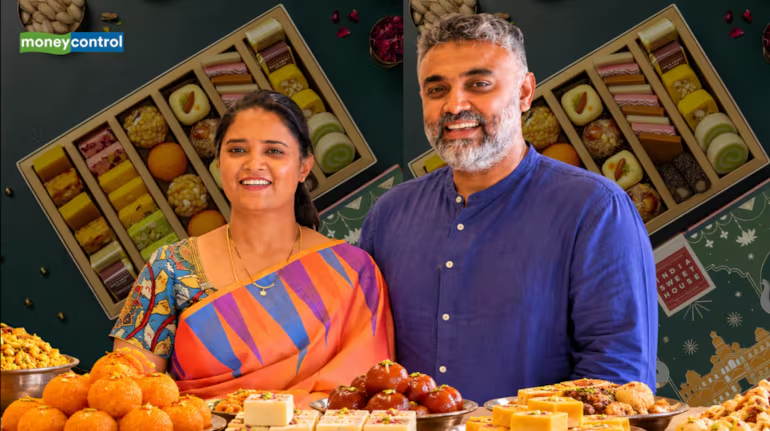
Bengaluru | What began as an attempt to solve a milk-surplus problem during the Covid-19 pandemic has evolved into a growing organised sweets and food-service business in Bengaluru.
India Sweet House (ISH), founded by Shwetha Rajashekar and Vishwanath Murthy, has reportedly grown from its roots in dairy farming into a chain with more than 50 outlets, with the business now generating over ₹80 crore in annual revenue, according to financial data cited by Tracxn.
From a 20-acre dairy farm to value-added products
The founders’ entrepreneurial journey began around 2015–16 with an organic farming venture. The couple operated a 20-acre farm with around 100 cows and developed a dairy business under the Karma Farms brand.
The initial focus was on products such as fresh milk, paneer and ghee.
However, the direct-to-consumer milk model faced significant challenges during the pandemic. Managing demand for fresh milk became difficult, while collecting and returning glass bottles added to the logistical burden.
The surplus milk problem eventually pushed the founders to rethink how the dairy output could be used.
Turning surplus milk into sweets
Rather than continuing to sell milk only as a standalone product, the founders began converting it into traditional Indian sweets.
This shift towards value addition became the foundation for India Sweet House, which was established in 2020.
The strategy allowed the business to move beyond the challenges of selling fresh milk while creating products with longer shelf life and potentially wider market appeal.
The company initially followed an online-first model, selling through platforms including BigBasket, Metro Cash and Carry and SPAR India. It later entered physical retail, opening its first store in Malleswaram, Bengaluru, in 2021.
Positioning between traditional and premium mithai
The founders entered a highly competitive sweets market dominated by established regional brands and family-run businesses.
India Sweet House sought to position itself between conventional, relatively low-priced sweet shops and premium mithai outlets.
Its stores combine traditional sweets with a broader food-service offering. Customers can find chaats, savouries, snacks and sweets, with seating available at outlets where consumers can eat rather than simply purchase products for takeaway.
The wider portfolio includes products such as murukku, chips, cookies and other savouries. The company has also expanded into the chaat segment through its Chaatimes business.
Building an organised sweets chain
The company’s expansion remains largely concentrated in Karnataka, although it has indicated plans to enter additional markets.
The broader strategy is to transform a Bengaluru-rooted sweets format into a larger organised retail network, combining traditional Indian sweets with snacks and food-service offerings.
Also Read: Kerala Delegation Visits Banas Dairy to Study Gujarat’s Cooperative Dairy Model
The leadership team also brings experience from different parts of the food business. Vishwanath Murthy serves as co-founder and CEO, while Shwetha Rajashekar is a co-founder. Rajesh Mehta, another co-founder, contributes several decades of experience in the food-service sector.
Revenue crosses ₹80 crore
According to financial data cited by Tracxn, India Sweet House recorded ₹83.10 crore in revenue in FY2024-25, along with EBITDA of ₹6.15 crore and a net profit of ₹1.83 crore.
The company has also attracted institutional capital. In October 2024, India Sweet House reportedly raised $1 million from Viney Equity Market in a funding round described as a pre-IPO raise, according to Tracxn.
A dairy-to-value-addition transformation
India Sweet House’s journey illustrates how a dairy enterprise can evolve when farmers or dairy entrepreneurs move beyond selling raw milk and explore value-added products.
What began with a 20-acre farm and around 100 cows eventually developed into a branded sweets and food-service business. The pandemic exposed the limitations of the original fresh-milk model, but the same milk supply also became the starting point for a new business direction.
In less than a decade, the founders have moved from managing a dairy operation to building an organised sweets retail network—turning a challenge around surplus milk into the foundation of a broader food business.
Join Our “Dairy & Food Jobs Updates” WhatsApp group
Follow the Agri Jobs Updates channel on WhatsApp:
Disclaimer
I do my best to share reliable and well-researched insights but occasional errors or omissions may slip through. Please view all content as informational.
Stay informed on all the latest news updates
All Agriculture Books Free Download
All Dairy Technology Books Free Download
All Agricultural Engineering Books Free download
All Horticulture Books Free Download
All Fisheries Science Books Free Download
For Daily Update follow us at:
Facebook Telegram Whatsapp Instagram YouTube
The contents are provided free for noncommercial purpose such as teaching, training, research, extension and self learning.
If you are facing any Problem than fill form Contact Us
If you want share any article related Agriculture with us than send at info@agrimoon.com with your contact detail.