
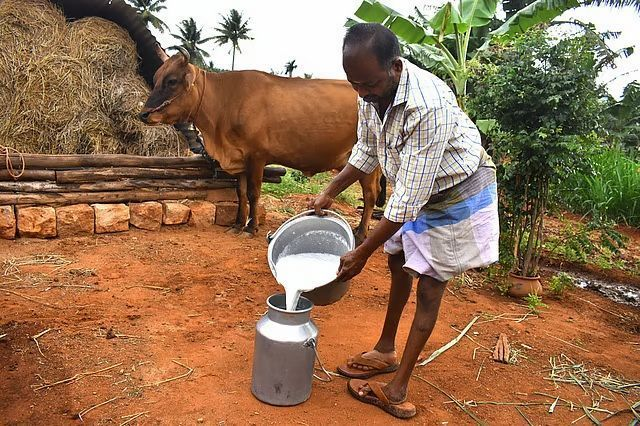
CHENNAI: Dairy farmers in Tamil Nadu are challenging deductions of up to ₹4 per litre reportedly imposed by primary milk cooperative societies, arguing that the reductions prevent them from receiving the full benefit of the state’s revised milk procurement rates.
The dispute follows a reported revision setting benchmark procurement prices at ₹44 per litre for cow milk and ₹53 per litre for buffalo milk. However, producers in areas including Tiruchirappalli say deductions ranging from ₹2.75 to ₹4 per litre are reducing their actual payments.
Farmers’ associations are urging the state government and dairy authorities to investigate the deductions, clarify the rules governing cooperative payments and ensure greater transparency in milk procurement.
Revised Procurement Rates Under Scrutiny
According to the report, the revised cow milk rate of ₹44 per litre comprises a base procurement price of ₹36 and a state incentive of ₹8 per litre, subject to specified quality parameters of 4.3% fat and 8.2% solids-not-fat (SNF).
Despite the announced rate, farmers say deductions at the primary society level can reduce their effective realisation to between ₹40 and ₹41.25 per litre.
The gap has raised questions about how the revised procurement price and associated incentive are being implemented at village collection centres. The applicable Government Order and payment instructions would need to be examined to establish whether the deductions are authorised and how the incentive is intended to be disbursed.
Cooperative Societies Cite Collection and Operating Costs
Primary milk cooperative societies form an important link between dairy farmers and the wider Aavin procurement network. Their responsibilities commonly include milk collection, quality testing, record-keeping and the operation of chilling and collection infrastructure.
These activities involve expenditure on staff, electricity, equipment maintenance, laboratory consumables and premises. Cooperative representatives, as described in the report, argue that deductions help cover operating expenses and contribute to reserves or bonus payments.
The central issue is whether such charges are properly authorised, transparently accounted for and consistent with the state’s procurement policy. Farmers argue that operational costs should not undermine the benefits of a publicly announced price revision.
Deductions Add Pressure to Farm Incomes
For small dairy farmers, even a modest reduction per litre can have a substantial effect on monthly cash flow, particularly when feed, fodder, veterinary care and other production costs remain high.
For a farmer supplying 30 litres of milk per day, a deduction of ₹4 per litre amounts to ₹120 daily, or approximately ₹3,600 over a 30-day month.
Also Read: Gujarat’s Dairy Growth Faces Margin Pressure as Cattle Feed and Fodder Costs Rise
That money can be important for purchasing cattle feed, meeting veterinary expenses and servicing livestock-related loans. The financial impact is particularly significant for smallholders who depend on regular milk payments to manage household and farm expenditure.
Risk of Milk Diversion to Private Buyers
If farmers believe cooperative procurement payments are less favourable than alternative channels, some may consider selling milk to private dairies or informal buyers offering more attractive net returns.
Any substantial diversion could affect milk procurement stability for the cooperative network. Transparent payment calculations and predictable settlement procedures are therefore important for maintaining producer participation.
However, the extent to which farmers are actually diverting supplies because of these deductions would need to be established through procurement data or statements from the affected societies.
Calls for Transparent Payment Rules
Resolving the dispute will require clarity on permissible deductions, the treatment of state incentives and the responsibility of primary societies for collection-related expenses.
Possible measures include:
- Transparent payment statements: Clearly itemising the gross procurement rate, quality-based calculations, incentives, deductions and final payment.
- Standardised deduction rules: Publishing an authorised schedule of any permissible society-level charges.
- Dedicated operating support: Assessing whether district unions or the state should provide handling allowances or financial support for eligible collection-centre expenses.
- Digital traceability: Maintaining auditable records of milk volumes, quality results and payments to individual producers.
The immediate priority is to establish whether the reported deductions comply with the applicable procurement policy and cooperative rules. Ensuring that farmers receive the amounts to which they are entitled will be essential to protecting producer confidence and sustaining Tamil Nadu’s organised dairy supply chain.
Join Our “Dairy & Food Jobs Updates” WhatsApp group
Follow the Agri Jobs Updates channel on WhatsApp:
Disclaimer
I do my best to share reliable and well-researched insights but occasional errors or omissions may slip through. Please view all content as informational.
Stay informed on all the latest news updates
All Agriculture Books Free Download
All Dairy Technology Books Free Download
All Agricultural Engineering Books Free download
All Horticulture Books Free Download
All Fisheries Science Books Free Download
For Daily Update follow us at:
Facebook Telegram Whatsapp Instagram YouTube
The contents are provided free for noncommercial purpose such as teaching, training, research, extension and self learning.
If you are facing any Problem than fill form Contact Us
If you want share any article related Agriculture with us than send at info@agrimoon.com with your contact detail.