
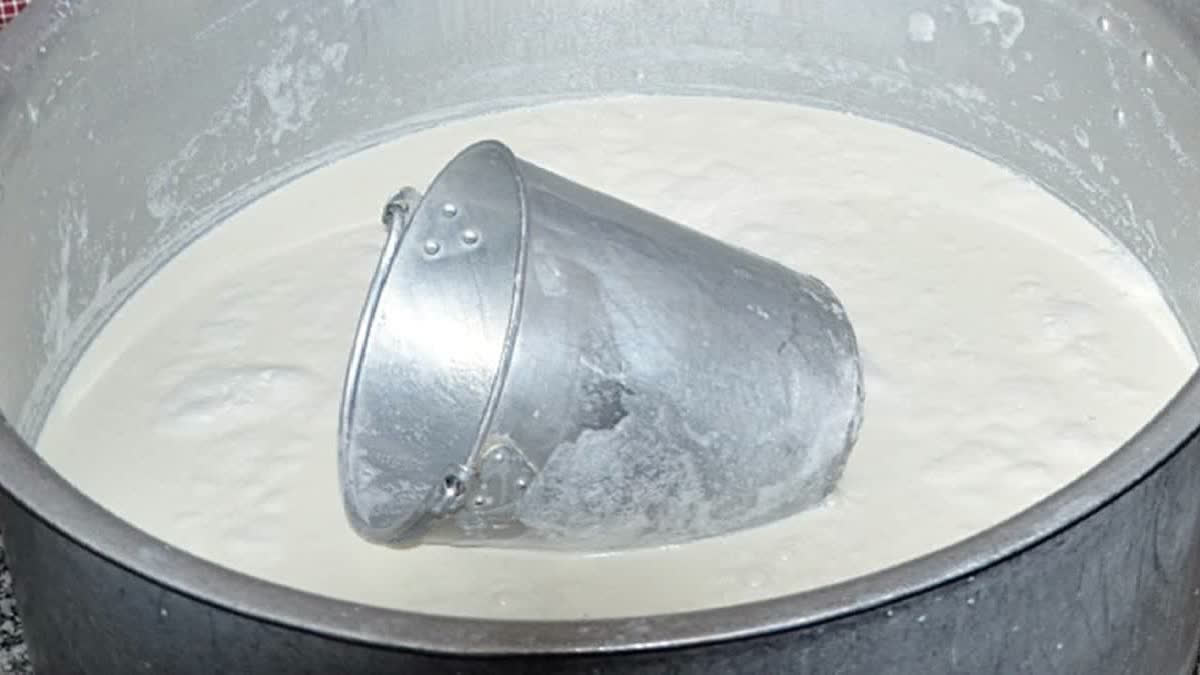
Ahmedabad | Gujarat’s dairy sector has expanded milk production and market supply over recent years, but rising cattle feed and fodder costs are putting pressure on farmers’ earnings. Dairy producers in Banaskantha and South Gujarat say higher input expenses are eroding savings despite increases in the prices paid for milk.
The issue highlights a growing challenge for the dairy industry: rising production and sales do not necessarily translate into higher farm-level profitability when feed, fodder and livestock maintenance costs increase.
Farmers report shrinking margins
Dairy farmers in Banaskantha say the prices they receive for milk have not kept pace with the cost of maintaining their animals.
Parthibhai Chaudhary, a farmer from the district, said he supplies milk at rates of around ₹30–32 per kilogram of fat and claimed that cattle feed prices had doubled over five years.
Other farmers described similar difficulties. Bhikhabhai Chaudhary said expensive feed and fodder were leaving little money for savings, while Prakash Chaudhary argued that periodic milk-price increases had not adequately improved household finances.
Sandeep Chaudhary said farmers were struggling to obtain returns that reflected the prices consumers pay for dairy products. He also raised concerns about cattle-feed quality and access to subsidies.
Kiransinh Rajput called for measures to address the gap between milk procurement prices and input costs.
These accounts reflect farmers’ reported experiences; assessing the scale of the problem across Gujarat would require comparable data on feed prices, farm-level production costs and procurement payments.
Cooperative payments and farmer concerns
The concerns come amid claims from dairy cooperatives that milk producers have benefited from higher payments.
Banas Dairy Chairman Shankar Chaudhary reportedly said at the cooperative’s annual general meeting that ₹2,239 crore had been paid as a price differential to farmers, ₹108 crore more than the amount determined the previous year.
The figures illustrate the importance of distinguishing between total payments made to producers and the net income farmers retain after meeting production expenses. Higher procurement payments can benefit farmers, but the effect on profitability depends on how quickly input costs rise.
Former Sumul Dairy director Jayesh Delad said dairy production costs had increased faster than milk prices in recent years. He estimated that cattle-feed costs had risen by 10–15%, compared with milk-price increases of 3–4%, and said inflation had added further pressure.
These estimates are attributed to Delad and would need to be assessed against consistent, independently verified price data.
Gujarat’s milk production continues to grow
Despite the concerns over farm profitability, the supplied figures indicate sustained growth in Gujarat’s milk production.
| Year | Annual milk production | Average daily milk sales |
|---|---|---|
| 2019–20 | 15.3 million tonnes | 14 million litres |
| 2020–21 | 15.9 million tonnes | 14.5 million litres |
| 2021–22 | 16.7 million tonnes | 15.2 million litres |
| 2022–23 | 17.6 million tonnes | 16 million litres |
| 2023–24 (estimated) | 18.5 million tonnes | 17 million litres |
Figures are from the supplied report and have not been independently verified here. Milk production and average daily sales are different measures and should not be treated as directly equivalent.
The report places Gujarat among India’s major milk-producing states, with buffaloes and cows both contributing substantially to output.
According to the Basic Animal Husbandry Statistics figures cited in the report, Gujarat produced 16.72 million tonnes of milk in 2021–22, accounting for 7.56% of India’s production. Buffaloes contributed approximately 7.83 million tonnes, crossbred and exotic cows 5.67 million tonnes, and indigenous cows 2.87 million tonnes.
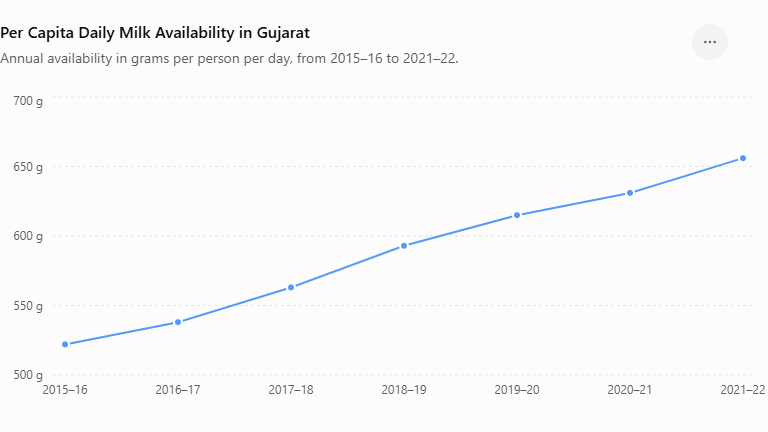
The same data indicate that the state’s total milk production increased from 12.26 million tonnes in 2015–16 to 16.72 million tonnes in 2021–22. Per-capita milk availability rose from 522 grams per day to 656 grams over that period.
Higher retail prices do not guarantee higher farm income
Consumer milk prices have also increased. According to the report’s cited GCMMF data, retail prices rose by approximately ₹8–12 per litre over five years, depending on the product and market.
Farmers argue that these increases have not necessarily translated into proportionate improvements in their earnings.
Naresh Kachotiya, a dairy farmer from Surat who maintains 18 animals, said higher milk prices had been offset by increased feed and fodder expenses, leaving little savings.
Manish Ojha, in-charge managing director of Amul Dairy, offered a different perspective on the procurement trend. According to the report, he said milk collection had increased from around 1.5 billion kilograms five years earlier to more than 1.76 billion kilograms. He also said the price paid to farmers had risen from ₹837 to ₹1,035 per kilogram of fat.
These figures point to an important distinction: an increase in total milk procurement and the price paid per unit does not, by itself, establish whether individual farmers’ margins have improved. That assessment requires accounting for animal productivity, feed consumption, labour, veterinary care, breeding and other operating expenses.
| Year | Per Capita Daily Milk Availability |
|---|---|
| 2015–16 | 522 grams |
| 2016–17 | 538 grams |
| 2017–18 | 563 grams |
| 2018–19 | 593 grams |
| 2019–20 | 615 grams |
| 2020–21 | 631 grams |
| 2021–22 | 656 grams |
Feed and fodder availability remain key concerns
Farmers have also cited limited green-fodder availability during the monsoon and the increasing cost of purchased feed. When affordable fodder is scarce, producers may have to rely more heavily on commercial feed, increasing the cost of maintaining productive animals.
The pressure can be especially difficult for small and marginal farmers, who may have less land for fodder cultivation and fewer resources to absorb fluctuations in input prices.
Also Read: Sudha Expands Northeast Presence With 20,000-Litre-Per-Day Dairy Plant in Assam
Potential responses include improving access to quality-assured cattle feed, strengthening local fodder production and conservation, improving ration balancing and ensuring that farmers understand the relationship between feed costs and milk yield. The effectiveness of these measures will depend on local conditions and the support available through cooperatives and extension services.
The challenge: Turning output growth into sustainable farm returns
Gujarat’s experience illustrates a broader issue for India’s dairy sector. Higher milk production, expanding retail sales and rising procurement volumes are important indicators of industry growth, but they do not necessarily show whether dairy farming is becoming more financially sustainable for producers.
For cooperatives and policymakers, the key question is how to maintain reliable milk supplies while ensuring that farmers can cover their costs and earn a viable return.
That requires looking beyond headline milk prices to the economics of production—including feed and fodder costs, animal productivity, payment systems and access to technical support. For Gujarat’s dairy farmers, the sustainability of the next phase of growth may depend as much on controlling input costs as on increasing milk outpu
Join Our “Dairy & Food Jobs Updates” WhatsApp group
Follow the Agri Jobs Updates channel on WhatsApp:
Disclaimer
I do my best to share reliable and well-researched insights but occasional errors or omissions may slip through. Please view all content as informational.
Stay informed on all the latest news updates
All Agriculture Books Free Download
All Dairy Technology Books Free Download
All Agricultural Engineering Books Free download
All Horticulture Books Free Download
All Fisheries Science Books Free Download
For Daily Update follow us at:
Facebook Telegram Whatsapp Instagram YouTube
The contents are provided free for noncommercial purpose such as teaching, training, research, extension and self learning.
If you are facing any Problem than fill form Contact Us
If you want share any article related Agriculture with us than send at info@agrimoon.com with your contact detail.