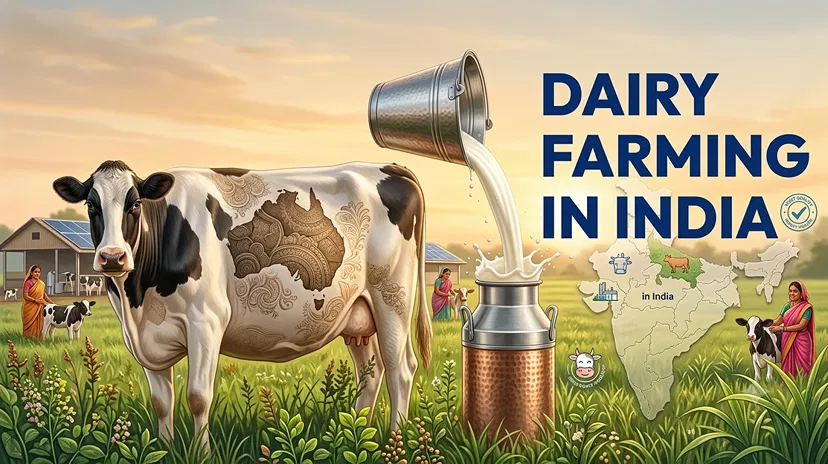
From less than five litres per animal per day in FY14 to around eight litres today, India’s dairy sector is moving towards scientific breeding, improved animal healthcare and diversified rural income generation.
India’s dairy sector is entering a new phase of development, driven by improvements in milk productivity, scientific breeding, animal healthcare and modern dairy infrastructure. Prime Minister Narendra Modi has highlighted that the average daily milk yield per cow or buffalo has increased to approximately eight litres, compared with less than five litres in 2013–14.
The development is significant for a sector that supports millions of rural households, particularly small and marginal farmers and women involved in livestock rearing. Beyond providing nutrition, dairying serves as a regular source of income and contributes to rural employment and economic resilience.
The emerging approach places greater emphasis on improving the productivity and health of existing livestock rather than relying solely on increasing animal populations.
Scientific breeding takes centre stage
A major initiative in this direction is the Bharat Bovine Breeding and Research Centre at Bhildi in Gujarat’s Banaskantha district, dedicated by the Prime Minister.
Spread across 127 acres, the facility is India’s first dedicated centre for the Kankrej cattle breed. It will focus on genetic improvement and advanced reproductive technologies, including in-vitro fertilisation (IVF) and embryo transfer.
The centre will support the conservation and improvement of indigenous cattle breeds such as Gir, Sahiwal, Kankrej and Tharparkar, along with buffalo breeds including Mehsana, Murrah, Banni and Jaffarabadi.
Its reported target is to produce approximately 25,000 high-quality embryos annually, potentially improving access to superior genetic material and supporting the development of more productive animals.
Scientific breeding can help farmers improve herd productivity, although its long-term benefits will also depend on the availability of quality feed, animal healthcare and appropriate breeding management.
Livestock population growth and the productivity challenge
India’s livestock statistics highlight the importance of improving productivity across the existing animal population.
According to the 20th Livestock Census, India’s cattle population increased from 190.90 million in 2012 to 192.52 million in 2019. The buffalo population rose from 108.7 million to 109.9 million during the same period.
The total bovine population reached approximately 303.76 million, representing growth of around 1.3% over seven years.
These figures underline the importance of improving milk yield, reproductive efficiency and animal health alongside livestock population growth.
State-level trends also reveal differences in livestock development. Between 2012 and 2019, Madhya Pradesh’s livestock population increased from 36.3 million to 40.6 million, West Bengal’s from 30.3 million to 37.4 million and Bihar’s from 32.9 million to 36.5 million.
In contrast, Rajasthan’s livestock population declined from 57.7 million to 56.8 million, while Gujarat recorded a marginal decline from 27.1 million to 26.9 million.
These variations reflect differences in livestock composition, regional production systems and state-level development priorities.
Gujarat’s cooperative dairy ecosystem
Gujarat has developed a strong dairy economy supported by cooperative institutions, organised milk procurement, veterinary services and farmer-oriented programmes.
The state’s 2019 Livestock Census recorded approximately 96.33 lakh cattle and 105.43 lakh buffaloes, demonstrating the importance of bovine livestock to its agricultural economy.
Gujarat’s dairy development has also been supported by institutional initiatives and cooperative networks. During Narendra Modi’s tenure as Chief Minister from 2001 to 2014, dairy cooperatives and livestock support programmes received attention as part of the state’s rural development agenda.
The Integrated Dairy Development Scheme, launched in 2007–08, has reportedly provided more than 1.96 lakh milch animals to tribal women. Its support includes assistance for animal purchases, insurance, transportation, cattle feed, veterinary treatment and training.
Institutions such as the Gujarat Gopalak Development Corporation and dairy cooperatives, including Banas Dairy, have helped connect livestock farmers with organised markets, technical assistance and veterinary services.
This cooperative structure is important because it enables small producers to access procurement networks and services that may otherwise be difficult to obtain individually.
Rashtriya Gokul Mission strengthens indigenous breeds
At the national level, the Rashtriya Gokul Mission focuses on the conservation, development and genetic improvement of indigenous bovine breeds.
The programme promotes scientific breeding practices, improved reproductive technologies and the development of breeding infrastructure.
The new Banaskantha centre is expected to complement these efforts by supporting genetic improvement and expanding access to advanced reproductive technologies.
Improved indigenous breeds can contribute to higher productivity and better adaptation to local environmental conditions. However, genetic potential must be supported by balanced nutrition, suitable housing, disease prevention and proper farm management.
Animal healthcare and vaccination remain essential
Animal health is another important factor influencing milk productivity and farm profitability.
Diseases such as foot-and-mouth disease can reduce milk production, affect reproductive performance and increase veterinary expenditure. India’s nationwide vaccination programme aims to reduce these risks through large-scale disease prevention.
According to figures cited by the Prime Minister, nearly 150 crore vaccine doses have been administered, covering livestock belonging to more than eight crore farmers.
Also Read: Amul Launches High Protein Cubes with 25g Protein and 150 kcal per Pack at ₹80
Regular vaccination, disease surveillance, veterinary access and timely treatment are essential for maintaining healthy herds and reducing production losses.
For small dairy farmers, preventive healthcare can be particularly important because disease outbreaks may directly affect household income.
Cattle dung creates opportunities beyond milk production
India’s dairy development strategy is also expanding towards the productive utilisation of cattle dung and agricultural residue.
Two proposed Bio-CNG plants of Banas Dairy at Tharad and Radhanpur are expected to process a combined 175 tonnes of cattle dung per day.
The facilities are intended to convert organic waste into biogas, Bio-CNG and organic fertiliser.
This approach can create additional value from livestock resources while supporting renewable energy production and nutrient recycling. It also offers dairy cooperatives an opportunity to diversify their activities beyond milk procurement and processing.
For farmers, the development of organised dung collection and processing systems could create additional income opportunities, provided suitable procurement and payment mechanisms are established.
Agricultural support complements dairy development
The broader agricultural support system also influences the financial stability of rural households engaged in dairying and animal husbandry.
During his address, the Prime Minister cited several government support measures, including:
- ₹4.5 lakh crore transferred to farmers through PM-KISAN.
- ₹24 lakh crore paid to paddy and wheat farmers through minimum support price (MSP) over 12 years.
- Government expenditure on fertiliser subsidies.
- Crop-loss compensation under the Pradhan Mantri Fasal Bima Yojana.
These figures were presented by the Prime Minister and relate to the wider agricultural support system rather than dairy-specific assistance.
Such interventions can contribute to the broader rural economy in which livestock rearing and dairy farming operate.
The next challenge: Converting productivity into better farmer incomes
Despite improvements in milk yield and the expansion of breeding infrastructure, several challenges remain.
Reliable access to green fodder, dry fodder and balanced cattle feed is essential for sustaining productivity. Milk chilling and cold-chain infrastructure are also important for reducing post-collection losses and maintaining quality.
Other priorities include:
- Affordable veterinary services and preventive healthcare.
- Access to quality breeding services and superior genetic material.
- Fair and transparent milk procurement prices.
- Expansion of village-level collection and chilling infrastructure.
- Better market access for small and marginal dairy farmers.
- Effective systems for collecting and utilising cattle dung.
The success of India’s dairy development strategy will ultimately depend on whether improvements in productivity translate into stable and higher net incomes for livestock-rearing households.
Towards a more diversified dairy economy
India’s dairy revolution is gradually moving beyond herd expansion towards a science-driven and diversified production model.
Scientific breeding, animal healthcare, cooperative institutions, modern processing facilities and cattle-dung-based energy projects represent different components of this transition.
The long-term opportunity lies in connecting these initiatives into an integrated rural value chain in which milk remains the primary product, while livestock waste, organic fertiliser and renewable energy create additional economic value.
For India’s millions of dairy households, the next stage of development will be measured not only by litres of milk produced, but also by improvements in animal health, production efficiency and the income farmers retain from their work.
Join Our “Dairy & Food Jobs Updates” WhatsApp group
Follow the Agri Jobs Updates channel on WhatsApp:
Disclaimer
I do my best to share reliable and well-researched insights but occasional errors or omissions may slip through. Please view all content as informational.
Stay informed on all the latest news updates
All Agriculture Books Free Download
All Dairy Technology Books Free Download
All Agricultural Engineering Books Free download
All Horticulture Books Free Download
All Fisheries Science Books Free Download
For Daily Update follow us at:
Facebook Telegram Whatsapp Instagram YouTube
The contents are provided free for noncommercial purpose such as teaching, training, research, extension and self learning.
If you are facing any Problem than fill form Contact Us
If you want share any article related Agriculture with us than send at info@agrimoon.com with your contact detail.