
Gujarat cooperative outlines plans for 200 bio-CNG plants, with projected annual returns of ₹875 crore for livestock farmers.
Banas Dairy is planning to increase its cattle-dung processing capacity by approximately 51%, from the existing 340 tonnes per day to 515 tonnes per day, through the development of new bio-CNG plants at Tharad and Radhanpur in Gujarat’s Banaskantha district.
The proposed expansion is part of the cooperative’s efforts to convert livestock waste into compressed biogas (CBG) and organic fertilisers while creating an additional source of income for cattle-rearing households.
The development comes ahead of Prime Minister Narendra Modi’s scheduled visit to Banaskantha on October 30, 2026, during which he is expected to inaugurate and lay the foundation stones for five major Banas Dairy projects.
Banas Dairy currently operates four bio-CNG plants with a combined cattle-dung processing capacity of around 340 tonnes per day. The proposed facilities at Tharad and Radhanpur are expected to increase the total capacity to 515 tonnes per day.
From cattle dung procurement to additional farmer income
Banas Dairy began procuring cattle dung from farmers in February 2020 in Dama village, Deesa. On August 25, 2020, the cooperative launched a compressed biogas outlet described by the state government as the country’s first commercial-standard facility of its kind.
Subsequently, plants were established at Agthala, Bhukhala and Vinchhiwada under a tripartite arrangement involving Banas Dairy, Suzuki Motor Corporation and the National Dairy Development Board (NDDB).
Under the procurement model, cattle dung is weighed at farmers’ premises and purchased at approximately ₹1 per kg. Payments are transferred directly to farmers’ bank accounts every fortnight, alongside their milk payments.
Integrating dung procurement into the existing cooperative payment system provides livestock rearers with an additional revenue stream while helping the cooperative secure a regular supply of raw material for its bioenergy operations.
Proposed network of 200 plants to utilise Banaskantha’s dung resources
Banaskantha has an estimated livestock population of 28 lakh animals, including approximately 24 lakh animals belonging to cattle breeders associated with Banas Dairy. The district is estimated to generate around 24,000 tonnes of cattle dung daily, indicating significant potential for biogas production.
To utilise this resource, the cooperative plans to establish approximately 200 bio-CNG plants over time.
According to Gujarat’s Energy and Petrochemicals Department, the proposed network could produce 1,168 lakh kg of compressed biogas annually and generate projected direct annual returns of ₹875 crore for livestock farmers.
These figures represent the estimated potential of the proposed network rather than the current output or income generated by operational plants.
Banas Dairy chairman Shankar Chaudhary has highlighted the cooperative’s broader role in linking clean-energy production with rural livelihoods and improving the economic prospects of livestock rearers.
Bio-CNG and organic fertilisers support a circular economy
Bio-CNG produced at the existing facilities is sold to motorists at approximately ₹75–80 per kg, compared with a conventional CNG price of around ₹92 per kg in Gujarat, according to the supplied information.
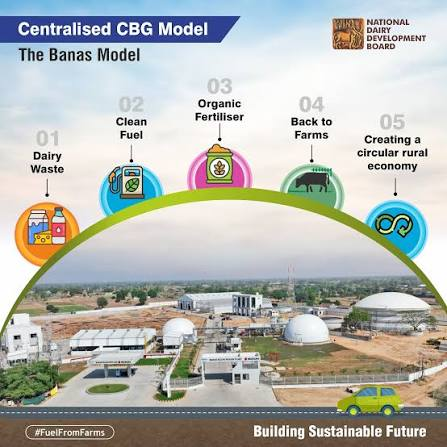
The plants also process residual slurry into solid and liquid organic fertilisers marketed under the ‘Bhumi Amrut’ brand. These products are supplied to farmers through local dairy societies, enabling nutrients recovered from livestock waste to be returned to agricultural soils.
The initiative also aims to reduce methane emissions associated with the unmanaged decomposition of cattle dung by capturing biogas and converting it into usable fuel.
By connecting dung procurement, renewable energy production and organic fertiliser distribution, the model creates potential benefits across the dairy and agricultural value chains. These include supplementary income for livestock rearers, alternative transport fuel, agricultural inputs, improved waste management and local employment opportunities.
Banas Dairy has also reportedly declined an offer to export cattle dung to Dubai, choosing instead to utilise the resource for domestic bioenergy production.
India-Japan cooperation to expand biogas infrastructure
The Banaskantha initiative is linked to a wider India-Japan cooperative effort to expand biogas infrastructure. The Japan-India Co-operative Biogas Initiative aims to establish 1,000 biogas plants across India, building on the experience of projects such as Banas Dairy’s cattle-dung-to-energy model.
The proposed expansion highlights the potential of dairy cooperatives to integrate renewable energy and waste management into established livestock value chains.
For Banas Dairy, scaling up the network could help monetise an underutilised livestock resource while diversifying income opportunities for cattle-rearing households.
Join Our “Dairy & Food Jobs Updates” WhatsApp group
Follow the Agri Jobs Updates channel on WhatsApp:
Disclaimer
I do my best to share reliable and well-researched insights but occasional errors or omissions may slip through. Please view all content as informational.
Stay informed on all the latest news updates
All Agriculture Books Free Download
All Dairy Technology Books Free Download
All Agricultural Engineering Books Free download
All Horticulture Books Free Download
All Fisheries Science Books Free Download
For Daily Update follow us at:
Facebook Telegram Whatsapp Instagram YouTube
The contents are provided free for noncommercial purpose such as teaching, training, research, extension and self learning.
If you are facing any Problem than fill form Contact Us
If you want share any article related Agriculture with us than send at info@agrimoon.com with your contact detail.