
New Delhi, December 28, 2025 — India’s dairy sector is undergoing a significant structural shift—moving from a purely volume-driven system toward a technology-led, innovation-oriented industry. Yet despite clear advances and growing government support, the uptake of modern dairy technology remains uneven, particularly among farmers in remote areas.
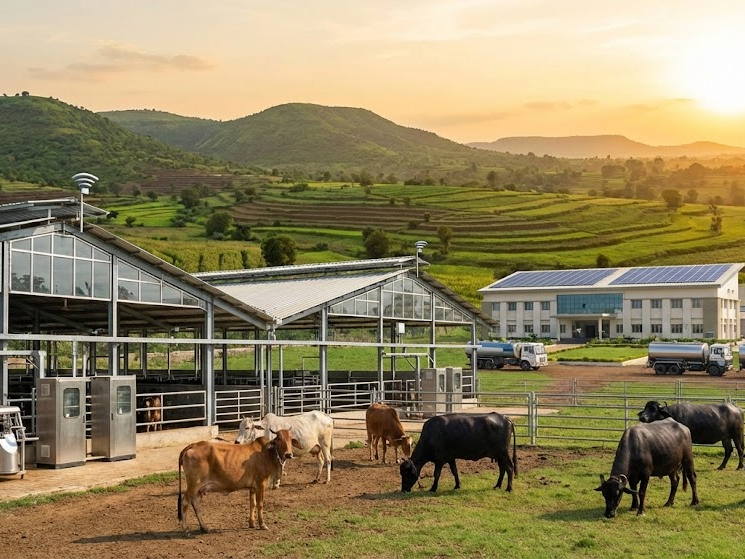
As the world’s largest milk producer, India contributes nearly a quarter of global milk supply. The sector has been shaped by iconic movements such as Operation Flood and the ongoing White Revolution 2.0, which have collectively bolstered rural incomes, enhanced food security, and built India’s dairy export potential.
According to the Department of Animal Husbandry and Dairying, milk production surged 63.56% from 146.30 million tonnes in 2014–15 to 239.30 million tonnes in 2023–24, indicating the sector’s rapid expansion. The dairy industry also accounts for roughly 5% of the national economy and directly employs more than 8 crore farmers, most of whom are marginal producers—including a significant share of women.
Government Push for Modernisation
To accelerate dairy technology adoption and strengthen infrastructure, the Union Cabinet in March 2025 approved the Revised National Program for Dairy Development (NPDD). The scheme’s budget was increased by Rs 1,000 crore, bringing the total allocation to Rs 2,790 crore for the 15th Finance Commission cycle (2021–22 to 2025–26).
The NPDD aims to:
- Modernise milk procurement systems
- Expand processing capacity
- Strengthen quality control
- Support technology adoption at grassroots levels
The programme has already yielded measurable socio-economic impact:
- Over 18.74 lakh dairy farmers benefited
- Creation of 30,000+ direct and indirect jobs
- Increase in milk procurement capacity by 100.95 lakh litres per day
Technology Deployment on the Ground
NPDD’s technology focus includes tools for quality assurance, bulk handling, and diagnostics:
- 51,777 village-level milk testing laboratories strengthened
- 5,123 bulk milk coolers installed with a combined capacity of 123.33 lakh litres
- 169 laboratories upgraded with Fourier Transform Infrared (FTIR) milk analysers
- 232 dairy processing plants equipped with advanced adulteration detection systems
These technologies are designed to improve milk quality, reduce spoilage, and enhance traceability throughout the value chain.
Read More: Protein Trend Fuels Explosion in Dairy Case Sales
Uptake Challenges Remain
Despite concrete progress, the uptake of advanced dairy technologies is still lagging in many regions, especially in remote and rural pockets. Analysts and industry stakeholders highlight key barriers:
1. High Cost of Technology
Modern dairy equipment and digital tools require capital investment beyond the reach of small and marginal farmers, limiting adoption without continued subsidy support.
2. Limited Awareness and Training
Farmers often lack access to technical training and hands-on experience with new systems, creating hesitation to invest in unfamiliar tools.
3. Infrastructure Gaps
Basic infrastructure such as reliable electricity, cold chain logistics, and digital connectivity remains inconsistent across many rural areas, further slowing technology diffusion.
4. Scale of Cooperatives
Smaller cooperatives and producer organisations sometimes lack the scale, managerial capacity, and financing to integrate advanced dairy technology.
Looking Ahead: A Technology-Led Future?
Government initiatives like the NPDD, coupled with cooperative-led modernization, signal a strong policy commitment to transform India’s dairy sector into a 21st-century industry. Experts say the challenge now lies in ensuring that technologies reach the farmgate and benefit the broadest base of producers possible.
For India’s dairy sector—already a global leader—technology adoption could be the key to higher efficiency, better quality, and sustainable growth in the coming decade. But realisation of that potential will depend on continued public investment, targeted training, and partnership with the private sector to ensure equitable technology penetration across all regions.
Join Our “Dairy & Food Jobs Updates” WhatsApp group
Disclaimer
I do my best to share reliable and well-researched insights but occasional errors or omissions may slip through. Please view all content as informational.
Stay informed on all the latest news updates
All Agriculture Books Free Download
All Dairy Technology Books Free Download
All Agricultural Engineering Books Free download
All Horticulture Books Free Download
All Fisheries Science Books Free Download
For Daily Update follow us at:
Facebook Telegram Whatsapp Instagram YouTube
The contents are provided free for noncommercial purpose such as teaching, training, research, extension and self learning.
If you are facing any Problem than fill form Contact Us
If you want share any article related Agriculture with us than send at info@agrimoon.com with your contact detail.