
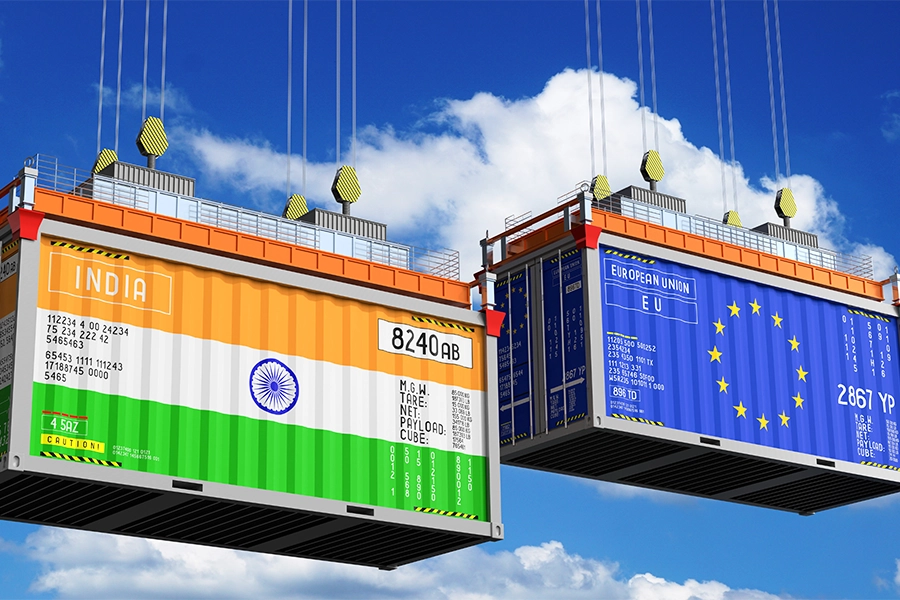
The long-awaited EU–India Free Trade Agreement (FTA) is moving toward approval in Brussels and New Delhi, with the potential to significantly alter trade flows across food and beverage (F&B) industries. If ratified, the deal would reduce or remove high tariffs that have long constrained market access on both sides—unlocking opportunities, while reviving old anxieties.
What Changes on Tariffs?
The EU says India’s current tariffs—often above 36% on European food products—are “prohibitive.” The FTA tackles this head-on:
- Wine: Tariffs cut from 150% → 75%, eventually falling to 20–30% depending on price band
- Spirits: Reduced by half initially, with a glide path to 40%
- Olive oil: 45% → 0% over five years
- Processed foods (bread, confectionery): Tariffs up to 50% eliminated
Result: European products become price-competitive in India, while Indian exporters gain smoother entry into the EU.
Winners: Indian Exporters & EU Premium Brands
Indian F&B producers—especially in spices, tea, processed foods, and specialty products—are optimistic. Easier EU access, combined with demand for organic, sustainable, and plant-based foods, could accelerate exports.
For Europe, wine and spirits producers are clearly celebrating.
- SpiritsEurope calls the deal a “game-changer,” noting India is the world’s second-largest spirits market by volume.
- EU spirits exports to India have already grown sixfold in a decade, despite sky-high tariffs.
- A new EU–India Working Group on Wine & Spirits aims to smooth regulatory friction.
Meanwhile, the European wine industry sees India’s expanding middle class as a strategic hedge against geopolitical trade shocks elsewhere.
Dairy: Excluded, but Not Ignored
Officially, dairy, sugar, beef, chicken, rice, and other “sensitive” sectors are excluded from tariff liberalization. Unofficially, the anxiety remains.
- Processed foods and dairy-based ingredients (e.g., milk powders) may still benefit from lower tariffs
- European producers fear incremental competition via indirect channels
- India remains cautious: dairy supports ~80 million smallholder farmers, making liberalization politically radioactive
Bottom line: No immediate disruption—but long-term uncertainty looms.
Standards, Safety & Regulation
The FTA pushes toward harmonized food safety and labeling standards, which could reduce red tape. However, EU regulatory requirements remain far stricter, meaning Indian exporters must invest in compliance—especially in hygiene, traceability, and quality systems.
Read More: Beef, Components and $11 Billion in New Plants Are Redefining the Milk Check
Animal Welfare: A Flashpoint
Animal-welfare groups are sounding alarms, warning that imports produced under non-EU-compliant systems—such as battery cages and high-density farming—could undercut European farmers and values.
Campaigners argue the deal risks a “race to the bottom” unless welfare safeguards are embedded, particularly as the EU moves toward stricter animal-welfare legislation, including a ban on cages.
What’s Next?
The agreement now heads to:
- European Council & Parliament
- India’s Cabinet
Approval would mark a major milestone—politically and economically. But as with the EU-Mercosur deal, unity is far from guaranteed.
The Takeaway
This FTA is less about tariffs alone and more about strategic alignment.
- For wine and spirits, it’s a clear win.
- For Indian exporters, it’s an opening to premium global markets.
- For dairy and animal welfare, it’s a reminder that trade liberalization always comes with trade-offs.
Join Our “Dairy & Food Jobs Updates” WhatsApp group
Disclaimer
I do my best to share reliable and well-researched insights but occasional errors or omissions may slip through. Please view all content as informational.
Stay informed on all the latest news updates
All Agriculture Books Free Download
All Dairy Technology Books Free Download
All Agricultural Engineering Books Free download
All Horticulture Books Free Download
All Fisheries Science Books Free Download
For Daily Update follow us at:
Facebook Telegram Whatsapp Instagram YouTube
The contents are provided free for noncommercial purpose such as teaching, training, research, extension and self learning.
If you are facing any Problem than fill form Contact Us
If you want share any article related Agriculture with us than send at info@agrimoon.com with your contact detail.