

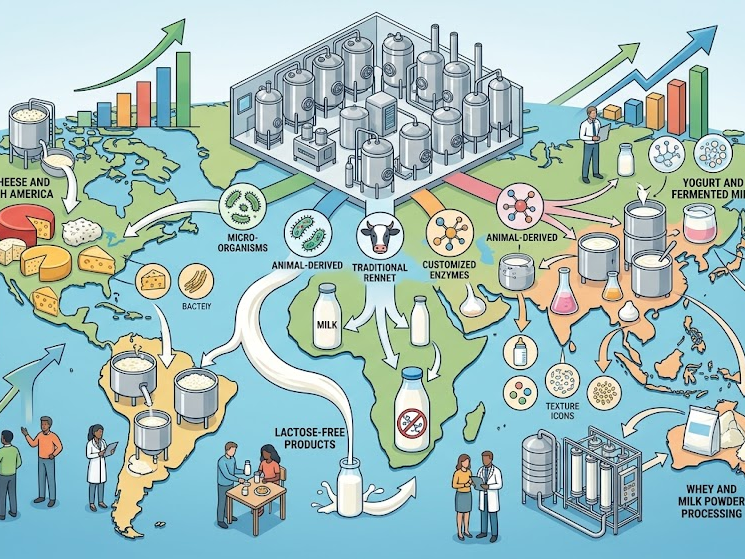
The global dairy enzymes market is poised for steady expansion, projected to grow at a CAGR of 6.54% from 2026 to 2034, reaching approximately $1.31 billion by 2034, up from $745.89 million in 2025. The growth reflects rising demand for efficiency, health-focused dairy products, and clean-label processing solutions.
What’s Driving the Market
At its core, the market revolves around key enzyme types:
- Lactase – for lactose-free dairy (huge demand driver)
- Proteases & rennet – for cheese coagulation
- Lipases – for flavor development
These enzymes are increasingly sourced from microbial and plant origins, replacing traditional animal-based sources due to scalability and sustainability advantages.
Growth Drivers
Several strong forces are accelerating the market:
- Health Awareness: Rising lactose intolerance is boosting demand for lactose-free milk and products
- Efficiency Gains: Enzymes reduce processing time (e.g., faster cheese ripening)
- Clean-Label Trend: Natural biocatalysts replacing chemical additives
- Sustainability Push: Microbial enzymes reduce reliance on animal-derived inputs
In simple terms: enzymes are making dairy faster, cleaner, and more consumer-friendly.
High-Growth Opportunities
The next wave of growth is expected from:
- Functional yogurts and gut-health products
- Vegan/vegetarian-friendly cheese using microbial rennet
- Precision biotechnology for customized textures and flavors
- Fortified and specialty dairy products
Market Trends to Watch
The industry is evolving rapidly with innovation at the center:
- Precision Fermentation: Custom-designed enzymes for specific dairy outcomes
- Liquid Enzyme Formats: Easier integration in automated dairy plants
- Functional Blends: Combining enzymes with probiotics
- Plant-Based Enzymes: Supporting organic and sustainable product lines
Regional Insights
- Europe: Dominates due to strong cheese production and strict quality standards
- North America: Innovation hub for lactose-free and functional dairy
- Asia-Pacific: Fastest-growing region driven by rising consumption and modernization
- Latin America & MEA: Emerging markets with export-driven dairy growth
Industry Players
Major companies shaping the market include:
- Novozymes A/S
- Chr. Hansen Holding A/S
- DSM Food Specialties B.V.
- Kerry Group
- Advanced Enzyme Technologies
These firms are investing heavily in R&D, heat-stable enzymes, and sustainable biotech solutions.
Read More: Jibal Enters Morocco’s Growing Kéfir Market with Premium Launch
Recent Developments
- Launch of new lactase enzymes for ultra-pasteurized milk
- Approval of microbial rennet for vegetarian cheese production
- Strategic partnerships in sustainable fermentation technology
- Innovations reducing cheese ripening time—especially beneficial for small producers
Future Outlook
The dairy enzymes market is heading toward a “precision dairy” era, where:
- Processing becomes faster and more efficient
- Products are tailored to individual health needs
- Waste is minimized
- Sustainability becomes standard, not optional
The bottom line?
Enzymes are quietly becoming the brains behind modern dairy—turning a traditional industry into a high-tech, customizable food system.
Join Our “Dairy & Food Jobs Updates” WhatsApp group
Follow the Agri Jobs Updates channel on WhatsApp:
Disclaimer
I do my best to share reliable and well-researched insights but occasional errors or omissions may slip through. Please view all content as informational.
Stay informed on all the latest news updates
All Agriculture Books Free Download
All Dairy Technology Books Free Download
All Agricultural Engineering Books Free download
All Horticulture Books Free Download
All Fisheries Science Books Free Download
For Daily Update follow us at:
Facebook Telegram Whatsapp Instagram YouTube
The contents are provided free for noncommercial purpose such as teaching, training, research, extension and self learning.
If you are facing any Problem than fill form Contact Us
If you want share any article related Agriculture with us than send at info@agrimoon.com with your contact detail.