

The India–New Zealand Free Trade Agreement (FTA) has emerged as a landmark deal for Wellington, opening up around 95% of New Zealand’s exports to the world’s fastest-growing major economy, while simultaneously underscoring the continued protection around India’s dairy sector.
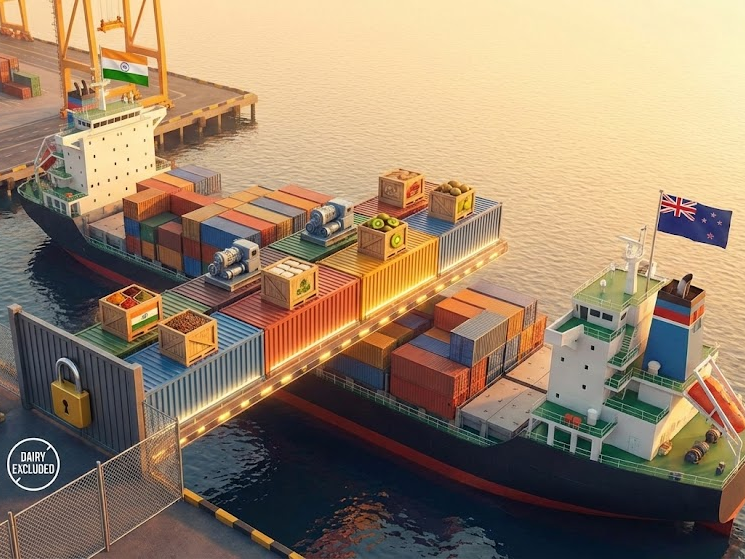
Formally approved by India’s Cabinet in late December 2025, the agreement was hailed by New Zealand Prime Minister Christopher Luxon as a milestone in strengthening the country’s long-term economic position. The pact grants duty-free or reduced-tariff access for a vast majority of New Zealand’s current exports, making it one of the most comprehensive trade frameworks New Zealand has secured in recent years.
New Zealand officials have pointed to the pace of negotiations—concluded in just nine months—as evidence of strong political alignment between the two countries. Once implemented, nearly 57% of New Zealand’s exports to India are expected to become duty-free in the initial phase of the agreement.
Horticulture is among the biggest beneficiaries. Apples will see tariffs halved within commercially meaningful quotas, while kiwifruit will gain duty-free access under a quota-based arrangement. Premium products such as Manuka honey will also benefit, with tariffs set to decline from 66% to 16.5% over five years—an unprecedented concession in the context of India’s previous trade agreements.
Despite these gains, the agreement has triggered debate in New Zealand due to the continued exclusion of core dairy products, including milk, cheese and butter. The omission has drawn criticism from sections of the political establishment and the wider Oceanian dairy industry.
New Zealand First leader Winston Peters has described the pact as “neither free nor fair,” arguing that it prioritises speed over substance and fails to deliver meaningful access for New Zealand’s NZ$24 billion dairy industry. He has also criticised provisions related to immigration and labour mobility, particularly a framework allowing up to 1,667 skilled work visas annually for roles on New Zealand’s Green List, warning that such clauses could limit future policy flexibility.
Despite opposition, the agreement is expected to pass Parliament with the backing of Labour and ACT, reflecting a broader consensus that deeper engagement with India is strategically necessary. Labour’s trade spokesperson Damien O’Connor acknowledged the agreement’s shortcomings but described it as a pragmatic step amid global trade uncertainty, noting that the deal includes review mechanisms that allow for future expansion.
From India’s perspective, the FTA is positioned as a gateway to deeper cooperation beyond goods trade, covering services, education, technology and investment. Bilateral trade in goods and services currently stands at about US$3.14 billion, with both governments expressing confidence that this figure can grow substantially. India has indicated ambitions to attract up to US$20 billion in private investment over the next 15 years through closer economic ties.
For the dairy sector, a key provision is the inclusion of a review clause one year after the agreement enters into force. Under this mechanism, India has committed to consult New Zealand if it offers improved dairy access to other comparable trading partners in the future. While this stops short of immediate market entry, it keeps dairy formally within the scope of future negotiations.
Read More: Bhuvaneswari Honoured with Outstanding Dairy Professional Award at SDFC 2026
The agreement also formalises rights for Indian students in New Zealand and provides for the establishment of a New Zealand Investment Desk in India, signalling long-term engagement beyond tariffs. India’s High Commissioner to New Zealand, Neeta Bhushan, has described the pact as an inflection point that could unlock untapped potential as India’s economy moves toward an estimated US$12 trillion by 2030.
Industry leaders have highlighted the role of the Indian diaspora as critical to translating the agreement into tangible outcomes. Edwin Paul, Chairman of the India New Zealand Business Council, has noted that people-to-people connections will be central to converting market access into commercial success.
For Australia and the wider Oceanian region, the India–New Zealand FTA sends a clear message: India is prepared to liberalise selectively, but dairy remains one of its most politically sensitive and protected sectors. As a result, the agreement is being closely watched as a benchmark for future Indo-Pacific trade negotiations involving agriculture.
Join Our “Dairy & Food Jobs Updates” WhatsApp group
Disclaimer
I do my best to share reliable and well-researched insights but occasional errors or omissions may slip through. Please view all content as informational.
Stay informed on all the latest news updates
All Agriculture Books Free Download
All Dairy Technology Books Free Download
All Agricultural Engineering Books Free download
All Horticulture Books Free Download
All Fisheries Science Books Free Download
For Daily Update follow us at:
Facebook Telegram Whatsapp Instagram YouTube
The contents are provided free for noncommercial purpose such as teaching, training, research, extension and self learning.
If you are facing any Problem than fill form Contact Us
If you want share any article related Agriculture with us than send at info@agrimoon.com with your contact detail.