WASHINGTON: The U.S. dairy industry is entering one of its biggest investment cycles in decades, with dairy processors announcing approximately $13 billion in new, expanded and modernised processing capacity across 19 states.
The investment is expected to provide the industry with capacity to process an additional 15 billion pounds of milk by 2030, equivalent to more than 1.7 billion gallons. The scale of the investment reflects growing confidence in both domestic dairy consumption and long-term international demand for U.S. dairy products and ingredients.
Michael Dykes, president and CEO of the International Dairy Foods Association (IDFA), said the investment demonstrates processors’ confidence in the industry’s long-term outlook.
New York, Texas and Wisconsin lead investment
The investment is concentrated in major dairy-processing and milk-production regions.
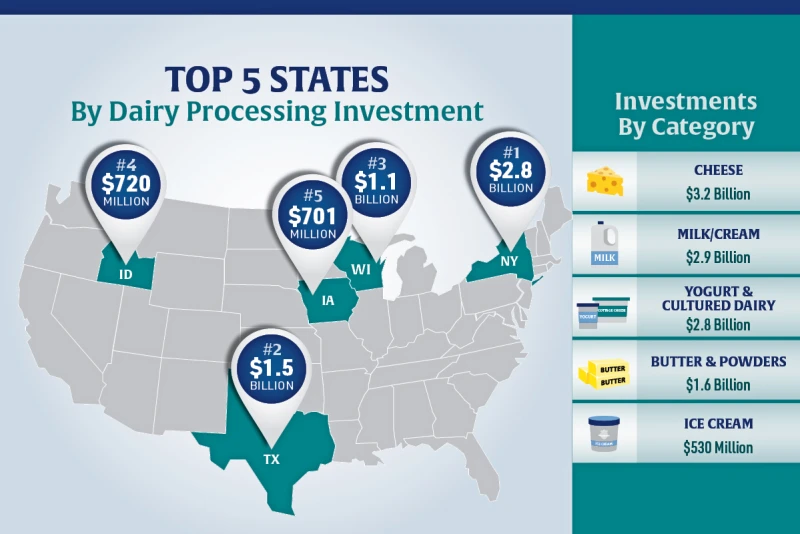
| State | Announced investment |
|---|---|
| New York | $2.8 billion |
| Texas | $1.5 billion |
| Wisconsin | $1.1 billion |
| Idaho | $720 million |
| Iowa | $701 million |
By product category, cheese attracts the largest share at approximately $3.2 billion, followed by milk and cream ($2.9 billion) and yogurt and cultured dairy ($2.8 billion).
Investments in butter and powders account for around $1.6 billion, while approximately $530 million is being directed towards ice-cream capacity.
Protein trend reshapes dairy processing
The investment in yogurt and cultured dairy is particularly significant as consumers increasingly seek convenient sources of protein.
New facilities and expansions are being designed not only for conventional yoghurt but also for products such as Greek yoghurt, skyr, high-protein beverages and other nutrition-focused dairy products.
This mirrors a wider transformation in the dairy industry: processors are increasingly moving from commodity products towards value-added, functional and protein-rich dairy formats.
Cheese remains another major growth area. U.S. per-capita cheese consumption has approximately doubled over the past five decades, while international demand is creating another outlet for rising production.
Exports become essential to absorb additional milk
The industry’s challenge is straightforward: 15 billion additional pounds of milk will need additional demand.
Domestic consumption alone is unlikely to absorb the entire increase, making exports increasingly important to U.S. dairy economics.
Also Read: Himachal Pradesh Bans Sale of Synthetic Paneer as Genuine Dairy Paneer
Will Loux, senior vice president of global economic affairs at the U.S. Dairy Export Council and National Milk Producers Federation, said exports are expected to become a critical growth engine for U.S. dairy producers towards the end of the decade.
Recent market data underline that shift. More than 60% of the additional cheese produced over the past two years has reportedly entered international markets.
USDA projections indicate that exports on a skim-solids basis could rise from 21.5% of U.S. milk production in 2027 to 25.2% by 2035.
That would make international markets an increasingly important component of the U.S. dairy supply-demand balance and, consequently, producer returns.
Latin America and Southeast Asia emerge as key markets
The U.S. dairy industry’s export strategy is expected to focus on a broad range of markets rather than a single destination.
Latin America and Southeast Asia are identified as important volume-growth regions, supported by population growth, urbanisation, rising incomes and increasing demand for protein-rich foods.
Other markets, including South Korea, Japan, Saudi Arabia, the UAE and Australia, are expected to provide opportunities for higher-value products such as cheese, dairy fats and specialised dairy ingredients.
The Middle East is particularly attractive for imported dairy because markets such as Saudi Arabia and the UAE combine relatively strong purchasing power with constraints on domestic dairy production.
Plants are becoming smarter, not simply bigger
The current investment cycle is also about modernising the way dairy is processed.
Many projects incorporate automation, sustainability technologies and flexible manufacturing systems capable of producing multiple dairy products and ingredients.
This flexibility is strategically important because processors must respond to changing demand across cheese, cultured dairy, milk powders, butterfat and specialised protein ingredients.
For the U.S. dairy industry, the objective is therefore not simply to process more milk, but to convert additional milk into products with stronger domestic and international market value.
A major bet on dairy’s global protein future
The $13 billion investment represents more than an expansion of factory capacity. It signals a strategic bet that global demand for dairy protein, cheese, specialised ingredients and value-added products will continue to grow.
For U.S. farmers, however, processing capacity alone will not guarantee stronger milk prices. The additional milk must ultimately find profitable markets.
That makes export competitiveness, product innovation, trade access and consumer demand critical to the success of this investment wave.
The direction is increasingly clear: America’s dairy industry is preparing not merely to produce more milk, but to build the processing infrastructure needed to turn that milk into higher-value dairy products for consumers at home and around the world.
The Competitive Reality
But the U.S. isn’t alone in eyeing these markets. The European Union, New Zealand, Australia and increasingly South American producers are all competing for the same customers.
So what’s the U.S. competitive position heading into 2030?
“The United States remains incredibly well positioned to succeed in global markets over the next five years,” Loux said. “However, success will not come easily. Other suppliers are unlikely to willingly cede market share.”
The U.S. has several distinct advantages that position it for export success:
- Resilient and growing milk production: While other major exporters face production constraints, the U.S. is positioned to grow.
- Significant investment in state-of-the-art processing capacity: The $13 billion in processing investments gives the U.S. modern, efficient facilities capable of producing the products global markets demand.
- An unparalleled food safety system: U.S. dairy’s reputation for safety and quality opens doors in premium markets.
- Impressive product innovation increasingly geared towards global customers: U.S. processors are developing products specifically for international tastes and preferences, not just exporting domestic products.
“Winning in global markets will not come easily, but the U.S. has more than enough potential to succeed,” Loux said.
The Domestic Demand Story
While exports grab headlines, domestic consumption remains the foundation of U.S. dairy’s growth story.
Per-capita dairy consumption in the United States hit a record 661 pounds per person in 2023, driven by surging demand for cheese and butter. For the first time since 2009, fluid milk consumption is growing again.
Cottage cheese sales surged approximately 20% in the year leading up to June 2025, according to Circana. It’s not nostalgia driving those sales — it’s high-protein nutrition meeting social media influence meeting consumer demand for wholesome, recognizable foods.
“Consumer demand for high-protein, wholesome foods has led to surging sales for dairy foods, including yogurt, shakes and smoothies, cottage cheese, milk products, whey protein powder and more,” Dykes said.
This domestic demand provides a stable base that reduces reliance on potentially volatile export markets. And it’s driving processor investment in high-protein, value-added products that command premium prices.
Join Our “Dairy & Food Jobs Updates” WhatsApp group
Follow the Agri Jobs Updates channel on WhatsApp:
Disclaimer
I do my best to share reliable and well-researched insights but occasional errors or omissions may slip through. Please view all content as informational.
Stay informed on all the latest news updates
All Agriculture Books Free Download
All Dairy Technology Books Free Download
All Agricultural Engineering Books Free download
All Horticulture Books Free Download
All Fisheries Science Books Free Download
For Daily Update follow us at:
Facebook Telegram Whatsapp Instagram YouTube
The contents are provided free for noncommercial purpose such as teaching, training, research, extension and self learning.
If you are facing any Problem than fill form Contact Us
If you want share any article related Agriculture with us than send at info@agrimoon.com with your contact detail.