Higher cattle-feed costs, expensive fuel and packaging, and increased milk procurement prices are putting pressure on dairy companies and consumers.
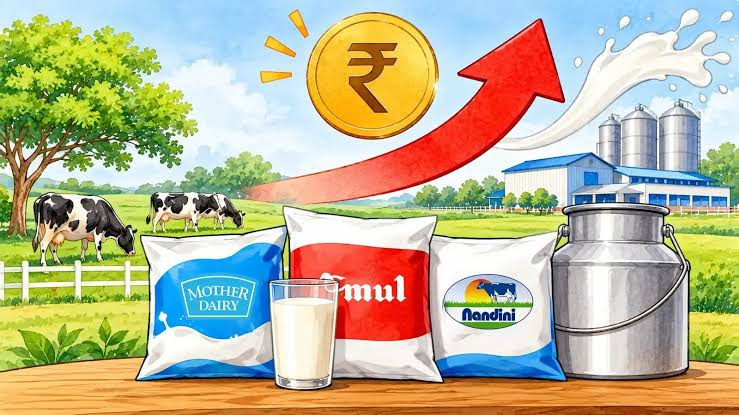
NEW DELHI: Milk prices are rising across several Indian markets, with major dairy brands and cooperative federations revising retail rates amid increasing production, procurement and distribution costs.
Amul and Mother Dairy have increased selected milk prices by ₹2–₹4 per litre from November 12, 2026. The revisions mark their second milk-price increase during the 2026–27 financial year. The changes follow Karnataka Milk Federation’s (KMF) decision to increase Nandini milk prices by ₹8 per litre from November 1.
The trend extends beyond these three brands. Dairy cooperatives and private companies, including Gokul in Maharashtra, Aavin in Tamil Nadu, Milma in Kerala, Jaipur Dairy’s Saras brand, Dodla Dairy and Heritage Foods, have also implemented retail price revisions in selected markets during 2026.
The increases come at the beginning of the traditional dairy flush season, when cooler temperatures, post-monsoon fodder availability and seasonal calving patterns can support higher milk production. However, seasonal production trends do not necessarily offset rising costs across the dairy supply chain.
Milk price revisions across India in 2026
Several dairy companies have revised prices during the year, although the scale and timing of increases differ by state, product and brand.
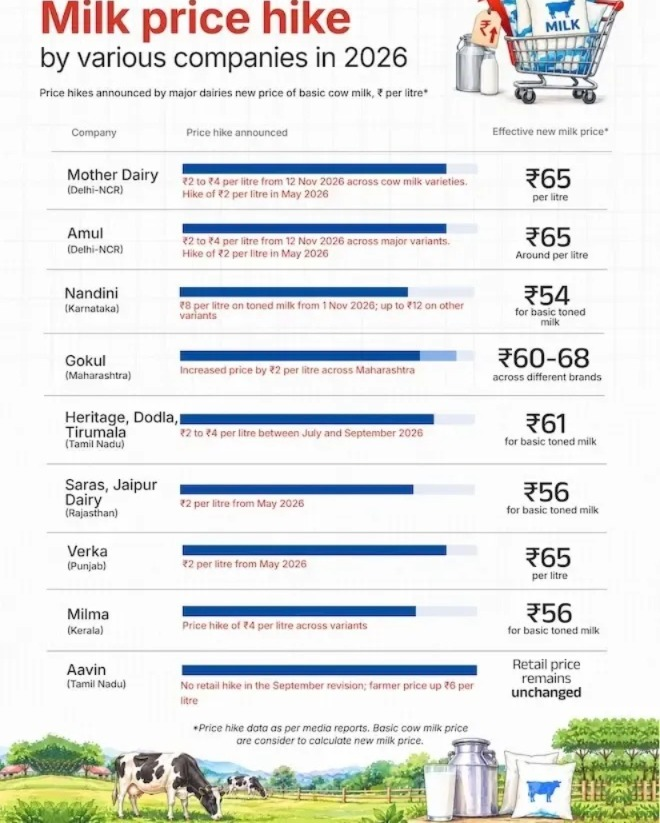
- Amul: Increased selected fresh pouch milk prices by ₹2–₹4 per litre from November 12.
- Mother Dairy: Revised selected liquid milk prices by ₹2–₹4 per litre in Delhi-NCR from November 12.
- Nandini: Increased milk prices by ₹8 per litre from November 1, with ₹7 of the increase reportedly allocated towards farmers.
- Gokul, Aavin, Milma and Saras: Implemented price revisions across selected products or markets during 2026.
- Private dairy companies: Dodla, Heritage and other brands have also adjusted prices in response to higher input costs.
These revisions reflect cost pressures affecting both cooperative and private dairy businesses, although their procurement models and pricing structures vary.
Why are milk prices increasing?
Milk price revisions are rarely driven by a single factor. The latest increases reflect the combined impact of higher cattle-feed expenses, fodder costs, fuel, packaging materials and procurement prices paid to farmers.
1. Rising cattle-feed and fodder costs
Feed and fodder are among the largest components of milk production costs. According to the National Dairy Development Board (NDDB), they account for approximately 70–75% of the cost of milk production.
Cattle-feed prices have reportedly increased significantly. According to cattle traders cited in the supplied report, feed costs in September 2026 were approximately 15–20% higher than in September 2025.
Wholesale price data compiled by IndiaInflation indicated that, in September 2026, prices of selected cattle-feed ingredients had increased year-on-year:
| Feed ingredient | Reported year-on-year price increase |
|---|---|
| Oilseed cakes, excluding mustard cake | Nearly 40% |
| Soyabean | 32% |
| Rice bran | 21% |
These ingredients are used in animal-feed formulations, and their rising prices increase the cost of maintaining milch animals.
Maize, another important cattle-feed ingredient, has also become more expensive. In early November, maize was reportedly trading at around ₹29–₹30 per kg in major mandis, above the 2026–27 minimum support price of ₹24.10 per kg.
A report from Wayanad, Kerala, also highlighted the pressure on farmers: the price of a 50-kg cattle-feed bag reportedly increased from ₹1,350 to ₹1,650 within two months.
Higher feed costs can affect dairy farmers in two ways. Farmers may reduce feed expenditure, potentially affecting animal productivity, or seek higher milk procurement prices to recover their increased production expenses.
Heritage Foods management also referred to weather-related uncertainty, including El Niño conditions, while discussing the challenges facing milk production. However, the impact of weather conditions varies across regions and should be considered alongside other production factors.
2. Higher diesel, fuel and packaging costs
Milk is highly perishable and requires an organised cold chain. It must be collected from villages, chilled, transported to processing facilities, packaged and distributed to retail outlets within a limited period.
Consequently, increases in fuel and packaging costs can directly affect dairy operating expenses.
The supplied report cites the following cost movements:
- Retail diesel prices in Delhi increased from ₹87.67 to ₹95.20 per litre in May, an increase of approximately 8.6%.
- Bulk diesel prices reportedly increased by around ₹22 per litre in March.
- Fuel and power prices were reported to be 25.85% higher year-on-year in September.
- Low-density polyethylene (LDPE) film, widely used in milk-pouch packaging, recorded an approximately 31% year-on-year increase in September wholesale prices.
These cost increases affect milk collection vehicles, refrigerated transportation, processing plants and packaging operations.
Amul cited higher cattle-feed, fuel and milk-packaging costs when it revised milk prices in May 2026. Dodla Dairy management has also referred to transportation, fuel, packaging and minimum-wage expenses as areas of cost pressure.
3. Higher procurement prices paid to dairy farmers
The increase in milk procurement prices is another major factor behind retail price revisions.
In Karnataka, the government increased the base procurement price paid to farmers from ₹35 to ₹42 per litre, while continuing the existing ₹5-per-litre incentive. The subsequent ₹8-per-litre increase in Nandini’s retail milk price reportedly includes an additional ₹7 allocated towards farmers.
Tamil Nadu also revised the price paid by Aavin for cow milk in September, increasing it from ₹38 to ₹44 per litre, approximately 16%. However, Aavin’s retail milk price was not revised at that time.
In Gujarat, Amul member unions had increased procurement prices by ₹30 per kg of fat by May compared with May 2025 levels. Anand-based Amul Dairy subsequently increased its buffalo milk procurement rate by ₹10 to ₹875 per kg of fat in June. Later reports indicated a further increase to ₹1,000 per kg of fat for the relevant milk category.
Fat-based procurement rates vary according to milk composition and cannot be directly interpreted as a uniform price per litre across all milk supplies.
Cooperative and private dairy companies also operate different farmer-payment models:
- Amul: GCMMF has stated that approximately 80% of consumer revenue is returned to milk producers through its cooperative structure.
- Mother Dairy: The company has stated that approximately 75–80% of its milk sales realisation is passed on to farmers.
- Dodla Dairy: Its management reported that milk procurement costs increased by 15.7%, while realisation increased by 8% in the period discussed.
The difference between procurement-cost growth and selling-price growth can put pressure on dairy companies’ margins, particularly when operating expenses are also rising.
How milk price increases affect the wider dairy value chain
Milk is the primary raw material for several dairy products, including paneer, curd, ghee, butter, cheese, milk powder and other value-added products.
When procurement prices increase, manufacturers face higher raw-material costs across multiple product categories. Companies may respond through product-price revisions, changes in pack sizes, product-mix adjustments or efforts to improve manufacturing efficiency.
Also Read: Nandini’s Price Hikes: Could Milky Mist Strengthen Its Presence in Karnataka?
The impact is not limited to dairy companies. Restaurants, sweet manufacturers, hotels, catering businesses and food-processing units also depend on milk and dairy ingredients.
For households, higher milk prices can increase monthly expenditure, while further price adjustments in value-added products may add to the overall cost of food consumption.
How are listed dairy companies performing?
Rising milk procurement and operating costs are influencing the financial performance of listed dairy companies. While several companies have reported revenue growth, profitability has not increased at the same pace across the sector.
The following figures were provided for Q2 FY27:
| Company | YTD share-price return* | Q2 FY27 revenue | Revenue growth YoY | Q2 FY27 net profit | Net profit growth YoY |
|---|---|---|---|---|---|
| Milky Mist Dairy | +117% | ₹1,092 crore | +41.8% | ₹78 crore | +174% |
| Hatsun Agro Product | +6.7% | ₹2,898 crore | +19.3% | ₹116 crore | +5.6% |
| Parag Milk Foods | +12.9% | ₹1,241 crore | +23.1% | ₹42 crore | -8% |
| Dodla Dairy | -22.9% | ₹1,196 crore | +17.4% | ₹36.5 crore | -44.3% |
| Heritage Foods | -18.4% | ₹1,320 crore | +18.6% | ₹30.8 crore | -39% |
Milky Mist’s share-price return is stated relative to its IPO issue price of ₹140 per share. Other YTD returns require a common reference date and calculation basis for direct comparison.
The figures indicate that revenue growth has not translated into equivalent profit growth for every company.
Milky Mist reported a significant increase in quarterly revenue and net profit. Its management has indicated that product-mix improvements and calibrated pricing could help absorb a 3–5% increase in milk prices while maintaining profitability.
Hatsun Agro Product recorded revenue and profit growth, although profit growth was lower than revenue growth. Parag Milk Foods also reported higher revenue but lower net profit. Dodla Dairy and Heritage Foods experienced year-on-year declines in net profit despite revenue growth.
Differences in procurement costs, product mix, pricing power, operating expenses and business models contribute to the varying financial performance of these companies.
Procurement costs versus selling-price realisation
The widening gap between milk procurement costs and selling-price realisation is an important challenge for dairy businesses.
According to the supplied figures, Dodla Dairy reported a 15.7% year-on-year increase in milk procurement costs, while its realisation increased by 8%. Heritage Foods reportedly experienced an 11% increase in procurement costs, compared with a 6–8% increase in average milk selling prices.
When procurement costs rise faster than selling prices, companies may face pressure on gross margins unless they offset the difference through better product mix, operational efficiencies or other cost-control measures.
What lies ahead for India’s dairy industry?
The latest price revisions highlight the importance of managing production costs while ensuring remunerative returns for dairy farmers.
In the coming months, the direction of milk prices will depend on several factors:
- Feed and fodder availability: Seasonal green-fodder availability and the prices of maize, oil cakes and other feed ingredients will influence farm-level production costs.
- Milk procurement prices: Further increases in farmer payments could create additional pressure on dairy companies’ cost structures.
- Fuel and packaging expenses: Transportation, refrigeration, electricity and packaging costs will remain important components of processing and distribution expenditure.
- Milk production and seasonal supply: Flush-season production may improve milk availability, but its effect on prices will depend on regional supply-demand conditions.
- Consumer demand and pricing strategies: Dairy companies will need to balance cost recovery with affordability, particularly in highly competitive liquid-milk markets.
Conclusion: Rising milk prices reflect pressure across the dairy supply chain
The latest price increases by Amul, Mother Dairy and Nandini reflect broader cost pressures across India’s dairy sector. Higher cattle-feed and fodder prices, rising fuel and packaging expenses, and increased procurement payments to farmers have all contributed to the changing cost structure.
Although the beginning of the flush season can improve milk availability, seasonal production gains do not automatically reduce the cost of producing and processing milk.
For dairy companies, the challenge is to maintain farmer returns, protect operating margins and manage consumer affordability. For farmers, the key concern is whether higher procurement prices adequately compensate for increasing feed and livestock-maintenance expenses.
The future direction of milk prices will therefore depend not only on milk availability, but also on how effectively the industry manages costs across the entire dairy value chain.
Join Our “Dairy & Food Jobs Updates” WhatsApp group
Follow the Agri Jobs Updates channel on WhatsApp:
Disclaimer
I do my best to share reliable and well-researched insights but occasional errors or omissions may slip through. Please view all content as informational.
Stay informed on all the latest news updates
All Agriculture Books Free Download
All Dairy Technology Books Free Download
All Agricultural Engineering Books Free download
All Horticulture Books Free Download
All Fisheries Science Books Free Download
For Daily Update follow us at:
Facebook Telegram Whatsapp Instagram YouTube
The contents are provided free for noncommercial purpose such as teaching, training, research, extension and self learning.
If you are facing any Problem than fill form Contact Us
If you want share any article related Agriculture with us than send at info@agrimoon.com with your contact detail.