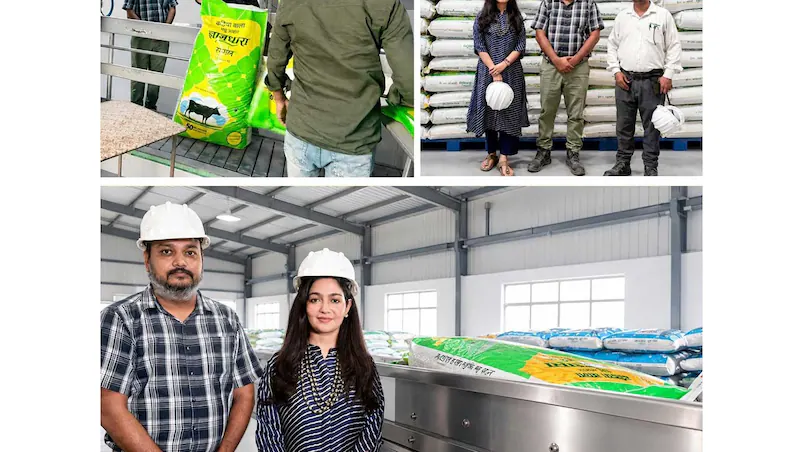
Lucknow : The cattle feed market in North India is witnessing a gradual shift from price-driven purchasing towards a greater focus on animal productivity, feed quality and return on investment, with Uttar Pradesh-based Gyandhara Industries seeking to position itself at the centre of that transition.
Founded in 2017, the cattle feed manufacturer, co-founded and led by Ritu Agarwal, has grown to reported annual revenues of more than ₹425 crore and a combined production capacity of 1,500 tonnes per day across two manufacturing facilities at Sandila and Trishundi in Uttar Pradesh.
The company currently operates across Uttar Pradesh, Bihar, Madhya Pradesh, Assam and Nepal.
Moving beyond the cheapest-feed equation
For years, cattle feed markets in several parts of India have been characterised by high price sensitivity, particularly among small and marginal dairy farmers. Gyandhara’s strategy has been based on a different proposition: farmers may accept a higher feed cost when the additional expenditure translates into measurable improvements in milk yield, animal health and overall farm economics.
“The farmer was not looking for the cheapest solution. He was looking for a solution that worked,” Agarwal said, describing the thinking behind the company’s approach.
Instead of relying primarily on mass advertising, the company has focused on village-level engagement, demonstrations and farmer education. Its strategy has been to encourage farmers to assess changes in milk production and animal performance rather than depend solely on marketing claims.
Nutrition becomes a productivity investment
The shift is significant for India’s dairy sector, where feed and fodder constitute a major component of milk production costs.
Gyandhara has developed feed formulations for different categories of dairy animals and invested in laboratory facilities and quality-control systems. The company says it follows BIS certification standards and maintains quality controls covering raw material procurement and finished-feed production.
The broader industry trend is towards treating cattle feed not simply as an input cost but as a productivity investment.
Better feed conversion, balanced nutrition and appropriate feeding practices can influence milk yield, milk composition, animal health and reproductive performance. However, the economic benefit ultimately depends on the additional milk income generated relative to the additional feeding cost.
Farmer education becomes part of the business model
Gyandhara has also built farmer outreach programmes around animal nutrition and dairy management.
Through initiatives such as Gyandhara Manthan and the Gyandhara Mitra network, the company says its programmes have reached more than 10 lakh farmers across multiple states. During FY2025-26, it reported that more than 70,000 farmers participated in structured education programmes and village-level interactions.
The emphasis on education reflects a wider challenge in India’s dairy industry: access to feed alone does not guarantee better productivity. Farmers also need guidance on ration balancing, fodder management, mineral supplementation, animal health and feeding practices.
From Uttar Pradesh to wider markets
The company’s expansion has progressed beyond its core Uttar Pradesh market into neighbouring states and Nepal. It identifies districts such as Hardoi, Sitapur and Bahraich among its important markets.
Its growth comes at a time when India’s dairy industry is increasingly focused on raising productivity per animal rather than relying solely on herd expansion to increase milk production.
This creates opportunities for organised cattle-feed manufacturers, particularly those capable of combining consistent feed quality with technical advisory services and reliable distribution.
Scale brings a new set of challenges
The company’s growth also highlights the competitive dynamics of India’s cattle-feed industry. Scaling manufacturing capacity is only one part of the challenge; maintaining consistent raw-material quality, controlling input costs, developing distribution networks and demonstrating measurable farm-level returns remain critical.
For farmers, the central question is ultimately straightforward: does the extra rupee spent on feed generate more than a rupee of additional economic value?
That calculation could increasingly determine the next phase of India’s organised cattle-feed market.
A changing dairy farmer mindset
Gyandhara’s journey illustrates a broader transformation underway in India’s dairy economy.
As dairy farmers become more commercially oriented, decisions around feed are increasingly being evaluated through milk yield, feed efficiency, animal health and profitability, rather than purchase price alone.
For cattle-feed companies, this creates a shift from simply selling bags of feed to becoming partners in dairy productivity.
Gyandhara’s strategy is built around that transition. Its long-term test, however, will be whether the claimed productivity benefits can be consistently demonstrated across farms, geographies and animal categories as the company expands.
Join Our “Dairy & Food Jobs Updates” WhatsApp group
Follow the Agri Jobs Updates channel on WhatsApp:
Disclaimer
I do my best to share reliable and well-researched insights but occasional errors or omissions may slip through. Please view all content as informational.
Stay informed on all the latest news updates
All Agriculture Books Free Download
All Dairy Technology Books Free Download
All Agricultural Engineering Books Free download
All Horticulture Books Free Download
All Fisheries Science Books Free Download
For Daily Update follow us at:
Facebook Telegram Whatsapp Instagram YouTube
The contents are provided free for noncommercial purpose such as teaching, training, research, extension and self learning.
If you are facing any Problem than fill form Contact Us
If you want share any article related Agriculture with us than send at info@agrimoon.com with your contact detail.