
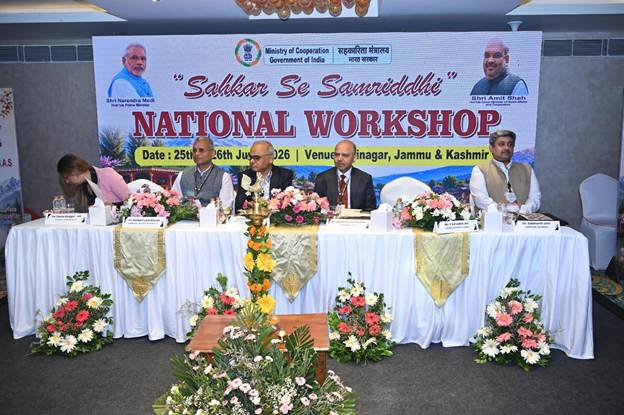
Srinagar, India – The Ministry of Cooperation has called for a decisive shift from expanding the number of cooperatives to improving their quality, governance, and grassroots impact, as policymakers and cooperative leaders gathered at the 8th National Conference on ‘Sahkar se Samriddhi – From Vision to Ground Reality’ in Srinagar.
Addressing the conference, Dr. Ashish Kumar Bhutani, Secretary, Ministry of Cooperation, said India’s cooperative movement has entered a new phase where implementation, professional management, technology adoption, and measurable outcomes must take precedence over policy formulation alone.
“The time has now come to move beyond numbers and focus on quality, accountability, professional management and visible ground-level impact in cooperatives,” Dr. Bhutani said, highlighting the Ministry’s transition from a regulatory role to a development-oriented approach since its establishment.
The conference, held under the vision of Prime Minister Narendra Modi and the leadership of Union Home Minister and Minister of Cooperation Amit Shah, brought together senior officials from States and Union Territories, Registrars of Cooperative Societies, national cooperative federations, financial institutions, and other stakeholders to review progress and define priorities for the next phase of cooperative development.
Digital Transformation a Key Priority
Dr. Bhutani stressed that cooperative banks must modernize their technology infrastructure to remain competitive in an increasingly digital financial ecosystem dominated by Unified Payments Interface (UPI) and digital banking services.
He called for common technology platforms, stronger governance frameworks, improved financial discipline, and enhanced customer services across rural and urban cooperative banks.
The Secretary also announced that the upcoming National Cooperative Database 2.0 will enable cooperatives to directly update and validate their data, strengthening evidence-based policymaking, monitoring, and governance.
Artificial intelligence and digital technologies were identified as central to the future of the cooperative sector, with discussions focusing on moving beyond computerisation towards intelligent, transparent, and responsive governance systems.
Sustainability and Circular Economy in Focus
The Ministry highlighted sustainability as a major growth opportunity for cooperatives, particularly in the dairy, compressed biogas (CBG), and sugar sectors.
Dr. Bhutani said cooperatives can play a significant role in converting agricultural and rural waste into renewable energy, organic manure, and other value-added products, creating new revenue streams for members while supporting India’s clean energy transition.
The conference also reviewed progress under the World’s Largest Grain Storage Plan, with States urged to accelerate infrastructure development to reduce post-harvest losses and strengthen farmer access to decentralized storage facilities through cooperatives.
Expanding Grassroots Cooperative Networks
States and Union Territories were encouraged to expedite the formation of new multipurpose Primary Agricultural Credit Societies (PACS), dairy cooperatives, and fishery cooperatives in uncovered Panchayats.
Discussions emphasized strengthening PACS through computerisation, adoption of model bye-laws, business diversification, and professional management to transform them into vibrant rural economic institutions.
National cooperative federations, including NABARD, NDDB, IFFCO, KRIBHCO, NAFED, NCCF, and NCDC, presented strategies for financing, capacity building, market development, and institutional strengthening. They were directed to prepare State-specific implementation plans and closely monitor scheme execution in collaboration with State governments.
State-Led Deliberations Shape Roadmap
A distinguishing feature of the conference was its State-led format, allowing States and UTs to present successful cooperative models, innovations, operational challenges, and best practices.
Special sessions focused on cooperative development in the North Eastern region, highlighting the need for region-specific strategies, improved institutional support, stronger market linkages, and inclusive growth.
The conference also explored strengthening national value chains through emerging cooperative institutions such as the National Cooperative Exports Limited (NCEL), National Cooperative Organics Limited (NCOL), and Bharatiya Beej Sahakari Samiti Limited (BBSSL), with an emphasis on exports, organic products, and quality seeds.
Action Plan for the Next Six Months
The conference concluded with a roadmap outlining actionable priorities and six-month implementation targets for States and Union Territories.
The Ministry expects faster execution of key initiatives covering digital transformation, cooperative infrastructure, business diversification, technology adoption, sustainability, and improved governance to accelerate the vision of ‘Sahkar se Samriddhi’—using the cooperative movement as a driver of rural prosperity, inclusive growth, and sustainable economic development across India.
Join Our “Dairy & Food Jobs Updates” WhatsApp group
Follow the Agri Jobs Updates channel on WhatsApp:
Disclaimer
I do my best to share reliable and well-researched insights but occasional errors or omissions may slip through. Please view all content as informational.
Stay informed on all the latest news updates
All Agriculture Books Free Download
All Dairy Technology Books Free Download
All Agricultural Engineering Books Free download
All Horticulture Books Free Download
All Fisheries Science Books Free Download
For Daily Update follow us at:
Facebook Telegram Whatsapp Instagram YouTube
The contents are provided free for noncommercial purpose such as teaching, training, research, extension and self learning.
If you are facing any Problem than fill form Contact Us
If you want share any article related Agriculture with us than send at info@agrimoon.com with your contact detail.