Industry Consolidation, Digital Farming, and Great Plains Expansion Are Defining the Future of U.S. Milk Production.
The U.S. dairy industry is undergoing one of the most significant transformations in its history. A combination of farm consolidation, technological innovation, and geographic expansion has resulted in an unprecedented concentration of milk production, with just five states now accounting for more than half of the nation’s total milk supply.
At the same time, dairy farms are becoming larger, more technologically advanced, and increasingly focused on efficiency as they respond to rising global demand for dairy protein.
Dairy Production Becomes More Concentrated
According to industry data, California, Wisconsin, Idaho, Texas, and New York now collectively produce over 50 percent of all milk generated in the United States.
This milestone reflects a decades-long structural shift within the industry. Since 2004, the number of licensed dairy farms across the country has declined by approximately 63 percent. Yet despite fewer farms, national milk production has increased by 32 percent during the same period.
The trend highlights a fundamental transformation in dairy farming: fewer producers are managing significantly larger herds and producing more milk than ever before.
Corey Gillins, Chief Milk Marketing Officer at Dairy Farmers of America (DFA), said the industry is experiencing consolidation rather than a decline in dairy production.
“We are not losing dairy cows; we are losing dairy farmers,” Gillins noted. “Those who remain in the industry are positioned to benefit from strong and growing global demand for dairy protein.”
The average herd size among DFA member farms has expanded from approximately 375 cows five years ago to more than 500 cows today.
Meanwhile, DFA’s membership has declined from around 6,500 dairy farmers in 2021 to approximately 4,600 today, a trend expected to continue as smaller operations exit the industry.
Infrastructure Drives Dairy Growth
Industry experts believe that modern dairy growth is increasingly determined by infrastructure rather than geography alone.
Phil Plourd of Ever.Ag and the Wisconsin Dairy Products Association explains that dairy production follows processing capacity.
Regions with strong manufacturing networks, cheese plants, export facilities, and value-added processing capabilities continue to attract milk production and investment.
Wisconsin remains a prime example. The state produces roughly one-quarter of all cheese manufactured in the United States, creating a stable foundation for continued dairy expansion.
“Processing infrastructure supports milk production,” Plourd said. “Where the plants are built, the cows eventually follow.”
The same principle is fueling rapid dairy growth across Texas, Idaho, South Dakota, and other Great Plains states, where billions of dollars are being invested in new dairy processing facilities.
These investments are creating new milk production corridors and shifting the center of gravity of the U.S. dairy industry toward regions with lower production costs, available land, and supportive business environments.
The Economics of Scale
Large dairy farms continue to gain a competitive advantage through economies of scale.
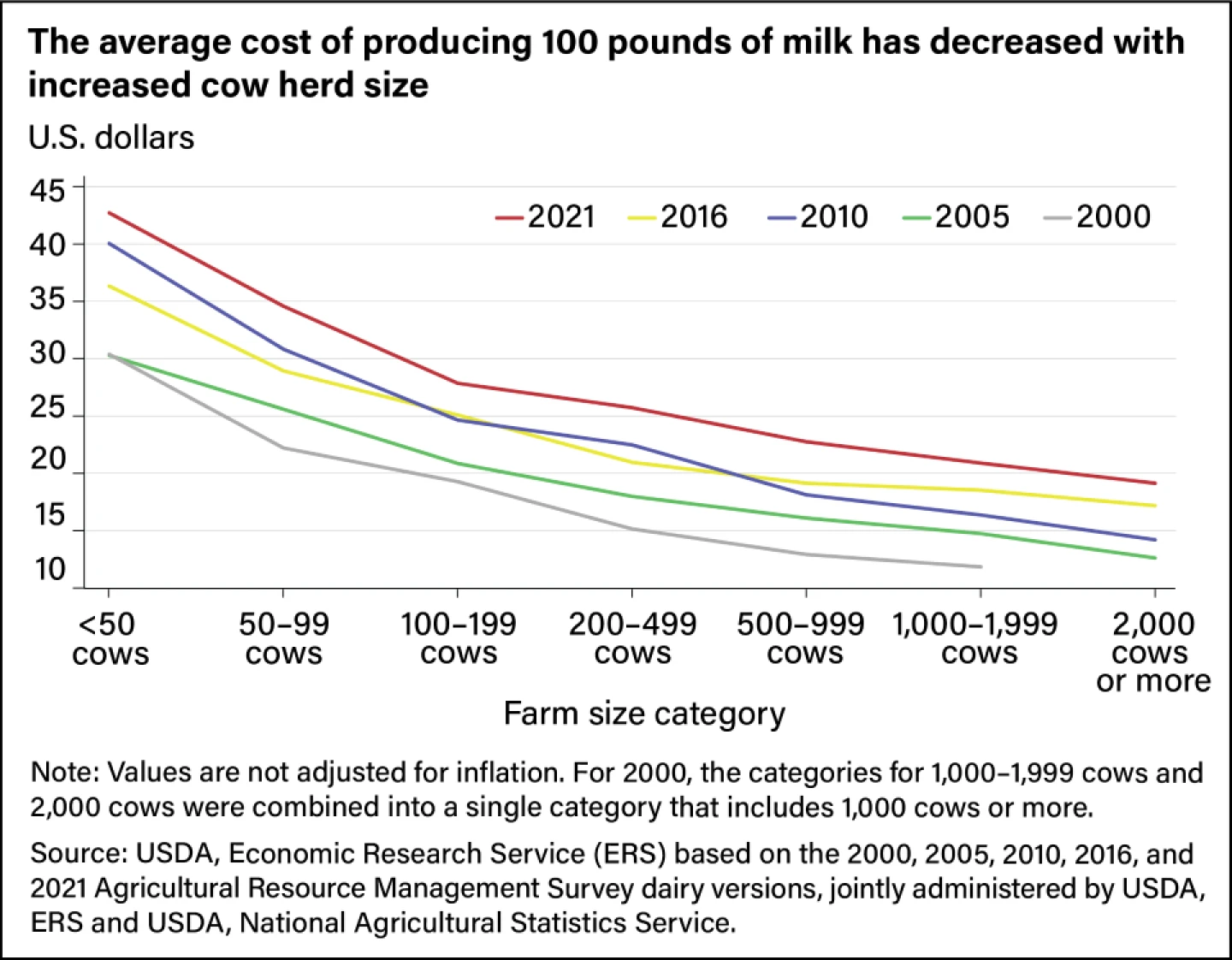
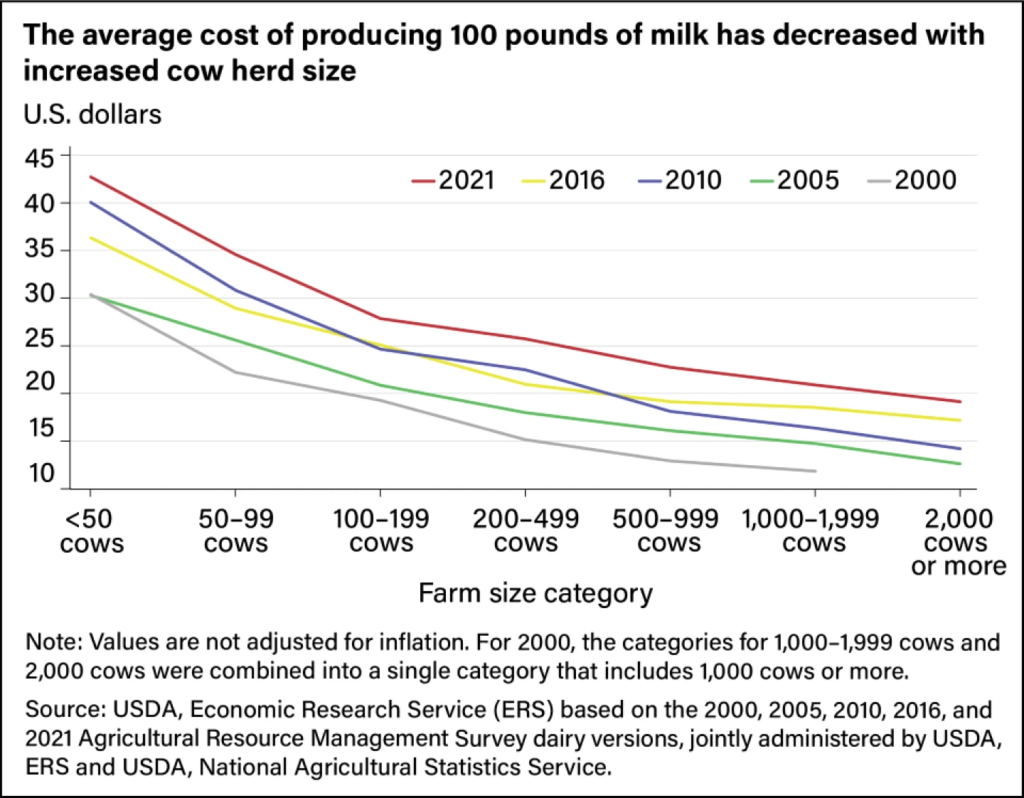
Production cost data illustrates the widening gap between small and large operations. Farms with fewer than 50 cows incur production costs exceeding $42 per hundredweight of milk, while operations with more than 2,000 cows can produce milk for less than half that amount.
This economic reality is encouraging further consolidation, as larger farms are better positioned to absorb market volatility, invest in technology, and achieve higher productivity.
As a result, many family-owned dairies are either expanding significantly or exiting the industry altogether.
Digital Technology Revolutionizing Dairy Farms
While scale is important, technology has become equally critical to dairy success.
Modern dairy farms increasingly operate as data-driven enterprises, utilizing sophisticated digital systems to improve animal health, reproduction, feed efficiency, and milk production.
Read More: FSSAI Issues Notices to Eight Food Companies Over Misleading ‘Healthy’ Claims and Product Labels
At Top Deck Holsteins in Iowa, technology is integrated into nearly every aspect of farm management. The operation utilizes activity-monitoring collars to track cow behavior, advanced herd-management software to analyze performance data, and precision feeding systems that optimize nutrition.
These technologies provide real-time insights into animal health, heat detection, rumination patterns, and production efficiency, allowing farm managers to make faster and more informed decisions.
The results are substantial.
Top Deck Holsteins milks more than 700 cows three times daily and achieves annual production levels exceeding 33,500 pounds of milk per cow, significantly above national averages.
Across the United States, average milk production per cow has increased from approximately 18,960 pounds in 2004 to more than 24,178 pounds today, reflecting dramatic improvements in genetics, nutrition, management, and technology adoption.
Global Demand Fuels Industry Optimism
Despite consolidation and structural changes, industry leaders remain optimistic about the future of dairy.
Growing global demand for dairy proteins, particularly cheese, whey products, milk powders, and specialized nutritional ingredients, continues to create opportunities for U.S. producers.
The United States has emerged as a major supplier of dairy products to international markets, and processors are investing heavily to capture future export growth.
As dairy production becomes increasingly concentrated in a handful of high-performing states, the industry’s future will likely be shaped by three key factors: advanced technology, efficient processing infrastructure, and the ability to produce milk at globally competitive costs.
The modern dairy farm is no longer simply a livestock operation. It has evolved into a sophisticated, technology-enabled food production enterprise—one that is helping position the United States as a leading supplier in the rapidly growing global dairy economy.
Join Our “Dairy & Food Jobs Updates” WhatsApp group
Follow the Agri Jobs Updates channel on WhatsApp:
Disclaimer
I do my best to share reliable and well-researched insights but occasional errors or omissions may slip through. Please view all content as informational.
Stay informed on all the latest news updates
All Agriculture Books Free Download
All Dairy Technology Books Free Download
All Agricultural Engineering Books Free download
All Horticulture Books Free Download
All Fisheries Science Books Free Download
For Daily Update follow us at:
Facebook Telegram Whatsapp Instagram YouTube
The contents are provided free for noncommercial purpose such as teaching, training, research, extension and self learning.
If you are facing any Problem than fill form Contact Us
If you want share any article related Agriculture with us than send at info@agrimoon.com with your contact detail.