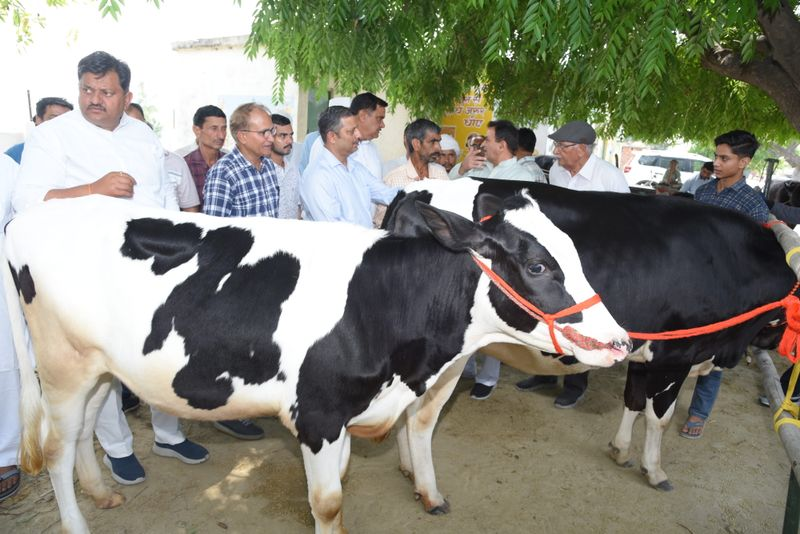
Karnal: Scientists at the ICAR–National Dairy Research Institute (ICAR-NDRI) have successfully demonstrated an artificial intelligence-assisted breed improvement model under the Rashtriya Gokul Mission, offering a scalable approach to enhancing dairy animal productivity and improving livestock farmers’ incomes.
Implemented in 100 villages of Uttar Pradesh’s Muzaffarnagar district, the programme combined scientific breeding, artificial insemination (AI), and superior bovine genetics to produce healthier, faster-growing and higher-yielding dairy animals.
Researchers believe the model has the potential to significantly strengthen India’s dairy sector if replicated across other states.
Scientific Breeding Programme Delivers Encouraging Results
The project was launched in 2022 under the Rashtriya Gokul Mission of the Ministry of Fisheries, Animal Husbandry and Dairying, with technical leadership from ICAR-NDRI.
During the programme, trained technicians carried out artificial insemination on 39,803 cows and buffaloes using high-quality semen from genetically superior breeding bulls maintained by ICAR-NDRI.
According to institute officials, around 16,200 animals conceived, and the majority have already calved, producing improved offspring with superior production potential.
Scientists reported that the new generation of animals is demonstrating faster growth, earlier maturity and improved genetic characteristics compared to existing local livestock.
Better Genetics, Higher Productivity
Researchers say the programme has shown that systematic breed improvement can substantially enhance dairy farm productivity while reducing the cost of obtaining quality breeding stock.
By improving genetic potential through scientific breeding, farmers are expected to benefit from increased milk production, stronger reproductive performance and better economic returns from their dairy enterprises.
Officials believe the programme could help make dairy farming more profitable by producing animals capable of delivering higher lifetime productivity.
100 Villages Covered Through Field-Based Services
The breed improvement initiative was implemented through ICAR-NDRI’s Farmer Service Centre at Lalukheri village in Muzaffarnagar district.
A team of 25 trained artificial insemination technicians provided doorstep breeding services across 100 villages, ensuring that livestock owners could access improved genetics without travelling long distances.
The project involved an investment of approximately ₹3.75 crore, supporting breeding operations, farmer outreach, technical services and awareness programmes.
Farmer Awareness Played a Key Role
According to Dr. Dheer Singh, Director of ICAR-NDRI, educating farmers about the benefits of artificial insemination was a crucial component of the programme’s success.
Scientists and field teams conducted extensive awareness campaigns, visiting livestock owners directly to explain the importance of scientific breeding and genetic improvement.
“The cooperation received from farmers was highly encouraging. As a result, improved calves are now being born in the region, and animals produced through earlier breed improvement programmes are already demonstrating better performance,” Dr. Singh said.
Model Offers Roadmap for Other States
ICAR-NDRI believes the Muzaffarnagar project provides a practical model that state governments can adopt to accelerate genetic improvement programmes.
According to Dr. Singh, expanding similar initiatives across the country could substantially increase milk production, strengthen India’s dairy sector and create new income opportunities for rural households.
“This model can serve as a blueprint for other states. Wider adoption of scientific breeding programmes will help improve livestock productivity, support dairy development and contribute to the growth of the rural economy,” he said.
Supporting India’s Dairy Development Goals
Experts note that genetic improvement remains one of the most effective long-term strategies for increasing milk production without proportionately increasing livestock numbers.
Programmes integrating artificial insemination, superior germplasm, scientific herd management and farmer extension services can improve productivity while enhancing the sustainability of dairy farming.
If implemented at scale, such models could play an important role in supporting India’s dairy development objectives under the Rashtriya Gokul Mission while strengthening the country’s position as the world’s largest milk producer.
Outlook
The successful implementation of the ICAR-NDRI breed improvement programme demonstrates the growing role of science and technology in transforming India’s livestock sector.
With improved genetics, wider adoption of artificial insemination, and stronger farmer outreach, experts believe similar initiatives can enhance milk productivity, improve the quality of dairy animals and increase the profitability of dairy farming across the country.
As India focuses on boosting dairy productivity through innovation, the ICAR-NDRI model offers a promising pathway for building a more productive, competitive and sustainable livestock sector.
Join Our “Dairy & Food Jobs Updates” WhatsApp group
Follow the Agri Jobs Updates channel on WhatsApp:
Disclaimer
I do my best to share reliable and well-researched insights but occasional errors or omissions may slip through. Please view all content as informational.
Stay informed on all the latest news updates
All Agriculture Books Free Download
All Dairy Technology Books Free Download
All Agricultural Engineering Books Free download
All Horticulture Books Free Download
All Fisheries Science Books Free Download
For Daily Update follow us at:
Facebook Telegram Whatsapp Instagram YouTube
The contents are provided free for noncommercial purpose such as teaching, training, research, extension and self learning.
If you are facing any Problem than fill form Contact Us
If you want share any article related Agriculture with us than send at info@agrimoon.com with your contact detail.