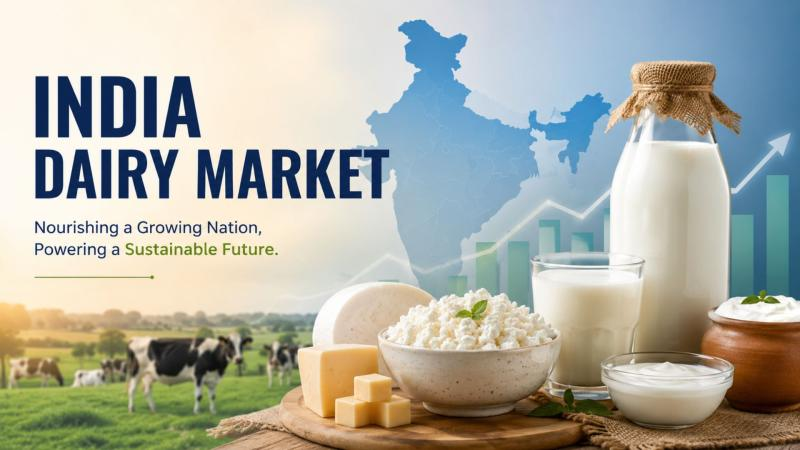
NEW DELHI : India’s dairy market is projected to expand from an estimated US$158.1 billion in 2026 to US$304.2 billion by 2033, registering a compound annual growth rate (CAGR) of 9.8%, according to market estimates from Persistence Market Research.
The projected growth reflects the continuing importance of dairy in Indian diets, alongside rising household incomes, urbanisation, increasing organised retail penetration and growing consumer demand for packaged, convenient and value-added dairy products.
Milk remains the foundation of the market, but categories such as curd, yogurt, paneer, cheese, butter, ghee, flavoured milk, ice cream and dairy-based beverages are increasingly contributing to industry value.
Packaged and Value-Added Dairy Drive Market Transformation
One of the most significant changes underway is the gradual shift from traditional and loose dairy consumption towards branded and packaged products.
Consumers are increasingly placing greater emphasis on hygiene, food safety, consistency, traceability and convenience, supporting demand for organised dairy products.
The expansion of supermarkets, convenience stores, e-commerce, quick-commerce and direct-to-consumer channels is further improving access to processed dairy products, particularly in urban and semi-urban markets.
At the same time, changing lifestyles and rising disposable incomes are encouraging demand for convenient and premium products.
Nutrition Becomes a Stronger Demand Driver
Growing awareness of protein, calcium and other nutritional attributes of dairy is influencing purchasing decisions across consumer segments.
This is creating opportunities for products positioned around specific nutritional and lifestyle needs, including:
- High-protein yogurt and dairy beverages
- Fortified milk
- Probiotic dairy products
- Lactose-free products
- Low-fat dairy
- Premium ghee
- Flavoured milk and dairy beverages
- Specialty and premium cheeses
The trend represents a broader transition from dairy being viewed primarily as a staple food towards dairy increasingly being marketed as a nutrition, wellness and convenience product.
Technology Modernising the Dairy Value Chain
Growth is not limited to consumer demand. India’s dairy supply chain is also undergoing rapid modernisation.
Investment is increasing in milk collection, chilling, processing, packaging, transportation, cold-chain infrastructure and organised distribution.
Automation and advanced processing technologies—including pasteurisation, homogenisation, UHT processing, aseptic processing and spray drying—are helping processors improve product consistency, shelf life and distribution reach.
Digital procurement systems are also enabling more efficient interaction between farmers and dairy companies.
AI and IoT Enter Dairy Operations
Technology is increasingly being integrated into dairy production and distribution.
Artificial intelligence (AI) can support demand forecasting, production planning, procurement analysis and inventory optimisation, while Internet of Things (IoT) systems can monitor temperature, humidity, equipment performance and cold-chain conditions in real time.
Such technologies can help dairy processors identify operational deviations earlier, reduce product losses and improve production efficiency.
Digital milk procurement platforms can also improve transparency in milk testing, quality-based pricing, farmer payments and collection operations.
Regional Markets Present Different Opportunities
North India remains a major dairy-producing and consuming region, supported by its large livestock population, strong milk production base and established dairy networks. Demand for milk, ghee, paneer, curd and other traditional dairy products remains significant.
Western India benefits from strong cooperative structures, established dairy brands, processing infrastructure and developed distribution networks. Urban and industrial centres provide a substantial market for both liquid milk and value-added dairy.
Southern India is expected to remain an important growth market as urbanisation, organised retail and changing dietary preferences encourage consumption of yogurt, cheese, flavoured milk and other processed products.
Eastern and northeastern India offer longer-term opportunities as milk collection, cold-chain infrastructure, organised processing and modern retail networks continue to develop.
Rural and Urban Markets Require Different Strategies
Urban and semi-urban markets are likely to remain particularly attractive for premium and functional dairy products, supported by higher disposable incomes, convenience-oriented lifestyles and increasing health awareness.
Rural markets, meanwhile, remain strategically important because they are both major production centres and large consumer markets.
Also Read: 4,710 Litres of Suspected Adulterated Milk Destroyed in Navi Mumbai FDA Crackdown
For dairy companies, the challenge will be to develop procurement and distribution models that can simultaneously improve farmer participation, maintain product quality and make branded dairy products affordable to a wider consumer base.
Foodservice Creates Another Growth Avenue
India’s expanding organised foodservice and hospitality sectors are also creating demand for standardised dairy ingredients.
Restaurants, cafés, hotels, bakeries, quick-service restaurants and catering businesses require products such as cheese, paneer, butter, cream, milk powders and other dairy ingredients.
As the organised foodservice sector expands, demand for consistent-quality B2B dairy supplies is expected to increase.
Sustainability Moves Up the Industry Agenda
Dairy companies are also facing growing pressure to improve resource efficiency and environmental performance.
Key areas of focus include:
- Water efficiency
- Energy-efficient processing
- Renewable energy
- Sustainable refrigeration
- Packaging waste reduction
- Biogas and waste utilisation
- Responsible sourcing
- Emissions reduction
For processors, sustainability is increasingly being linked with operational efficiency rather than treated solely as a corporate responsibility initiative.
Competitive Landscape
The Indian dairy market includes a combination of cooperatives, private dairy companies and emerging direct-to-consumer brands.
Major players mentioned in the market landscape include GCMMF (Amul), Mother Dairy, Hatsun Agro Product, Heritage Foods, Parag Milk Foods, Dodla Dairy, Milky Mist Dairy Food, Karnataka Milk Federation (Nandini), Gokul, Verka, Country Delight and Akshayakalpa, among others.
Competition is increasingly shifting beyond liquid milk towards value-added dairy, premium products, nutrition-led offerings, convenience formats and digital distribution.
The Next Growth Phase: More Value from Every Litre of Milk
The projected expansion of India’s dairy market highlights an important structural change.
The industry’s growth is increasingly being driven not simply by higher milk consumption, but by greater value extraction from milk through processing, branding, innovation and organised distribution.
For dairy processors, this means opportunities across the entire value chain—from farmer-linked procurement and chilling to processing, packaging, cold-chain distribution and direct consumer sales.
The biggest opportunities are likely to emerge where companies can combine nutrition, affordability, convenience, quality and technology.
Outlook to 2033
If the projected 9.8% CAGR is sustained, India’s dairy market could nearly double in value between 2026 and 2033.
The next phase of development is expected to be shaped by five interconnected forces:
Formalisation + Value Addition + Premiumisation + Technology + Farmer Integration
Companies that strengthen procurement networks, invest in efficient processing, develop differentiated products and build reliable cold-chain and distribution systems will be better positioned to capture the industry’s growth.
For India’s dairy sector, the opportunity is therefore much larger than selling more milk. The bigger opportunity lies in building a more organised, technology-enabled and value-added dairy ecosystem capable of serving both India’s mass market and its rapidly expanding premium consumer base.
Join Our “Dairy & Food Jobs Updates” WhatsApp group
Follow the Agri Jobs Updates channel on WhatsApp:
Disclaimer
I do my best to share reliable and well-researched insights but occasional errors or omissions may slip through. Please view all content as informational.
Stay informed on all the latest news updates
All Agriculture Books Free Download
All Dairy Technology Books Free Download
All Agricultural Engineering Books Free download
All Horticulture Books Free Download
All Fisheries Science Books Free Download
For Daily Update follow us at:
Facebook Telegram Whatsapp Instagram YouTube
The contents are provided free for noncommercial purpose such as teaching, training, research, extension and self learning.
If you are facing any Problem than fill form Contact Us
If you want share any article related Agriculture with us than send at info@agrimoon.com with your contact detail.