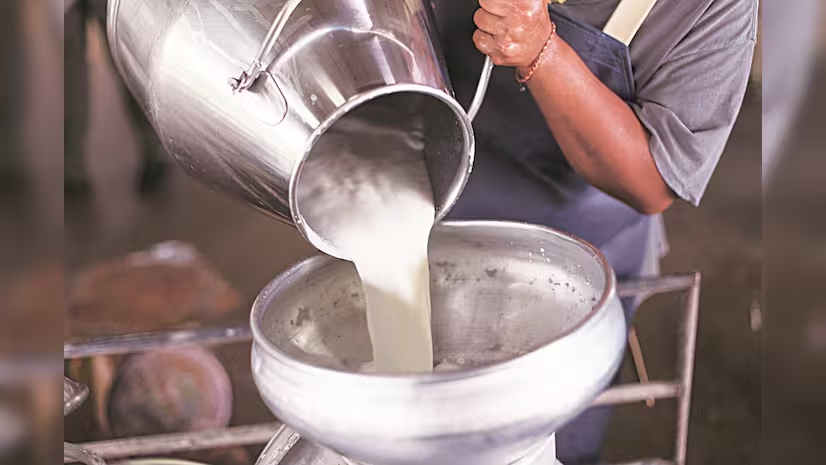
New Delhi | India’s milk production has continued to expand rapidly, but the share of total output being consumed has declined in recent years, pointing to a changing balance between production, consumption, processing and market absorption in the country’s dairy sector.
The trend comes as the government continues to invest in dairy-processing infrastructure. On October 3, Union Home and Cooperation Minister Amit Shah laid the foundation stone for a ₹255-crore dairy plant in Madhya Pradesh, underscoring the emphasis on expanding organised dairy infrastructure.
Milk production continues to climb
India’s milk production increased from around 176 million tonnes in FY2017–18 to 230 million tonnes in FY2022–23.
It is projected to reach approximately 266 million tonnes by FY2026–27, according to the data cited.
The growth reflects the continued expansion of India’s dairy sector, supported by rising productivity, a large livestock base, organised procurement and increasing investment in processing and value-added dairy products.
India currently has more than 800 dairy plants, while a significant share of milk continues to be processed through traditional and informal channels.
Consumption share declines
Despite the increase in total milk production, the proportion of output accounted for by consumption has declined in the data cited.
The share fell from around 90% in FY2017–18 to 87% in FY2022–23 and further to 83% by FY2026–27.
The decline in this ratio should not necessarily be interpreted as a fall in absolute milk consumption. With overall production increasing substantially, consumption can continue to rise even when its share of total production declines.
The trend may instead indicate that a larger proportion of milk is moving into processing, inventory, value-added products and other uses.
Processing remains an important growth area
Dairy-processing plants accounted for approximately 50–53% of India’s milk production during the FY2017–18 to FY2026–27 period, according to the data cited.
The remaining milk continues to move through traditional or less-formal processing and marketing channels.
This highlights the scale of the opportunity for organised dairy companies and cooperatives to expand chilling, processing, packaging, cold-chain infrastructure and value-added dairy categories.
As India’s milk pool expands, greater processing capacity will become increasingly important for converting additional production into products with longer shelf lives and higher value.
Dairy trade surplus loses ground
Higher domestic milk production has not translated into a steadily increasing dairy trade surplus.
India recorded a dairy-product trade surplus of approximately $49 million in FY2017–18, which increased to $152 million in FY2021–22 before declining to around $42 million in FY2025–26.
The contraction in the trade surplus in value terms may partly reflect weaker international dairy prices, rather than a simple deterioration in India’s domestic production capability.
Also Read: Amit Shah slams Congress over dairy development, farmer neglect
The figures also underline the difference between producing more milk and becoming more competitive in international dairy markets. Export performance depends on global prices, product mix, processing efficiency, quality standards, logistics and market access.
Milk inflation remains relatively subdued
Domestically, milk-price inflation has remained relatively subdued since 2024, according to the data cited.
For consumers, this suggests that increased milk availability and supply-side developments have not translated into a sustained acceleration in retail milk inflation during the period.
For producers and processors, however, the relationship between consumer prices and farm-level economics remains more complex because feed, fodder, labour, energy, transportation and packaging costs can change independently of retail milk prices.
From volume growth to value creation
The latest data point to a broader transition in India’s dairy economy.
The country is producing substantially more milk than it did a decade ago, while investment in processing infrastructure is increasing. The next challenge is to ensure that additional milk is efficiently absorbed through organised procurement, processing and value-added products.
For the dairy industry, the opportunity increasingly lies not only in producing more milk but also in creating greater value from every litre through products such as cheese, paneer, yoghurt, milk powders, whey proteins, ghee, ice cream and other specialised dairy products.
The combination of rising production and expanding processing infrastructure could therefore reshape India’s dairy value chain—but the ultimate gains will depend on how effectively the sector converts additional milk supply into sustainable returns for farmers, processors and consumers.
Join Our “Dairy & Food Jobs Updates” WhatsApp group
Follow the Agri Jobs Updates channel on WhatsApp:
Disclaimer
I do my best to share reliable and well-researched insights but occasional errors or omissions may slip through. Please view all content as informational.
Stay informed on all the latest news updates
All Agriculture Books Free Download
All Dairy Technology Books Free Download
All Agricultural Engineering Books Free download
All Horticulture Books Free Download
All Fisheries Science Books Free Download
For Daily Update follow us at:
Facebook Telegram Whatsapp Instagram YouTube
The contents are provided free for noncommercial purpose such as teaching, training, research, extension and self learning.
If you are facing any Problem than fill form Contact Us
If you want share any article related Agriculture with us than send at info@agrimoon.com with your contact detail.