
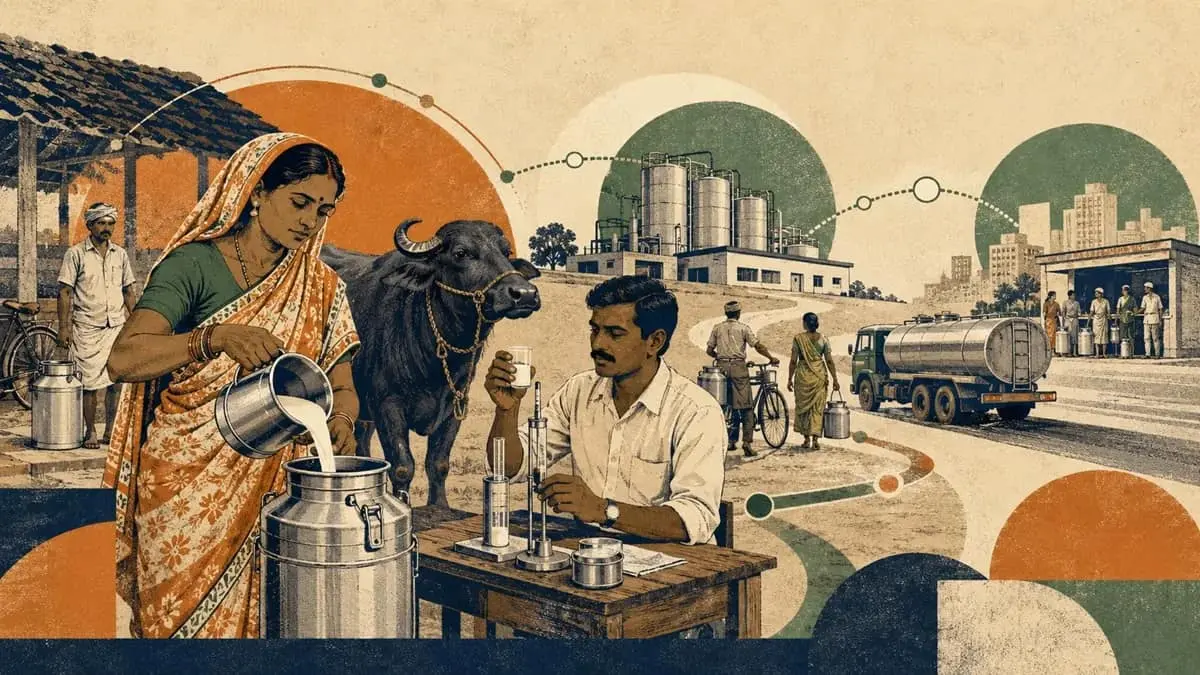
India’s White Revolution was not merely a story of producing more milk. It was the creation of a farmer-owned system that connected village producers to processing plants, urban consumers and national markets.
Milk has a clock inside it.
For a small farmer, particularly one owning a buffalo or a few cows, that clock once determined everything. Milk was highly perishable, transport infrastructure was limited and local producers had little bargaining power. If the milk could not be sold quickly, it had to be consumed, boiled, converted into ghee or risk being wasted.
In Gujarat’s Kaira district, this perishability became a source of economic vulnerability. Farmers often had to accept whatever price traders and middlemen offered because they could not afford to wait.
The first task of India’s dairy revolution, therefore, was not simply to increase milk production. It was to change who controlled the milk after it left the animal.
From Kaira to Anand
The foundations were laid before Independence.
In 1946, milk producers in Kaira organised village cooperative societies and created a district milk union. The movement challenged the existing system in which private contractors and middlemen controlled procurement and marketing.
The story is often told through the towering figure of Verghese Kurien, but the revolution was built by several people performing different roles.
Tribhuvandas Patel provided the organisational leadership that built the cooperative movement. Kurien brought professional management and eventually transformed the Kaira model into a national development strategy. Dairy technologist H. M. Dalaya addressed one of the most important technical challenges facing the cooperative: how to handle seasonal milk surpluses.
The problem was particularly serious with buffalo milk, which was abundant in India but had traditionally been considered difficult to convert into milk powder using conventional spray-drying technology.
Dalaya developed a process for spray-drying buffalo milk, and Amul dates the installation of its buffalo-milk spray dryer to 1955.
The significance went far beyond a new piece of equipment.
Milk powder allowed the cooperative to separate production from immediate consumption. Seasonal surplus could be processed, stored and marketed later. The farmer was no longer completely dependent on finding a buyer for every litre on the day it was produced.
Technology, in other words, gave the cooperative time.
The Anand Pattern
The system that emerged at Anand became known as the Anand Pattern.
It was essentially a three-tier cooperative structure.
At the village level, milk producers formed cooperative societies and supplied milk to collection centres. Milk was tested, including for fat content, and farmers were paid according to the quantity and quality of milk supplied.
At the district level, village societies owned a milk union responsible for milk procurement, processing and the provision of services such as animal health care, artificial insemination, cattle feed and farmer training.
At the state level, milk unions were brought together through a federation responsible for large-scale marketing.
The structure created something that India’s fragmented dairy economy had lacked: an organised link between millions of small producers and large consumer markets.
The seemingly mundane processes — weighing milk, testing fat, recording deliveries and making regular payments — were crucial.
A farmer supplying one or two litres could participate in the same system as a much larger producer. Industrial scale was created not by replacing small farmers but by aggregating their production.
Operation Flood: Turning Aid Into Dairy Infrastructure
The Anand model attracted national attention.
In 1965, the National Dairy Development Board (NDDB) was established at Anand, with the objective of replicating the cooperative model across India.
Then came Operation Flood.
Launched in 1970, the programme became one of the world’s largest dairy development initiatives. Its financing mechanism was unusual.
The European Economic Community supplied skimmed milk powder and butter oil through the World Food Programme. Instead of simply distributing the commodities as food aid, the products were sold in India and the proceeds were invested in developing the country’s domestic dairy infrastructure.
It was a clever economic mechanism.
Imported dairy commodities generated funds to build domestic collection, processing and marketing systems. The objective was ultimately to strengthen India’s own milk economy and reduce dependence on imports.
The aid was not the destination. It was used to build the road.
Operation Flood Phase I
Phase I of Operation Flood ran from 1970 to 1980.
The programme initially connected 18 established milksheds with major metropolitan markets including Delhi, Mumbai, Kolkata and Chennai.
Its objectives were straightforward:
- increase milk production;
- raise rural incomes;
- create organised milk procurement systems; and
- supply urban consumers with reliable milk at reasonable prices.
The National Milk Grid subsequently became an important mechanism for linking surplus-producing regions with deficit markets and reducing seasonal and regional fluctuations in milk availability and prices.
This was crucial because producing more milk without creating a market for it could simply create another version of the old problem.
Production needed demand.
The City Became Part of the Revolution
A rural dairy cooperative cannot survive on village production alone. It needs a consumer at the other end of the supply chain.
During the 1970s, the urban side of India’s dairy system expanded rapidly.
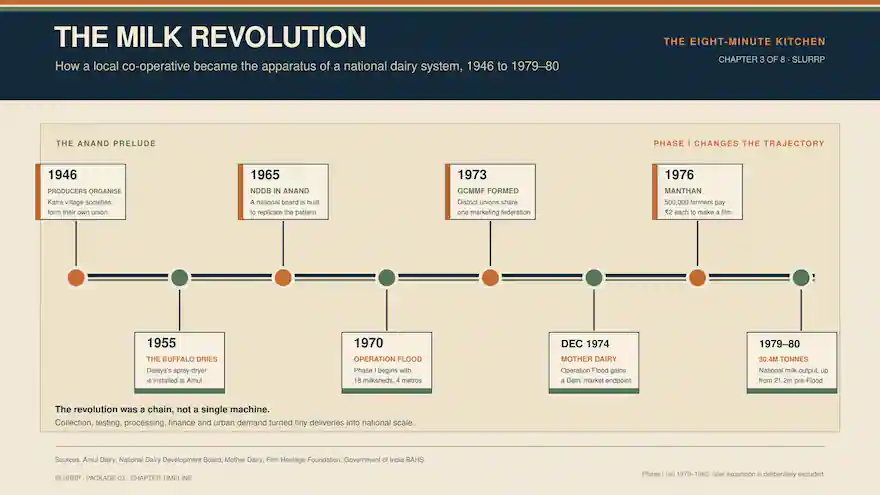
In Gujarat, district milk unions established the Gujarat Cooperative Milk Marketing Federation (GCMMF) in 1973 to market products under the Amul brand.
In Delhi, Mother Dairy was commissioned in December 1974 under Operation Flood.
These institutions connected the village collection centre with the metropolitan consumer.
The significance of marketing is sometimes underestimated in accounts of the White Revolution. But marketing was not an afterthought.
It was part of rural development itself.
A farmer can increase production only when there is a dependable market willing to buy the additional milk.
Who Really Owned the Revolution?
The cooperative model was built around farmer ownership and democratic participation. But its implementation across India was not uniform.
The Anand model provided the institutional blueprint, yet local politics, bureaucracy and administrative structures influenced how cooperatives operated in different states.
Later evaluations found that farmer control at union and federation levels varied considerably. In some places, political and bureaucratic appointments diluted the cooperative ideal.
There was also a significant gender gap.
Women were deeply involved in livestock care and milk production in rural households, but early cooperative structures and extension systems were often dominated by men. Women’s participation increased substantially in later phases, including through women-only dairy cooperatives.
The White Revolution therefore had two dimensions.
It transformed the economic relationship between farmers and milk markets, but it did not automatically eliminate the social inequalities surrounding rural production.
When Farmers Became Film Producers
The cooperative movement even found its way into Indian cinema.
In 1976, filmmaker Shyam Benegal released Manthan, a film inspired by the dairy cooperative movement.
Its financing was as remarkable as its subject.
Around 500,000 dairy farmers contributed ₹2 each to finance the film, making it an extraordinary example of collective ownership and one of India’s earliest widely cited examples of crowdfunding.
But Manthan did more than celebrate cooperative dairying.
It showed the conflicts surrounding the transformation: caste, class, gender, local power and resistance to changing the traditional milk trade.
The message was clear.
A cooperative was not simply a dairy plant arriving in a village.
It was a change in who controlled the milk, who determined its value and who had a voice in the institution handling it.
The Numbers Begin to Move
India’s milk production began to rise significantly during the period.
According to historical NDDB figures, India produced approximately 21.2 million tonnes of milk in 1968–69, with per-capita availability of about 112 grams per day.
By 1979–80, milk production had increased to around 30.4 million tonnes — an increase of roughly 43%.
But attributing every additional litre directly to Operation Flood would oversimplify the story.
The programme directly procured only a portion of India’s total milk production. Its wider impact came through the institutional changes it encouraged: more reliable markets, reduced price risk, better animal husbandry services, improved processing capacity and the creation of credible alternatives to traditional intermediaries.
The White Revolution therefore operated on two levels.
It moved milk physically through new collection and processing networks, but it also changed the economic incentives surrounding milk production.
More Than a Milk Production Story
The greatest achievement of India’s dairy revolution was not simply that India produced more milk.
It was that millions of small producers were gradually connected to an organised market.
A village producer could deliver milk every morning, have it tested, receive a payment linked to quality and become part of a much larger supply chain stretching from the village collection centre to an urban consumer.
The system brought together cooperation, technology, processing, cold-chain logistics, animal husbandry, finance and marketing.
That combination was the real innovation.
The White Revolution did not make the small farmer large.
It made the small farmer part of something large.
And that may be the most important lesson of the Anand model even today: in agriculture, scale does not always require larger farms. Sometimes, scale can be created by organising millions of small producers into a system that gives them collective access to technology and markets.
Operation Flood would continue through subsequent phases, expanding the cooperative network and transforming India’s dairy economy.
But the fundamental idea had already been established:
Start with the farmer. Build the institution around the farmer. Connect that institution to the market. Then let scale emerge from the network.
That was the architecture behind India’s Milk Revolution.
Join Our “Dairy & Food Jobs Updates” WhatsApp group
Follow the Agri Jobs Updates channel on WhatsApp:
Disclaimer
I do my best to share reliable and well-researched insights but occasional errors or omissions may slip through. Please view all content as informational.
Stay informed on all the latest news updates
All Agriculture Books Free Download
All Dairy Technology Books Free Download
All Agricultural Engineering Books Free download
All Horticulture Books Free Download
All Fisheries Science Books Free Download
For Daily Update follow us at:
Facebook Telegram Whatsapp Instagram YouTube
The contents are provided free for noncommercial purpose such as teaching, training, research, extension and self learning.
If you are facing any Problem than fill form Contact Us
If you want share any article related Agriculture with us than send at info@agrimoon.com with your contact detail.