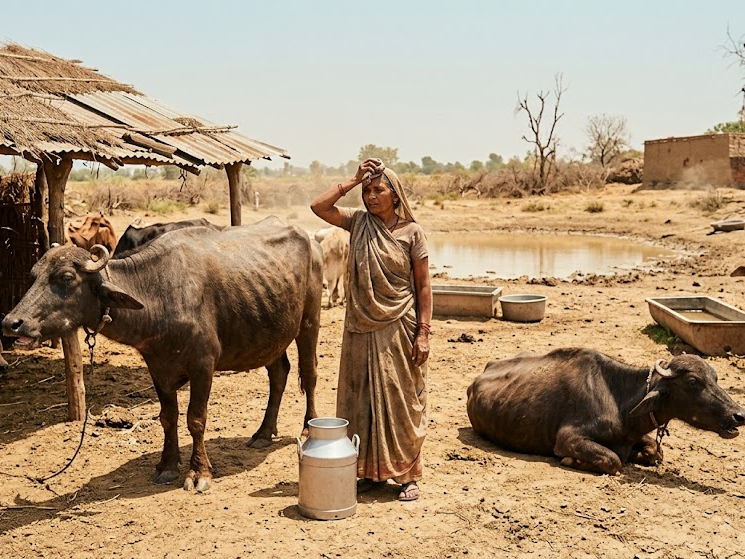
New Delhi: From morning chai and paneer dishes to mithai, butter, ghee and milk chocolates, dairy lies at the centre of Indian food culture. But as heatwaves intensify across the country, India’s dairy industry is facing mounting pressure from climate change, raising concerns over future milk production, supply stability and rising prices.
The Scale of the Crisis
Milk is the lifeblood of the Indian economy, with a value exceeding that of rice and wheat combined.
- Production Powerhouse: India produces roughly 25% of the world’s milk (239 million tonnes in 2024).
- Livelihood at Stake: Over 80 million farmers rely on cattle, and for many rural households, dairy is the primary source of daily cash flow.
How Heat “Shuts Down” Milk Production
Extreme heat creates a physiological chain reaction in cattle that directly impacts your grocery bill.
Shutterstock
- Metabolic Shift: When temperatures exceed a cow’s comfort zone, it enters “survival mode.” It eats less and diverts energy away from mammary glands to internal cooling mechanisms.
- Yield Drop: Research indicates that heat stress can slash milk output by up to 25.8%.
- The Fodder Trap: Heatwaves wither grasslands and spike the cost of cattle feed. Since feed accounts for 60–70% of production costs, high temperatures make dairy farming financially unviable for smallholders.
Read More: Buttermilk vs Lassi: Which Drink Keeps the Body Cooler During Extreme Heat
The Domino Effect on the Indian Plate
A “bad summer” for a buffalo in Haryana eventually reaches the dining tables of Mumbai and Bengaluru:
- Price Volatility: In 2025, early heatwaves forced leading dairy brands to hike prices as procurement dropped.
- The “Mithai” Tax: Festivals like Diwali and Eid face “milk inflation,” making traditional sweets, paneer, and ghee luxury items rather than staples.
- Industry Stress: Emerging sectors like artisanal cheese and milk chocolates are particularly vulnerable to supply instability.
Making Dairy “Climate-Proof”
To save the morning chai, the focus is shifting from maximum yield to climate resilience.
| Strategy | Action Plan |
| Breed Selection | Shifting focus to indigenous breeds (promoted via the Rashtriya Gokul Mission) which are naturally more heat-tolerant than crossbreeds. |
| Fodder Security | Developing “fodder banks” and drought-resistant grass varieties to shield farmers from market spikes. |
| Infrastructure | Installing misting fans, cooling sheds, and improved ventilation in rural dairy cooperatives to manage animal body temperatures. |
| Policy Shift | Aligning breeding choices with local climate realities rather than just chasing higher litre counts. |
The “White Revolution” was built on the back of cooperatives and technology. Ensuring its survival in 2026 and beyond will require a new kind of revolution—one centered on climate adaptation.
Join Our “Dairy & Food Jobs Updates” WhatsApp group
Follow the Agri Jobs Updates channel on WhatsApp:
Disclaimer
I do my best to share reliable and well-researched insights but occasional errors or omissions may slip through. Please view all content as informational.
Stay informed on all the latest news updates
All Agriculture Books Free Download
All Dairy Technology Books Free Download
All Agricultural Engineering Books Free download
All Horticulture Books Free Download
All Fisheries Science Books Free Download
For Daily Update follow us at:
Facebook Telegram Whatsapp Instagram YouTube
The contents are provided free for noncommercial purpose such as teaching, training, research, extension and self learning.
If you are facing any Problem than fill form Contact Us
If you want share any article related Agriculture with us than send at info@agrimoon.com with your contact detail.