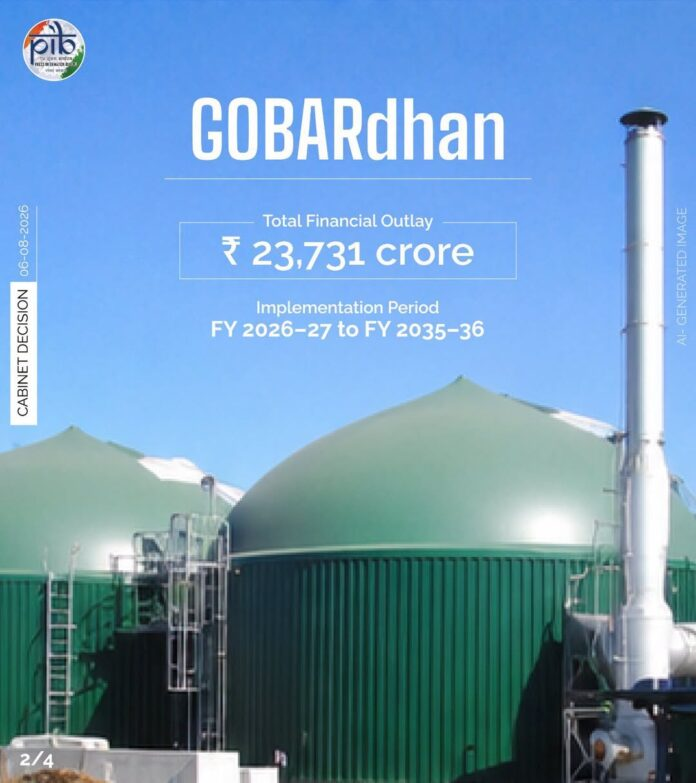
The Union Cabinet, chaired by Prime Minister Narendra Modi, has approved GOBARdhan – the National Circular Bioenergy Scheme, with a total outlay of ₹23,731 crore for the period FY 2026-27 to FY 2035-36.
The scheme aims to transform cattle dung, agricultural residues, press mud, municipal organic waste and other biomass into compressed biogas (CBG), organic manure and additional rural income, while strengthening India’s energy security.
CBG production targeted to grow nearly 10-fold
The flagship objective of GOBARdhan is to drive nearly ten-fold growth in domestic CBG production and create a stronger ecosystem for investment in renewable gaseous fuels.
The scheme brings together several components of the CBG value chain under a unified framework, including assured offtake, stable pricing, capital assistance, pipeline connectivity, credit guarantees and ecosystem development.
Six growth engines
1. Assured CBG offtake:
City Gas Distribution (CGD) entities will provide a predictable market for CBG producers, supported by the notified CBG blending obligation of 3% in FY27, 4% in FY28 and 5% from FY29 onwards for CNG transport and domestic PNG segments.
2. Stable pricing:
The scheme introduces an administered CBG price of ₹2,110/MMBTU, with a framework designed to provide revenue visibility for producers over a minimum 10-year horizon.
3. Capital assistance:
Eligible greenfield CBG projects can receive assistance of up to ₹2 crore per tonne per day (TPD) of installed CBG capacity. Brownfield capacity expansion projects will also be eligible.
4. Pipeline infrastructure:
Support will be provided for cluster-based and standalone pipelines connecting CBG plants with trunk pipelines and CGD networks, helping reduce evacuation costs and improve market access.
5. Credit guarantee support:
A dedicated mechanism will facilitate institutional lending to eligible MSME-based CBG projects by reducing lending risks and collateral requirements.
6. CBG Ecosystem Challenge Fund:
The fund will support feedstock mapping, aggregation infrastructure, district-level planning, technology adoption, organic manure value addition, capacity building and local ecosystem development.
Also Read: Parag Milk Foods Reports ₹22 Crore PAT in Q1 FY27 Despite Higher Milk Costs
Building on SATAT and other initiatives
The new scheme builds on the foundation created through initiatives such as SATAT, Market Development Assistance for organic manure, Biomass Aggregation Machinery, Development of Pipeline Infrastructure and Central Financial Assistance under the National Bioenergy Programme.
According to the government, these initiatives have already contributed to the commissioning of more than 200 CBG plants.
Major opportunity for dairy and rural India
For the dairy sector, the scheme has particular significance because cattle dung becomes a commercial feedstock rather than merely a waste-management challenge.
The proposed ecosystem can generate income opportunities across:
Dairy farms → cattle dung collection → CBG production → renewable fuel + organic manure → additional rural income
The production of Fermented Organic Manure (FOM) and Liquid Fermented Organic Manure (LFOM) can further strengthen the circular bioeconomy by returning nutrients to agriculture.
Expected impact
The government expects GOBARdhan to:
- Create additional income opportunities for farmers and rural entrepreneurs
- Promote scientific utilisation of cattle dung and agricultural waste
- Increase domestic production of renewable gaseous fuel
- Reduce dependence on imported fossil fuels
- Attract large-scale private and institutional investment
- Expand the organic manure economy
- Encourage participation of cooperatives, MSMEs and women entrepreneurs
- Reduce greenhouse-gas emissions through waste-to-energy conversion
Why it matters for India’s dairy industry
GOBARdhan could become an important pillar of Dairy Circular Economy 2.0. Traditionally, dairy economics has focused mainly on milk, but the new approach increasingly treats the entire livestock resource stream—milk, dung, manure and associated biomass—as economically valuable.
For dairy cooperatives, large farms and village-level milk societies, this creates an opportunity to diversify revenue while simultaneously addressing waste management and environmental concerns.
Join Our “Dairy & Food Jobs Updates” WhatsApp group
Follow the Agri Jobs Updates channel on WhatsApp:
Disclaimer
I do my best to share reliable and well-researched insights but occasional errors or omissions may slip through. Please view all content as informational.
Stay informed on all the latest news updates
All Agriculture Books Free Download
All Dairy Technology Books Free Download
All Agricultural Engineering Books Free download
All Horticulture Books Free Download
All Fisheries Science Books Free Download
For Daily Update follow us at:
Facebook Telegram Whatsapp Instagram YouTube
The contents are provided free for noncommercial purpose such as teaching, training, research, extension and self learning.
If you are facing any Problem than fill form Contact Us
If you want share any article related Agriculture with us than send at info@agrimoon.com with your contact detail.