Vinchhiwadi facility will convert cattle dung into compressed biogas and organic manure, creating an additional value stream for dairy farmers
Gujarat: Banas Dairy, the National Dairy Development Board (NDDB) and Suzuki have commissioned a 100 metric tonnes per day (MTPD) dung-based Compressed Biogas (CBG) plant at Vinchhiwadi in Banaskantha, Gujarat, strengthening efforts to convert cattle dung into renewable energy and create additional economic value from dairy waste.
The facility is designed to process cattle dung into CBG and organic manure, linking dairy farming with clean energy and agriculture. The initiative is expected to support more efficient utilisation of livestock waste, reduce dependence on conventional fuels and create an additional revenue opportunity within the dairy ecosystem.
NDDB-Suzuki partnership expands
Speaking at the commissioning, Dr. Meenesh Shah, Chairman of NDDB, said the partnership between Banas Dairy, Suzuki and NDDB represents an important step towards developing sustainable energy solutions for the dairy sector.
Shah noted that establishing dung-based CBG plants involves several challenges, but collaboration among dairy cooperatives, technology partners and other stakeholders can help overcome these barriers.
He described the Vinchhiwadi project as the third Banas biogas/CBG plant and said NDDB and Suzuki plan to strengthen the initiative further, with five more similar plants proposed at milk unions across Gujarat.
According to Shah, the experience gained through these projects could provide a model for replication in other parts of the country and accelerate the adoption of biogas and CBG solutions within the dairy sector.
He also termed Banas Dairy a “torchbearer” in the CBG journey, highlighting its role in demonstrating how cooperative infrastructure, technology and stakeholder collaboration can support large-scale renewable-energy projects.
‘Gobar is not waste’
Shankarbhai Chaudhary, Speaker of the Gujarat Legislative Assembly and Chairman of Banas Dairy, emphasised the economic potential of cattle dung, saying the project reflects the principle that “gobar is not waste.”
The statement underlines a broader shift in the dairy sector, where cattle dung is increasingly being viewed not merely as farm waste but as a potential raw material for energy generation and organic fertiliser production.
By converting dung into CBG and manure, the project aims to create value from a resource generated directly through dairy farming.
Gujarat government sees new cooperative opportunity
Jitubhai Vaghani, Gujarat Agriculture and Cooperation Minister, described the Banas Bio-CNG model as a new cooperative revolution.
He said such initiatives could contribute to higher farmer incomes while also creating rural employment opportunities and increasing the participation of women in dairy-related activities.
The model brings together dairy farmers, cooperative institutions, renewable-energy technology and agricultural inputs within a single value chain.
Suzuki backs expansion
Toshihiro Suzuki, President of Suzuki, said the partnership is being expanded through plans for additional biogas plants, signalling the company’s continued support for dung-based renewable-energy projects.
Also Read: U.S. Dairy Processors Commit $13 Billion to New Capacity as Protein Demand and Exports Drive Growth
The collaboration combines NDDB’s technical guidance, Banas Dairy’s cooperative network and Suzuki’s support to develop a scalable model for converting livestock waste into useful energy and agricultural products.
From dairy waste to a circular rural economy
The Vinchhiwadi plant represents a broader effort by dairy cooperatives to extract greater economic value from cattle dung.
Traditionally, dung has been used mainly as farmyard manure or household fuel in rural areas. The CBG model adds another dimension by enabling the same resource to enter the renewable-energy value chain.
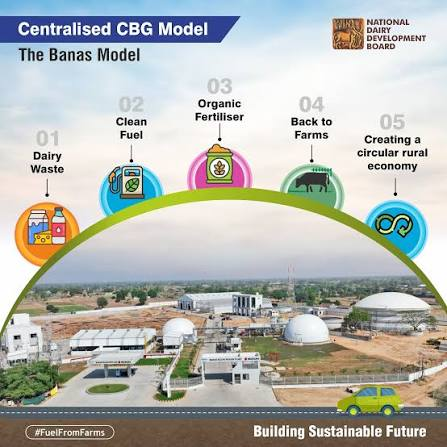
A well-integrated system can connect:
Dairy animals → dung collection → biogas production → CBG + organic manure → clean energy + agricultural inputs → additional rural value
For dairy cooperatives, this approach has the potential to create a more circular rural economy, in which livestock waste becomes a productive input rather than a disposal challenge.
The commissioning of the 100-MTPD Vinchhiwadi facility, along with plans for additional plants across Gujarat, signals an increasing convergence of dairy cooperatives, renewable energy and sustainable agriculture.
If successfully scaled, the Banas model could offer dairy cooperatives another pathway to diversify farmer-linked income while contributing to India’s transition towards cleaner fuels and more resource-efficient rural production systems.
Join Our “Dairy & Food Jobs Updates” WhatsApp group
Follow the Agri Jobs Updates channel on WhatsApp:
Disclaimer
I do my best to share reliable and well-researched insights but occasional errors or omissions may slip through. Please view all content as informational.
Stay informed on all the latest news updates
All Agriculture Books Free Download
All Dairy Technology Books Free Download
All Agricultural Engineering Books Free download
All Horticulture Books Free Download
All Fisheries Science Books Free Download
For Daily Update follow us at:
Facebook Telegram Whatsapp Instagram YouTube
The contents are provided free for noncommercial purpose such as teaching, training, research, extension and self learning.
If you are facing any Problem than fill form Contact Us
If you want share any article related Agriculture with us than send at info@agrimoon.com with your contact detail.