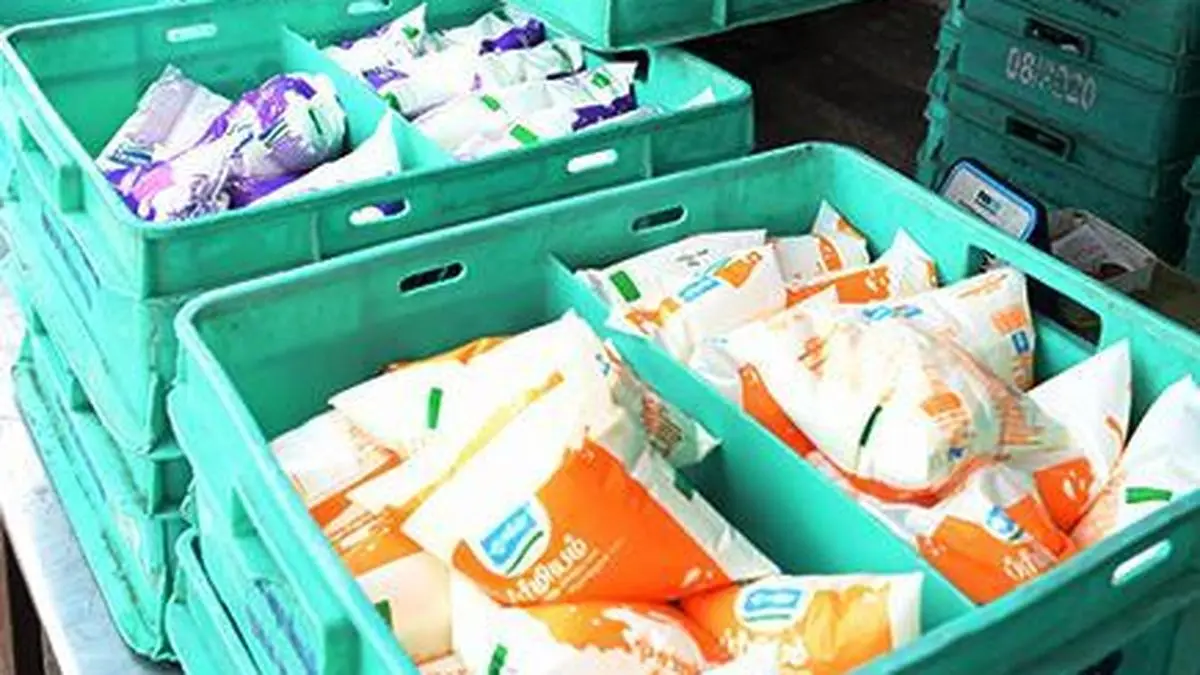
NEW DELHI: India’s dairy sector has achieved what few agricultural industries have managed at such scale: transforming the country from a milk-deficit economy into the world’s largest milk producer. But the next challenge is considerably harder — turning that enormous production base into a globally competitive, high-value dairy industry.
India produced nearly 248 million tonnes of milk in 2024–25, supporting the livelihoods of more than eight crore families, predominantly small and marginal farmers. Dairy also contributes around 6% to the economy, making it far more than a food industry; it is a major pillar of rural livelihoods.
Yet India’s extraordinary production scale has not translated proportionately into global dairy trade.
India produces the most — but exports very little
India’s dairy paradox is striking.
The country produces more milk than any other nation, but less than 1% of its total milk production is exported. Meanwhile, countries such as New Zealand, with a much smaller milk-production base, have built powerful positions in international dairy markets.
The comparison highlights a fundamental issue: milk volume alone does not determine dairy competitiveness.
Global buyers demand consistent quality, food safety, traceability, competitive pricing, reliable supply and products that meet precise technical specifications.
India’s next dairy transformation therefore needs to shift from simply producing more milk towards producing higher-value milk and converting it into globally competitive products.
Productivity is the first challenge
A major opportunity lies at the farm level.
India’s dairy sector is dominated by smallholders, and average animal productivity remains considerably below that of leading specialised dairy systems.
Improving productivity does not necessarily mean simply increasing herd size. It requires better:
- animal genetics and breeding;
- balanced nutrition;
- fodder availability;
- disease prevention;
- reproductive management;
- veterinary services;
- heat-stress management; and
- farmer access to technology.
Higher productivity per animal can increase farmer income while allowing the country to produce more milk without proportionately increasing the resource base.
The supply chain needs to become smarter
Milk is highly perishable, making the supply chain particularly important.
A globally competitive dairy system requires an integrated chain from farm → collection centre → testing → chilling → processing → cold chain → consumer/export market.
Digital milk collection systems, automated quality testing, IoT-based temperature monitoring, electronic traceability and data-driven procurement can reduce losses and improve transparency.
Quality-linked payments can further incentivise farmers to deliver milk with better compositional and microbiological quality.
The objective should be to know not only how much milk entered the system, but where it came from, what its quality was and how it was handled throughout the chain.
Traceability will become a competitive advantage
Traceability is increasingly becoming a prerequisite for international food trade.
For India, this means moving beyond basic batch identification towards systems capable of tracing dairy products back through processors, collection centres and, where appropriate, individual or groups of producers.
Such systems can help with:
food-safety investigations → faster recalls → quality assurance → export compliance → consumer confidence.
Traceability also creates an opportunity for Indian dairy brands to differentiate themselves in premium markets where consumers increasingly want information about origin, quality and production practices.
India needs to export more value, not simply more milk
The biggest opportunity may lie in value-added dairy products.
Instead of competing primarily in bulk commodities, Indian processors can expand exports of products such as:
- cheese and specialised cheeses;
- whey and whey proteins;
- milk protein concentrates;
- casein and caseinates;
- lactose;
- high-protein dairy beverages;
- infant and specialised nutrition ingredients;
- UHT and shelf-stable dairy products; and
- premium traditional dairy products.
India’s large domestic market provides a significant advantage because processors can develop scale domestically before targeting international markets.
The cooperative model remains strategically important
India’s dairy cooperative network has already demonstrated how millions of small producers can be connected to organised markets.
The next stage should strengthen this model through professional management, digital procurement, transparent quality testing, efficient processing and stronger market linkages.
Also Read: Karnataka Bans Non-Dairy Paneer Sold as ‘Paneer’ for One Year
For farmers, the ultimate objective is not merely higher milk procurement volumes but better realisation per litre.
For processors, it means converting that milk into products with greater margins and export potential.
Trust may become India’s most valuable dairy asset
Food safety and authenticity are increasingly central to the dairy industry’s future.
Recent regulatory scrutiny surrounding analogue paneer, adulterated ghee and incorrect product labelling demonstrates why consumer trust cannot be treated as a secondary issue.
A globally competitive Indian dairy industry will need to establish confidence at every level:
genuine raw material → verified quality → safe processing → accurate labelling → complete traceability.
One weak link can damage an entire category.
From the White Revolution to the Value Revolution
India’s first dairy revolution solved a fundamental problem: how to produce, collect and market enough milk to feed the nation while improving rural incomes.
The next revolution must solve a different problem:
How can India convert its enormous milk production into greater economic value, stronger farmer incomes and global market leadership?
The answer will not come from production growth alone.
It will require higher productivity, smarter supply chains, advanced processing, rigorous quality systems, traceability, value-added products and consumer trust.
India has already demonstrated that it can become the world’s largest milk producer.
The next ambition should be to become one of the world’s most trusted and competitive dairy value chains.
Join Our “Dairy & Food Jobs Updates” WhatsApp group
Follow the Agri Jobs Updates channel on WhatsApp:
Disclaimer
I do my best to share reliable and well-researched insights but occasional errors or omissions may slip through. Please view all content as informational.
Stay informed on all the latest news updates
All Agriculture Books Free Download
All Dairy Technology Books Free Download
All Agricultural Engineering Books Free download
All Horticulture Books Free Download
All Fisheries Science Books Free Download
For Daily Update follow us at:
Facebook Telegram Whatsapp Instagram YouTube
The contents are provided free for noncommercial purpose such as teaching, training, research, extension and self learning.
If you are facing any Problem than fill form Contact Us
If you want share any article related Agriculture with us than send at info@agrimoon.com with your contact detail.