
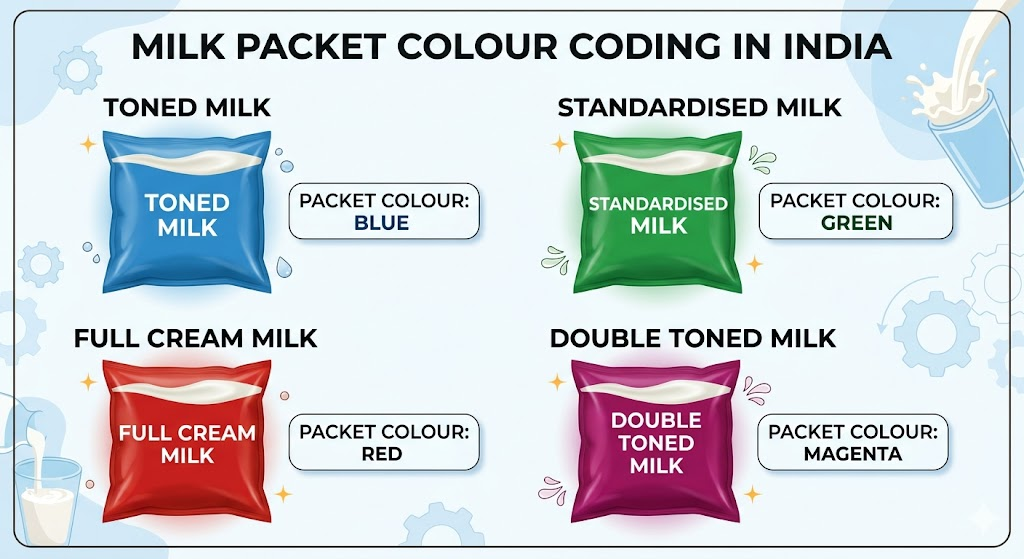
In India, the color-coding of milk packets is a “visual shorthand” that allows millions of consumers to identify fat content and milk type at a glance. While the FSSAI (Food Safety and Standards Authority of India) regulates labeling and safety, the specific colors are a industry-standard convention adopted by major brands like Amul, Mother Dairy, and Nandini to simplify the shopping experience.
Here is the breakdown of what those colors typically signify:
The Standard Color Code
The logic is tied directly to the fat percentage and the processing method of the milk:
- Blue (Toned Milk): This is the most common household staple. It contains roughly 3.0% fat. It is made by adding skimmed milk powder and water to whole milk to “tone down” the fat while keeping the nutrition intact.
- Green (Standardized Milk): A bit richer than the blue packet, this usually contains 4.5% fat. It is often preferred for making tea or coffee where a slightly creamier texture is desired.
- Orange (Full Cream Milk): This is the richest common variant, containing a minimum of 6.0% fat. It is the go-to choice for making curd (dahi), sweets, or heavy cooking because of its high cream content.
- Magenta or Red (Double-Toned Milk): This is the lightest version, containing about 1.3% fat. It is ideal for those managing weight or heart health.
Milk Packaging and Composition Standards
Based on the provided charts, here are the standardized packet colors and nutritional compositions for various types of milk:
Milk Packet Color Codes
| Type of Milk | Packet Colour |
| Toned Milk | Blue |
| Standardised Milk | Green |
| Full Cream Milk | Red |
| Double Toned Milk | Magenta |
Composition (FAT & SNF)
| Type of Milk | Quantity | FAT (%) | SNF* (%) |
| Toned Milk | 1 ltr | 3.00 | 8.50 |
| Toned Milk | 500 ml | 3.00 | 8.50 |
| Standardised Milk | 500 ml | 4.50 | 8.50 |
| Full Cream Milk | 500 ml | 6.00 | 9.00 |
| Double Toned Milk | 500 ml | 1.30 | 9.00 |
Read More: Which Place Is Known As The Kulfi Capital Of The India?
Why This System Works
Milk is a high-frequency, “autopilot” purchase. Dairies use these colors for several practical reasons:
- Speed of Decision: In a busy dairy booth or supermarket, shoppers can identify their preferred variant in seconds without reading technical labels.
- Universal Language: The system transcends literacy and language barriers. Whether in a rural village or a metro city, a customer can simply ask for the “blue packet.”
- Error Prevention: Distinct colors prevent logistical mix-ups for both the retailers stocking the shelves and the customers grabbing a packet during their morning rush.
Common Misconceptions
- Quality vs. Fat: A common myth is that orange packets are “better” than blue packets. In reality, the color only indicates the type and fat content, not the hygiene or overall quality of the milk.
- Nutritional Needs: The “best” packet is subjective. For example, a household might buy the blue packet for daily consumption but switch to the orange packet specifically for making festive desserts like kheer.
Ultimately, these colors have moved beyond simple branding to become part of India’s domestic vocabulary—a small design choice that provides massive daily convenience.
Join Our “Dairy & Food Jobs Updates” WhatsApp group
Follow the Agri Jobs Updates channel on WhatsApp:
Disclaimer
I do my best to share reliable and well-researched insights but occasional errors or omissions may slip through. Please view all content as informational.
Stay informed on all the latest news updates
All Agriculture Books Free Download
All Dairy Technology Books Free Download
All Agricultural Engineering Books Free download
All Horticulture Books Free Download
All Fisheries Science Books Free Download
For Daily Update follow us at:
Facebook Telegram Whatsapp Instagram YouTube
The contents are provided free for noncommercial purpose such as teaching, training, research, extension and self learning.
If you are facing any Problem than fill form Contact Us
If you want share any article related Agriculture with us than send at info@agrimoon.com with your contact detail.