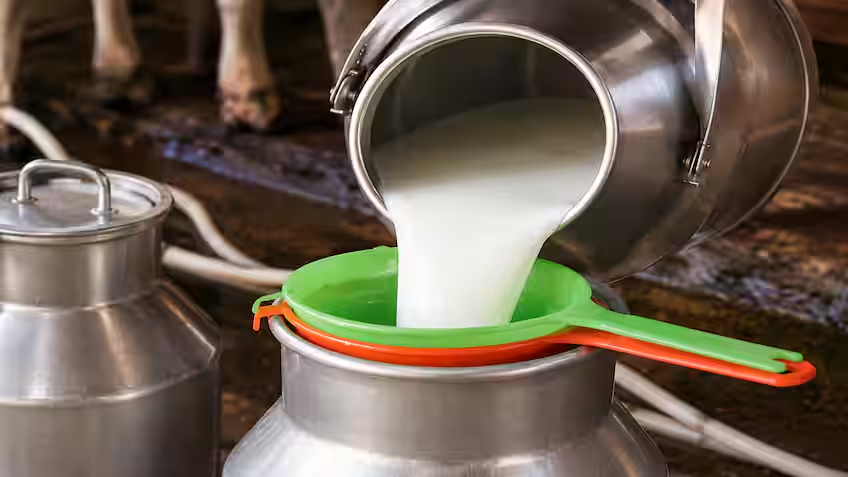
New Delhi : The Central government has ruled out the introduction of a Minimum Support Price (MSP) for milk, stating that procurement prices will continue to be determined by dairy cooperatives and private dairies based on prevailing market conditions.
The clarification was made by Union Minister for Fisheries, Animal Husbandry and Dairying, Rajiv Ranjan Singh alias Lalan Singh, in a written reply to a starred question in the Lok Sabha on Tuesday.
Responding to questions regarding the possibility of introducing an MSP mechanism to safeguard dairy farmers’ interests, the Minister stated that there is currently no proposal under consideration to fix a Minimum Support Price for milk.
“Milk procurement prices are determined by cooperatives and private dairies based on market conditions,” the Ministry said, adding that several initiatives are being implemented to protect farmers’ interests, improve milk quality, stabilize prices, and strengthen the organized dairy sector.
Food Safety Findings Raise Concerns
The government also placed before Parliament provisional data from nationwide food safety surveillance undertaken by State Food Safety Authorities based on information compiled by the Food Safety and Standards Authority of India (FSSAI).
According to figures for FY 2025-26 (up to March 31, 2026):
- Total milk and milk product samples analyzed: 39,351
- Samples found non-conforming: 14,668
- Civil cases launched: 10,714
- Criminal cases launched: 1,054
- Civil penalties/convictions: 9,783
- Criminal convictions: 204
- Civil penalties imposed: ₹34.37 crore
- Criminal penalties imposed: ₹34.51 lakh
Officials clarified that the figures remain provisional and are subject to revision based on laboratory confirmations, appellate proceedings, and court judgments.
The data indicates that approximately 37% of the samples tested during the period did not conform to prescribed standards, underscoring the continued challenge of ensuring quality compliance across India’s vast dairy supply chain.
India’s Milk Production Continues to Grow
Despite concerns over quality compliance, the government highlighted the robust growth of India’s dairy sector over the past decade.
India’s milk production has increased from 146 million metric tonnes in 2014-15 to 248 million metric tonnes in 2024-25, representing a growth of nearly 69%, further consolidating the country’s position as the world’s largest milk producer.
Read More: Milky Mist Eyes India’s Largest Dairy IPO with ₹1,553 Crore Issue
The Ministry informed Parliament that approximately 37% of milk produced in the country is consumed by dairy-farming households, while the remaining 63% enters the market.
Of the marketable surplus:
- 32% is handled by organized cooperatives and private dairies.
- 68% continues to be marketed through the unorganized sector.
Industry experts say the predominance of the informal market presents both an opportunity and a challenge, particularly in areas of quality assurance, traceability, and farmer remuneration.
Push Towards Organized Dairying
To strengthen the organized dairy ecosystem, the Department of Animal Husbandry and Dairying has undertaken several initiatives aimed at improving procurement infrastructure and market access.
As of March 2026, the government reported:
- Establishment of 36,283 new village-level Dairy Cooperative Societies.
- Strengthening of 31,150 existing dairy cooperatives.
- Creation of approximately 168 lakh litres per day of milk chilling capacity.
- Distribution of 76,748 milk quality testing devices.
- Approval of dairy projects with a cumulative milk processing capacity of 418 lakh litres per day.
The Ministry said these interventions are intended to enhance milk collection, quality testing, value addition, and farmer access to organized markets while reducing dependence on intermediaries.
Debate on MSP Likely to Continue
The government’s position is expected to keep the debate over MSP for milk alive, particularly among dairy farmer organizations that have periodically sought a price assurance mechanism similar to those available for certain agricultural commodities.
However, policymakers have traditionally argued that the dairy sector’s decentralized nature, daily procurement model, regional pricing variations, and significant private sector participation make a nationwide MSP framework difficult to implement.
With India producing nearly 250 million metric tonnes of milk annually, the focus, for now, appears to remain on strengthening cooperatives, improving quality compliance, and expanding processing infrastructure rather than introducing a statutory price support mechanism.
For millions of dairy farmers, the challenge remains unchanged: securing remunerative prices while operating in a sector where market forces—not government support prices—continue to determine the value of every litre of milk.
Join Our “Dairy & Food Jobs Updates” WhatsApp group
Follow the Agri Jobs Updates channel on WhatsApp:
Disclaimer
I do my best to share reliable and well-researched insights but occasional errors or omissions may slip through. Please view all content as informational.
Stay informed on all the latest news updates
All Agriculture Books Free Download
All Dairy Technology Books Free Download
All Agricultural Engineering Books Free download
All Horticulture Books Free Download
All Fisheries Science Books Free Download
For Daily Update follow us at:
Facebook Telegram Whatsapp Instagram YouTube
The contents are provided free for noncommercial purpose such as teaching, training, research, extension and self learning.
If you are facing any Problem than fill form Contact Us
If you want share any article related Agriculture with us than send at info@agrimoon.com with your contact detail.