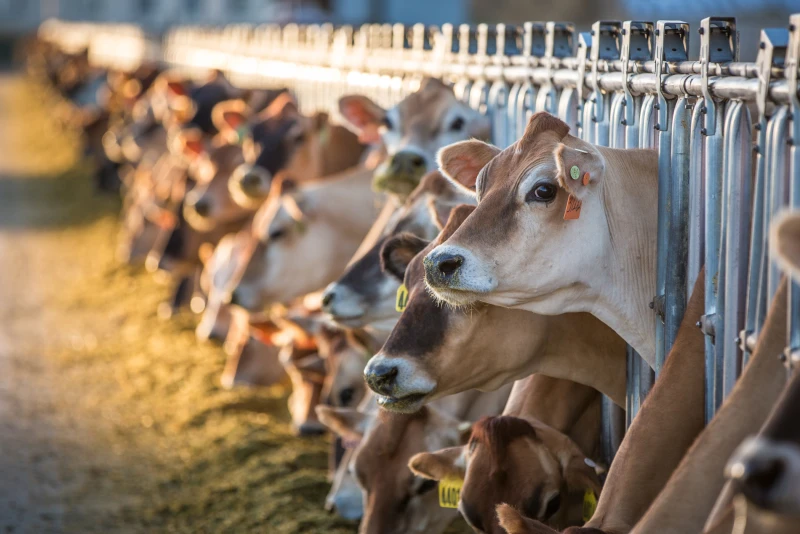
The U.S. dairy industry is undergoing a major structural transformation, with the number of dairy farms expected to fall below 20,000 by the end of this decade as larger operations gain greater economic and technological advantages.
According to a report by agricultural analytics firm Terrain, the U.S. had 23,609 licensed dairy herds in 2025, down sharply from 131,509 in 1992. Despite the dramatic decline in farm numbers, milk production has continued to rise. The country produced 231.7 billion pounds of milk in 2025, about 54% more than in 1992, even with significantly fewer farms and cows.
Production increasingly concentrated in large farms
The shift toward larger operations is particularly evident in the distribution of milk production. According to the USDA’s 2022 Census of Agriculture, farms with fewer than 100 cows represented about half of all U.S. dairy farms but accounted for only 4% of total milk sales.
By comparison, farms with 2,500 or more cows represented just 4% of dairy farms but produced 45% of total milk sales.
The trend reflects the growing importance of economies of scale, advanced technology and professional farm management in the U.S. dairy sector.
Economies of scale drive consolidation
Lower production costs are one of the strongest forces behind consolidation. USDA economic analysis has found that a 1% increase in milk output results in less than a 1% increase in production costs, allowing larger farms to spread fixed costs over greater volumes of milk.
Overhead expenses are particularly challenging for smaller farms. Larger dairies can distribute costs for technology, facilities, management and specialized labor across thousands of cows.
Advanced milking systems, genetic improvement programmes, automated cow monitoring, specialized heifer facilities and other technologies are increasingly becoming important tools for large-scale operations.
Fewer farmers, but greater productivity
The consolidation does not necessarily mean a decline in U.S. dairy production. Instead, the industry is producing more milk through fewer and larger operations.
As one industry observation puts it, the U.S. is losing dairy farmers rather than dairy cows.
Global demand for dairy protein remains strong, creating opportunities for efficient producers. However, access to capital, technology and economies of scale increasingly determines which farms can capture that opportunity.
Changing milk-market dynamics
The consolidation of milk production could also change how the U.S. dairy market responds to price fluctuations.
Historically, smaller farms could adjust production relatively quickly when milk prices changed. Large modern dairies, however, often operate within tightly managed production systems and make major investment decisions over much longer time horizons.
Risk-management programmes such as Dairy Revenue Protection (Dairy-RP) have further enabled producers to protect margins against market volatility.
As a result, U.S. milk supply may become less responsive to short-term price changes. When demand rises, supply may take longer to respond, potentially keeping prices elevated for longer periods. Conversely, during periods of oversupply and falling prices, smaller farms with higher break-even costs may face financial pressure sooner.
The Rise of Vertical Integration
An increase in vertical integration has developed in tandem with farm consolidation, but in a pattern distinct from other livestock sectors.
When the industry was defined by numerous small farms, vertical integration was limited to farmstead cheese production or producer-bottlers selling fluid milk directly. The cooperative structure evolved to allow farms to focus on milk production while cooperatives pooled milk and handled marketing, manufacturing and supply balancing.
As farms expanded, large-scale operations began to feel the limitations of this system. They sought opportunities to partner and invest in processing assets, taking greater control of what happened to their milk.
Adapting to the 20,000-Farm Future
The absolute number of farms exiting each year may begin to slow in the medium to long term, but near-term factors could accelerate departures.
“In the near term, the combination of aging farmers and high cattle prices could accelerate exits,” Laine warns.
Because consolidation changes how milk supply responds to markets and who holds leverage along the supply chain, producers must prepare to adapt accordingly. For some, achieving scale will continue to present opportunities.
“For those not looking to change scale, a range of strategies exists, from differentiation to technology and precision or vertical integration,” Laine notes.
“Despite ongoing consolidation pressure, there continues to be value in a diverse milk production base in the U.S.,” he adds. “Farms of all scales will face unique challenges and opportunities and must compete on their size-based strengths to continue evolving with the future of the industry.”
The Terrain report emphasizes that successful strategies at any scale “will rely on competing on dimensions other than the ability to produce commodity milk at low cost.”
As the industry hurtles toward the 20,000-farm threshold, the transformation of U.S. dairy continues to accelerate — reshaping not just farm numbers, but the fundamental economics, market dynamics and competitive strategies that will define the sector for decades to come.
What it means for the future
The U.S. dairy sector is therefore moving toward a model dominated by fewer, larger, technologically advanced and professionally managed farms.
The transformation highlights a broader global dairy trend: productivity growth is increasingly being driven by scale, automation, genetics, data-driven management and supply-chain integration.
For smaller farms, survival may increasingly depend on differentiation, niche markets, direct marketing, value-added products, cooperative strength or other strategies that allow them to compete without matching the scale of the largest operations.
The projected decline below 20,000 farms would mark another major milestone in the long-term consolidation of U.S. dairy — transforming not only the structure of milk production but also the way the country’s dairy markets respond to prices, risk and global demand.
Join Our “Dairy & Food Jobs Updates” WhatsApp group
Follow the Agri Jobs Updates channel on WhatsApp:
Disclaimer
I do my best to share reliable and well-researched insights but occasional errors or omissions may slip through. Please view all content as informational.
Stay informed on all the latest news updates
All Agriculture Books Free Download
All Dairy Technology Books Free Download
All Agricultural Engineering Books Free download
All Horticulture Books Free Download
All Fisheries Science Books Free Download
For Daily Update follow us at:
Facebook Telegram Whatsapp Instagram YouTube
The contents are provided free for noncommercial purpose such as teaching, training, research, extension and self learning.
If you are facing any Problem than fill form Contact Us
If you want share any article related Agriculture with us than send at info@agrimoon.com with your contact detail.